
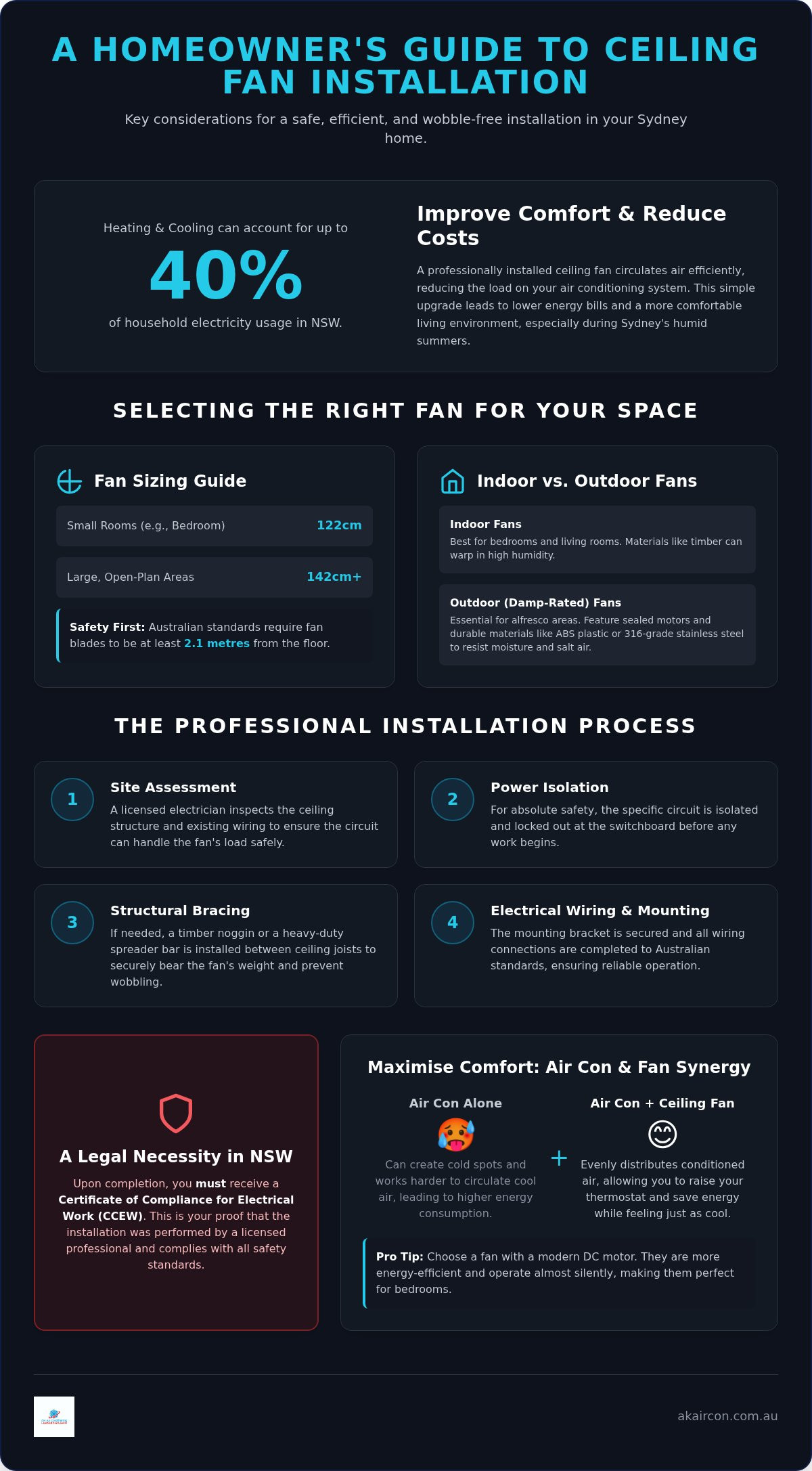
Did you know that heating and cooling can account for up to 40% of an average household's electricity usage in NSW? For many homeowners in Bankstown and across Sydney, the heavy reliance on air conditioning during humid summers leads to staggering power bills and a constant search for relief. If you've ever felt that your AC is working overtime while your rooms still feel stuffy, you aren't alone. Choosing a professional ceiling fan installation in Sydney is one of the most effective ways to circulate air and significantly reduce the load on your primary cooling systems.
It's understandable to feel overwhelmed by the technical requirements, from wondering if you need a new wiring point to finding a reliable, licensed electrician who understands local NSW standards. This guide will walk you through everything you need to know for 2026, including the legal necessity of a Certificate of Compliance for Electrical Work (CCEW) and how the Home Energy Saver program might assist your upgrade. You'll learn how to achieve a safe, wobble free result that keeps your home cool and your energy expenses under control.
Key Takeaways
- Discover how to select the ideal fan size and blade material for Sydney's humidity to ensure long term durability and performance.
- Understand the legal requirements for ceiling fan installation sydney, including why you must receive a mandatory Certificate of Compliance for Electrical Work (CCEW).
- Learn the professional step by step process used by licensed electricians to ensure a safe, quiet, and wobble free installation.
- Find out how to pair ceiling fans with your air conditioning to improve comfort levels while lowering your household electricity bills.
- Gain clarity on the factors that affect installation costs, such as existing wiring, ceiling height, and roof access in your home.
Selecting the Right Ceiling Fan for Your Sydney Home
Selecting the right unit is the first step in a successful ceiling fan installation sydney. It's not just about aesthetics; it's about physics. Room dimensions dictate the blade span needed to move air effectively. For instance, a small bedroom usually requires a 122cm fan, while large open-plan living areas in Sydney homes often need 142cm or larger. While the history of the ceiling fan dates back to the 19th century, modern technology has turned these devices into precision-engineered cooling tools that can transform your home's comfort levels.
Ceiling height is equally critical for safety and performance. To meet Australian safety standards, fan blades must be at least 2.1 metres from the floor. if you have high or raked ceilings, you'll likely need an extension downrod to keep the airflow within reach of the occupants. Conversely, low ceilings require "hugger" or flush-mount models to maintain safe clearances without sacrificing air movement.
To help you visualise how a professional setup looks and functions, watch this helpful video on the installation process:
Material choice depends on where the fan sits. Timber blades look great in traditional homes but can warp in Sydney's high humidity. High-grade plastic (ABS) or metal blades are often better for longevity and ease of cleaning. You also need to decide on the control interface. Traditional wall switches are reliable and never get lost; however, remote controls offer convenience and often include timer functions. If you're replacing an existing light fixture, look for a model with an integrated light kit to ensure a clean "change-over" installation without the need for extra ceiling cut-outs.
Indoor vs. Outdoor Ceiling Fans
Sydney's alfresco lifestyle requires fans with a specific "Damp Rating". Standard indoor fans lack the sealed motors and UV-stabilised finishes needed for outdoor use. If you live in coastal areas, salt-air resistance is vital to prevent hardware failure. We recommend 316-grade stainless steel or high-grade polymer blades to prevent the pitting and corrosion that often plagues cheaper units in salty environments. Indoor fans will quickly corrode if installed in outdoor entertaining spaces, potentially voiding your warranty.
AC Synergy: Choosing a Fan to Match Your Aircon
A well-chosen fan acts as a force multiplier for your split system aircon. We often suggest DC motor fans for this purpose. They use significantly less energy than AC models and operate almost silently, which is ideal for bedrooms. Look for a fan with a steep blade pitch, usually between 12 and 15 degrees. This angle ensures the fan can push a high volume of air to circulate conditioned air into every corner of the room, allowing you to set your air conditioning to a higher, more economical temperature.
The Professional Ceiling Fan Installation Process: Step-by-Step
A professional ceiling fan installation sydney follows a methodical sequence to ensure the unit operates silently and safely for years. Unlike a simple light bulb change, installing a fan involves managing dynamic weight and electrical loads. Our technicians begin by verifying that your chosen location can support the unit without vibrating or compromising the ceiling's integrity. Skipping these technical checks often leads to the annoying "clicking" sounds or wobbling that plague DIY attempts.
The standard professional process includes these five essential steps:
- Step 1: Site Assessment. We inspect the ceiling structure and existing wiring to determine if the circuit can handle the additional load.
- Step 2: Power Isolation. Safety is our priority. We isolate the specific circuit at the switchboard before any work commences.
- Step 3: Structural Bracing. If the ceiling lacks a solid mounting point, we install a timber noggin or a heavy duty spreader bar between the joists to bear the fan's weight.
- Step 4: Electrical Wiring. We secure the mounting bracket and execute the wiring connections, ensuring all cables are correctly rated and terminated.
- Step 5: Assembly and Testing. We assemble the motor and blades, balance them to prevent wobbles, and perform a comprehensive safety test.
Site Assessment and Structural Support
A common mistake is assuming a standard light fitting box can support a fan. Most light boxes are designed for static weights under 2kg, whereas a ceiling fan creates significant centrifugal force. In modern Sydney apartments with concrete ceilings, we use specialized anchors to ensure a permanent bond. For older homes in Bankstown or Liverpool, checking roof access is vital; brittle timber or restricted space can make bracing more complex, requiring a tailored approach to ensure the fan remains secure. If you're unsure about your ceiling's strength, it's best to speak with a licensed professional for a quick assessment.
Wiring and Electrical Connection
Depending on your home's age, we may need to run a new circuit or upgrade existing light points to accommodate the fan's controller. Every connection we make must strictly adhere to AS/NZS 3000 standards to prevent fire risks or short circuits. An electrical licence in NSW is a formal credential issued by Fair Trading that certifies a person has the necessary qualifications to perform electrical work legally and safely. By choosing an authorised installer, you ensure your home insurance remains valid and your family stays safe from electrical hazards.
Understanding Installation Costs and NSW Safety Standards
When planning a ceiling fan installation sydney, it's helpful to understand that quotes are rarely "one size fits all". Every home has a unique layout, and several variables influence the final investment. These factors mainly revolve around the time required to complete the work safely and the materials needed to secure the unit. For instance, a cottage in Bankstown with easy roof access allows an electrician to run cables quickly; whereas a multi-storey house or an apartment with limited ceiling cavities requires more intricate labour. High or raked ceilings also add to the complexity. These installations often require specialised ladders or scaffolding, plus additional time to fit extension downrods so the fan sits at the optimal height for airflow.
In NSW, any prescribed electrical work must be accompanied by a Certificate of Compliance for Electrical Work (CCEW). This document is your legal proof that the installation meets the Australian Standard AS/NZS 3000:2018. If an electrical fault occurs and you can't produce this certificate, your home insurance provider may refuse your claim. Professional installation ensures your home remains compliant and your family stays safe from the risks of faulty wiring.
Factors Influencing Your Installation Quote
Replacing an existing fan is generally a faster process because the wiring is already in place. However, creating a completely new installation point involves running new cables from your switchboard or nearest junction box, which increases the time on site. You should also consider the control method. Choosing a remote control model can sometimes reduce labour costs because it eliminates the need to "fish" wires through the wall cavities for a physical switch. Conversely, bundling multiple fans into a single visit is a smart way to manage your budget. It reduces the per-fan price because the electrician can set up their equipment once and work through each room systematically. If you have several rooms to upgrade, it's best to request a comprehensive quote for the whole project.
Licensed Electrician vs. DIY: The Legal Reality
It's a common misconception that homeowners can "save a few bucks" by attempting a DIY installation. In Sydney, all fixed electrical work is legally required to be performed by a licensed professional. DIY electrical work is not only dangerous; it's illegal under NSW Fair Trading regulations. Beyond the legalities, a professional ensures the fan is perfectly balanced. Unbalanced blades cause "fan wobble", which puts immense strain on the motor and leads to premature failure. We use precision balancing kits to ensure your fan runs silently and efficiently, protecting your investment for the long term and preventing the need for noisy operation or motor burn-out down the track.
Maximising Comfort: Ceiling Fans and Air Conditioning Synergy
Many Sydney homeowners mistakenly view ceiling fans and air conditioning as separate, competing systems. In reality, they work most effectively as a partnership. A professional ceiling fan installation sydney allows you to create a high performance cooling ecosystem that reduces your reliance on heavy refrigeration. When you use fans to circulate the air from your ducted air conditioning, you eliminate the "dead zones" where cool air pools on the floor while the ceiling remains warm. This constant movement ensures a uniform temperature throughout the room, allowing your AC unit to cycle off more frequently.
Setting your air conditioner to 24°C instead of 20°C can significantly lower your power bills. When paired with a ceiling fan, the moving air creates a breeze that makes you feel roughly 4°C cooler than the actual room temperature. This simple adjustment reduces the workload on your compressor, which is the most expensive part of your cooling system to repair or replace. By easing this burden, you naturally extend the operational lifespan of your air conditioner.
The Wind Chill Effect and Energy Savings
The cooling sensation from a fan doesn't actually lower the room's temperature. Instead, it relies on the wind chill effect. As air moves across your skin, it accelerates the evaporation of moisture, which draws heat away from your body. This is particularly effective during Sydney's humid shoulder seasons in late spring and early autumn, where the humidity makes the air feel heavy but it isn't hot enough to justify full air conditioning. Industry data suggests that pairing fans with AC can reduce cooling energy consumption by up to 40% compared to running the AC alone at lower temperatures, provided the thermostat is adjusted accordingly.
Year-Round Efficiency with Reverse Cycle Fans
Most modern fans are designed for year round utility. You can find a small winter switch on the motor housing or a dedicated button on your remote control to reverse the blade direction. In winter, setting the blades to rotate clockwise pulls cool air up and pushes trapped warm air down from the ceiling. This process, known as destratification, is vital for high ceiling Sydney homes where heat naturally migrates out of reach. Pairing this function with your reverse cycle air conditioning ensures you aren't wasting money heating the top few centimetres of your room while your feet stay cold.
Reliable Ceiling Fan Services in Bankstown and Greater Sydney
AK Air Conditioning & Electrical Quality Service is a locally owned business dedicated to professional ceiling fan installation sydney. We understand that a fan is more than just a fixture; it's a critical component of your home's thermal comfort and energy efficiency strategy. Our licensed electricians ensure that every unit is mounted to structural supports, wired to current NSW safety standards, and balanced for silent operation. We take pride in leaving every worksite as clean as we found it, providing a hassle-free experience for residential homeowners and commercial property managers alike. Our focus is on building long-term trust through transparent communication and technical excellence.
Our team treats every job with the same level of meticulous care, whether we're installing a single unit in a nursery or managing a large-scale commercial upgrade. We don't just "hook up" wires; we assess the electrical load of your property to ensure your switchboard can handle the new additions safely. This professional oversight prevents the circuit overloads and flickering lights that often result from cut-price installations. By choosing AK Air Conditioning & Electrical Quality Service, you're investing in the safety and longevity of your home's electrical system.
Our Local Service Areas
Based in Bankstown, our team covers a broad radius of approximately 30km to support the local community. We regularly assist families in Yagoona and Greenacre with energy-efficient cooling upgrades that stand the test of time. Our expertise extends to the diverse architecture found across Western Sydney. We manage the specific technical needs of modern apartments in Auburn, where concrete ceilings require specialised anchoring, as well as classic heritage homes in Strathfield that often feature delicate plasterwork and complex ceiling cavities. Our familiarity with these local housing styles means we arrive prepared with the right specialised hardware for a prompt, professional result.
Book Your Sydney Ceiling Fan Installation
Planning your cooling strategy shouldn't be a source of stress or uncertainty. We offer tailored assessments to determine the best fan placement, motor type, and control options for your specific floor plan. This holistic approach ensures you get the maximum airflow benefit for every dollar spent. If you're looking to overhaul your entire home climate system for the coming season, we also provide comprehensive air conditioning services and repairs. This allows us to ensure your AC and fans work in perfect harmony to lower your power bills. Whether you need a single replacement in a bedroom or a multi-fan installation for a new commercial space, our team provides the same level of professional care.
We look forward to helping you create a more energy-efficient and comfortable living space for your family.
Frequently Asked Questions
Do I need a licensed electrician to install a ceiling fan in Sydney?
Yes, any ceiling fan installation sydney must be performed by an authorised electrician. In NSW, this is classified as "prescribed electrical work," meaning it is illegal for anyone without a current licence to perform the task. Beyond the legalities, a professional ensures that your home's switchboard and existing circuits are safe to handle the additional load. AK Air Conditioning & Electrical Quality Service provides fully compliant installations that protect your property and your manufacturer's warranty.
How much does it typically cost to install a ceiling fan if I supply the unit?
While we provide a labour-only service for units you have already purchased, the final investment depends on the complexity of your home's infrastructure. Factors such as the age of your wiring, the presence of asbestos in older ceilings, or the need for new internal wall switches will influence the total time on-site. We provide transparent, upfront quotes so you know exactly what the labour component covers before we begin the work at your property.
Can a ceiling fan be installed where there is currently only a light?
We can certainly adapt a light-only point into a fan-light combination, but it involves more than a simple swap. Our team must ensure the electrical cable is rated for the motor's draw and that a "switch wire" is present if you prefer wall-switch operation. If the existing wiring is insufficient, we can often bypass this by installing a remote-control kit, which simplifies the process while providing modern convenience for your cooling needs.
What is the difference between AC and DC motor ceiling fans?
DC motors are a significant advancement in cooling technology, being lighter and more compact than traditional AC motors. This reduced weight makes them an excellent choice for certain ceiling types found in modern Auburn or Yagoona apartments. While AC fans are reliable, DC motors offer up to 70% better energy efficiency and are virtually silent. This makes them the preferred option for bedrooms where quiet operation and low running costs are the top priorities.
How long does a professional ceiling fan installation take?
A standard installation generally takes between one and three hours per unit. A straightforward replacement of an existing fan is usually on the shorter end of that scale, while a fresh installation in a room with no previous wiring takes longer. Our electricians manage the entire process, from structural bracing to the final safety test, ensuring we work efficiently while maintaining the high standards expected from AK Air Conditioning & Electrical Quality Service.
What should I do if my ceiling fan is wobbling or making noise?
If you notice a persistent hum or a visible wobble, you should turn the unit off and arrange a professional inspection. These symptoms often point to an internal motor fault or a mounting bracket that has worked loose over time. Unlike the minor "clicking" that can occur during a brief break-in period, a heavy wobble indicates the fan is out of balance. We use precision tools to re-align the blades and secure the housing to prevent mechanical failure.
Will a ceiling fan really help me save money on my air conditioning bills?
Pairing a fan with your AC allows you to raise the thermostat by several degrees without losing comfort, which significantly reduces the run-time of your air conditioner's compressor. This not only lowers your monthly power bills but also reduces the wear and tear on your cooling system. By decreasing the frequency of high-load cooling cycles, you effectively extend the service life of your primary air conditioning unit, saving you money on long-term maintenance and replacements.
Is a Certificate of Compliance (CCEW) required for a fan installation?
Every professional ceiling fan installation sydney requires a Certificate of Compliance for Electrical Work (CCEW). This is a mandatory requirement under NSW Fair Trading, and the electrician must lodge this document within seven days of completing the work. AK Air Conditioning & Electrical Quality Service issues this document digitally for your records. It serves as essential proof for home insurance and property valuations that your electrical modifications meet all current Australian Standards.
Important Information
This article provides general information only. Air-conditioning requirements, installation costs, energy savings and rebate eligibility vary between properties and systems. NSW program rules, certificate values and eligible models may change. Contact AK Air Conditioning & Electrical Quality Service Pty Ltd for a property-specific assessment and confirmation of current eligibility before making a purchase or installation decision.


