
A five-star energy rating won't save you a cent if your air conditioner installation is handled poorly. An inefficient setup can turn a premium Daikin or Mitsubishi unit into a noisy, expensive drain on your bank account. We all know Sydney summers are getting more intense. With electricity prices across NSW hitting new heights, the pressure to find a bargain is real. You might feel stuck between split and ducted systems, or perhaps you're worried that a new install might void your manufacturer warranty. It's a confusing time, especially when you're trying to figure out if you actually qualify for the latest NSW government rebates.
We're here to clear the air by debunking the most common myths that lead to costly mistakes. You deserve a cooling system that won't pack it in during a Sydney heatwave or struggle with our coastal humidity. This guide explains the reality of 2026 compliance standards, the truth about strata approvals, and how professional placement ensures your aircon runs at peak efficiency. We'll help you secure a setup that's fully compliant with Australian standards, ensuring you stay cool for less while protecting your long-term investment.
Key Takeaways
- Learn why professional air conditioner installation is a precision engineering task that protects your manufacturer warranty and ensures your system cools effectively.
- Discover why a larger unit often leads to higher power bills and how correct sizing prevents the "short-cycling" that wears out your system prematurely.
- Understand the legal requirements of the ARCtick licence and why using an unlicensed installer could leave you with a voided warranty and significant fines.
- Find out how to navigate the 2026 NSW government rebate criteria to help lower the cost of upgrading to a high-efficiency system.
- Learn why the first 100 hours of operation are vital for your new unit and what a professional service actually involves beyond a basic filter clean.
The "Just a Box on the Wall" Myth: Why Installation Quality Matters
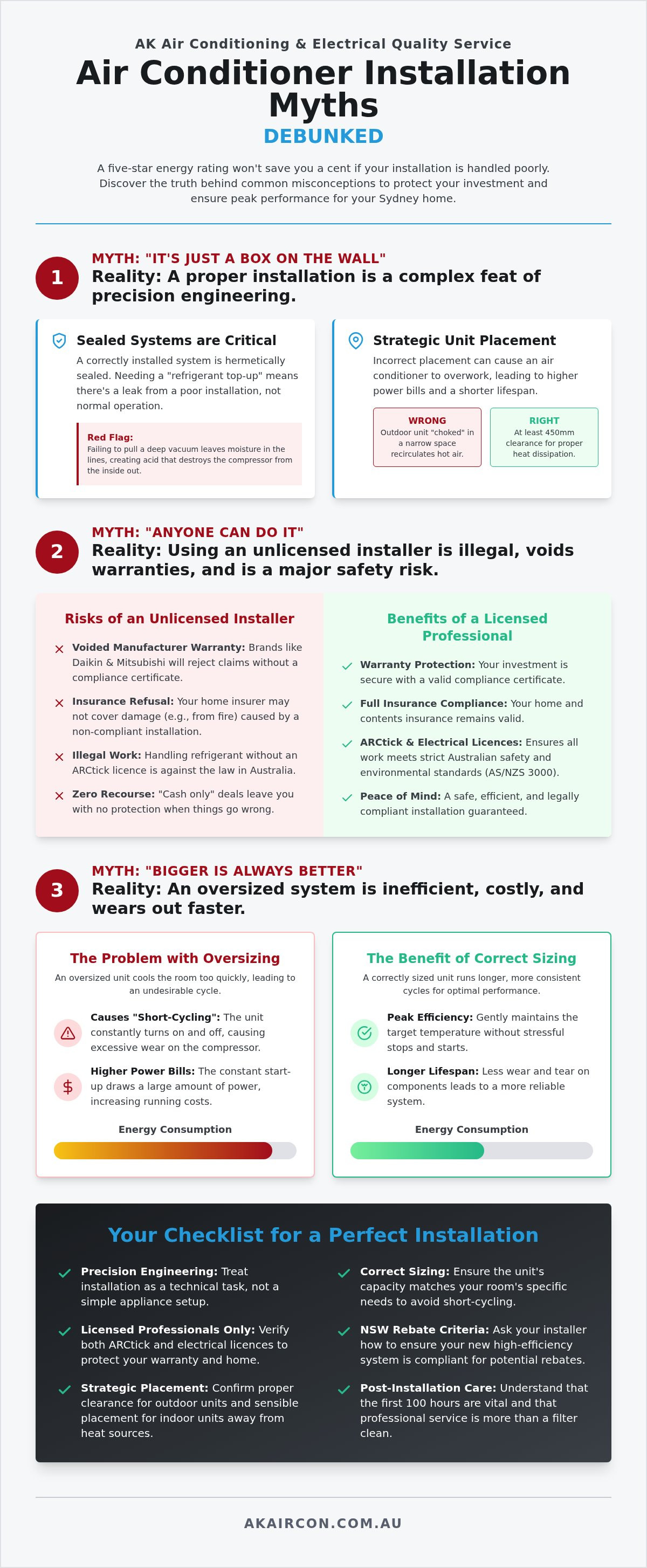
Many homeowners view a new split system as a simple appliance, similar to a fridge or a washing machine. In reality, a proper air conditioner installation is a complex feat of precision engineering. When you invest in a high-end brand like Daikin or Mitsubishi, you aren't just buying the hardware; you're buying a delicate thermal cycle that must be calibrated to your home's specific layout. Modern Heating, ventilation, and air conditioning (HVAC) systems are finely tuned machines. If they aren't integrated correctly into the building's structure, they'll never reach their advertised efficiency.
One of the most persistent myths is that units occasionally need a "refrigerant top-up" as part of standard maintenance. This is a red flag. A correctly installed system is hermetically sealed; if the gas is low, there's a leak. Topping it up without finding the leak is like pouring water into a bucket with a hole in the bottom. It's a sign of a botched install. Similarly, failing to pull a deep vacuum during the initial setup leaves moisture and non-condensable gases in the lines. This moisture reacts with the oil to create acid, which eventually eats the compressor from the inside out, leading to a total system failure well before its time.
The Science of Airflow and Unit Placement
Placement is everything. If an indoor unit is mounted directly opposite a large, sun-drenched window, the sensors will struggle to read the true room temperature. The unit thinks the room is hotter than it actually is, leading to constant overworking and a spiked power bill. Outdoor units need even more care. "Choking" a condenser by placing it in a narrow side-passage without at least 450mm of clearance causes it to recirculate its own hot exhaust. This heat soak forces the compressor to work twice as hard to achieve half the cooling, significantly shortening its lifespan.
Copper Piping and Drainage: The Silent Heroes
The "veins" of your system are the copper pipes. If an installer uses the wrong diameter or exceeds the manufacturer's maximum pipe length, the pressure balance is ruined. We often see "invisible" energy loss in Sydney homes where pipes haven't been insulated with high-quality UV-rated lagging. This allows the harsh Australian sun to warm the refrigerant before it ever reaches your living room.
- Drainage: We prefer gravity-fed drainage whenever possible. It's more reliable than mechanical condensate pumps, which can fail and cause nasty internal wall leaks or mould growth.
- Vibration: Proper mounting brackets and rubber "waffle" pads are essential to prevent the outdoor unit's hum from vibrating through your home's frame.
Flaring is the process of precisely shaping the end of the copper pipe to create a high-pressure, metal-to-metal seal that prevents refrigerant gas from escaping.
The "Anyone Can Do It" Myth: The Dangers of Unlicensed Installers
Hiring a "mate" or an uncertified handyman for your air conditioner installation might seem like a clever way to save a few hundred dollars. It isn't. In Australia, handling refrigerant gas without a valid ARCtick licence is illegal. These Australian refrigeration and air conditioning regulations exist to protect the environment and ensure safety. A professional air conditioner installation ensures your system is leak-free and legally compliant from day one, protecting both your property and the local Sydney environment.
Major brands like Daikin and Mitsubishi Electric have strict requirements. If your unit fails and you can't produce a compliance certificate from a licensed professional, they'll likely reject your warranty claim. Worse still, your home insurance provider may refuse to cover damage caused by an electrical fire if the system wasn't installed to Australian standards. A "cash only" deal with no paper trail leaves you with zero recourse when things go wrong, turning a cheap install into a massive financial liability.
Understanding NSW Electrical and Refrigeration Standards
A high-quality installation requires two distinct skill sets. You need a refrigeration mechanic to handle the gas lines and a licensed electrician to manage the power supply. Under AS/NZS 3000, often called the "Wiring Rules," all electrical work must be safe and certified. After every job in Sydney, you should receive a Certificate of Compliance for Electrical Work (CCEW). This document is your proof that the work meets legal safety requirements. If you're unsure about the paperwork needed, the team at AK Air Conditioning & Electrical Quality Service can guide you through the compliance process.
Why DIY Aircon Installation is a False Economy
Some homeowners think they can tackle the job themselves by watching a few online tutorials. However, the specialised tools required, such as vacuum pumps and manifold gauges, often cost more than the professional installation fee itself. Common DIY mistakes like kinking the copper pipes or failing to seal joints properly lead to slow gas leaks that are expensive to fix. These leaks often go unnoticed until the first Sydney heatwave hits and the unit fails to cool when you need it most.
There's also a heavy legal and environmental toll to consider. Venting refrigerant gas into the atmosphere is a serious offence that contributes to ozone depletion. Professional installers use recovery units to ensure no harmful gases escape during the process. By choosing a licensed expert, you avoid the risk of heavy fines and ensure your system operates at peak efficiency without harming the planet.
The "Bigger is Always Better" Myth: Sizing Your System
Many Sydney homeowners assume that buying the largest unit they can afford is a safe bet. They think a high-capacity system will cool the room faster and work less. In reality, an oversized unit creates a "short-cycling" nightmare. This happens when a powerful system reaches the target temperature almost instantly and shuts down, only to restart a few minutes later when the room warms up slightly. These constant starts and stops place immense strain on the compressor, leading to premature mechanical failure and higher electricity bills. Correct sizing is a fundamental part of a professional air conditioner installation because it ensures the system runs in long, efficient cycles.
Humidity control is another victim of poor sizing. In coastal Sydney, removing moisture from the air is just as important as lowering the temperature. An oversized unit cools the room so quickly that it doesn't run long enough to actually dehumidify the space. You're left with a room that's cold but feels "clammy" and uncomfortable. Conversely, an under-sized unit is equally problematic. A small 2.5kW unit struggling to cool a 40sqm open-plan lounge in Parramatta will run at 100% capacity all day, never reaching the set point and wearing itself out within a few seasons.
Heat Load Calculations: Beyond Square Metres
A basic floor plan doesn't tell the whole story. To get your air conditioner installation right, we look at the total heat load. This includes ceiling heights, the quality of your insulation, and how many people usually occupy the room. Sydney's afternoon sun is a major factor; a west-facing bedroom with large windows requires significantly more cooling capacity than a shaded, south-facing room. Modern inverter technology, pioneered by brands like ActronAir, helps by allowing the unit to "throttle down" its output once the room is cool, but the base size must still be accurate to handle peak summer days.
Multi-Split vs Ducted: Which Size Strategy Wins?
Choosing the right format depends on how you use your home. If you only need to cool the master bedroom and the main living area, a multi-split system is often the most efficient choice. This avoids the waste of "over-cooling" guest rooms or studies that aren't in use. For larger family homes, a ducted system with advanced zoning is the gold standard. Zoning allows you to shift the cooling capacity to where it's needed most, such as the living areas during the day and the bedrooms at night, keeping your running costs manageable even during a prolonged heatwave.
It's vital to remember that the "kW" rating on your unit refers to the cooling output capacity, not the amount of electricity it consumes from the grid.
The "Set and Forget" Myth: Post-Installation Reality
Many homeowners believe that once the physical air conditioner installation is complete, the unit will run perfectly for a decade without another thought. This "set and forget" mentality is a shortcut to high bills and premature failure. The first 100 hours of operation are actually the most critical. During this time, the system's components bed in and any minor installation oversights, such as a tiny refrigerant leak or a loose electrical connection, will start to manifest. Monitoring your unit closely during this initial period helps catch small issues before they become expensive repairs.
A common fallacy is that washing the plastic mesh filters once a year is enough maintenance. While clean filters are essential, professional servicing goes much deeper. Over time, a system can develop a slight gas leak that isn't large enough to stop the cooling entirely but is significant enough to increase running costs by 20%. You won't notice the unit struggling, but you'll certainly notice the jump in your NSW energy bill. Smart controllers and Wi-Fi integration are now standard in 2026, allowing you to monitor system health and energy usage in real-time, which helps maintain long-term efficiency.
Optimising Your New Installation for Sydney Summers
Staying cool in Sydney isn't just about turning the dial down to 18 degrees. In fact, chasing such low temperatures is a fast way to receive a $1,000 electricity bill. We recommend the "24-degree rule" as the ideal balance between comfort and cost. During Sydney's notoriously humid February nights, switching to "Dry Mode" is often more effective than standard cooling, as it removes the sticky moisture that makes the heat feel unbearable. Another pro tip is pre-cooling. Starting your AC at 10 am, before the house heats up, uses far less energy than trying to "crash cool" a 35-degree lounge room at 4 pm.
The Importance of Annual Professional Maintenance
Standard manufacturer warranties for brands like Fujitsu and Samsung often require proof of annual professional maintenance to remain valid. A yearly check-up involves testing refrigerant pressures and ensuring all electrical connections haven't vibrated loose. We also focus on the outdoor condenser coil. Sydney dust, salt spray in coastal areas, and western suburbs debris can clog these coils, forcing the compressor to work harder. Keeping these components clean preserves your system's lifespan and keeps your energy usage low. This is a vital step in any air conditioner installation lifecycle.
If you want to ensure your system is running at peak efficiency before the next heatwave hits, book a professional service with AK Air Conditioning & Electrical Quality Service today.
Choosing the Right Partner for Your Sydney Installation
Selecting the right team for your air conditioner installation is just as important as the brand of unit you choose. While big-box retailers offer attractive prices, they often outsource the actual work to a rotating pool of contractors. This can lead to a lack of accountability if things go wrong. Choosing a combined air conditioning and electrical specialist like AK Air Conditioning & Electrical Quality Service ensures a seamless process. We handle everything from the refrigeration pipework to the dedicated electrical circuit required for your switchboard. There's no need to coordinate between different trades; one expert team takes full responsibility for the entire setup.
Local Sydney knowledge is another factor that shouldn't be overlooked. Whether you're dealing with the strict strata requirements of a CBD apartment or the specific council standards in the western suburbs, we understand the local landscape. In 2026, statistics show that Sydney council permits are required in roughly 18% of cases, mostly for strata properties. We help you navigate these rules to ensure your system is fully compliant from day one. Buying a "Supply and Install" bundle from a specialist is always smarter than buying from a retailer, as it ensures the person who sold you the unit is the one responsible for making it work perfectly in your home.
Maximising the NSW Air Conditioning Rebate
The NSW government continues to offer incentives for homeowners looking to ditch their old, inefficient systems. To be eligible for these rebates in 2026, you generally need to be replacing an existing, less efficient unit with a high-efficiency reverse cycle model. This isn't a DIY job. The government requires a professional installation by a licensed technician to ensure the energy savings are actually realised. We assist you by checking your eligibility and ensuring all paperwork is submitted through the correct channels, helping you lower your upfront costs while securing long-term energy savings.
The AK Air Conditioning Difference
Our approach is built on "Quality Service" and a refusal to cut corners. We don't just "install a box"; we provide a cooling strategy tailored to your home's unique heat load. As specialists in premium brands like Daikin, Mitsubishi Heavy Industries, and ActronAir, we know exactly which units perform best in Sydney's coastal humidity and inland heat. We provide honest, transparent advice so you can make an informed decision without the marketing fluff. Our goal is to build a long-term relationship based on trust and technical excellence.
Organise your professional air conditioner installation with AK Air Conditioning & Electrical Quality Service today and experience the peace of mind that comes with true local expertise.
Secure Your Comfort for the Next Sydney Summer
Investing in a new cooling system is a significant decision for any Sydney household. As we've explored, the difference between a high-performing unit and a costly money pit often comes down to the precision of the initial setup. By moving past common myths regarding sizing, licensing, and "set and forget" maintenance, you protect your manufacturer warranty and ensure your home remains a sanctuary during the most humid February nights. A professional air conditioner installation isn't just about mounting hardware; it's about engineering a solution that accounts for your specific room orientation and local climate.
At AK Air Conditioning & Electrical, we provide the local expertise needed to get the job done right the first time. We are ARC licensed and fully insured, specialising in premium brands like Daikin and Mitsubishi while providing expert NSW rebate guidance. Don't leave your long-term comfort to chance or unlicensed contractors who might cut corners. We're here to ensure your system runs at peak efficiency for years to come.
Get a Professional Installation Quote from AK Air Conditioning today and stay cool for less.
Frequently Asked Questions
Do I really need a licensed electrician for air conditioner installation?
Yes, you definitely do. Any electrical wiring associated with an air conditioner installation must be performed by a licensed electrician under NSW law. This ensures your home's switchboard can safely handle the additional load and protects your family from potential fire risks. After the job is finished, you should receive a Certificate of Compliance for Electrical Work as your legal proof that the system meets Australian safety standards.
How long does a standard split system installation take in Sydney?
A standard "back-to-back" installation typically takes between three to five hours to complete. More complex setups, such as those in multi-story homes or apartments with difficult access, might require a full day of work. Our team focuses on a methodical process that includes precision flaring and deep vacuuming of the lines. We ensure the site is left spotless and the unit is fully tested before we finish.
Will a professional installation help me save on my electricity bill?
It certainly will. A professional setup ensures your unit is correctly charged with refrigerant and positioned for optimal airflow. If a system is poorly installed, it can consume up to 20% more power to achieve the same cooling results. We focus on airtight seals and high-quality pipe insulation, which prevents your unit from overworking and helps keep your NSW energy bills manageable during a heatwave.
What is the NSW air conditioning rebate and how do I apply?
The NSW government offers incentives for residential upgrades to energy-efficient reverse cycle systems. Eligibility usually requires you to replace an old, inefficient unit with a new, high-efficiency model. You don't apply for this like a standard grant; instead, you must use an approved provider. We handle the eligibility checks and all the necessary paperwork to ensure your upgrade is compliant and that you receive the maximum benefit available.
Can I buy my own air conditioner and just hire you to install it?
You can buy your own unit, but our "Supply and Install" bundles are often a better choice for Sydney homeowners. When we supply the system, we take full responsibility for both the hardware and the labour. If you buy from a retailer and the unit arrives with a factory fault, you'll have to manage the return yourself, which often leads to frustrating delays and additional call-out fees.
What is a "back-to-back" installation and is it right for my home?
This is the most straightforward setup where the indoor unit is mounted on an external wall, with the outdoor compressor sitting directly behind it. It's the most cost-effective method because it uses minimal copper piping and electrical cabling. If the room you want to cool doesn't have an external wall, we can still perform the install, but it will involve longer pipe runs and a more complex drainage strategy.
How often should I have my newly installed air conditioner serviced?
We recommend a professional service at least once a year, ideally in spring before the summer heat arrives. While you should wash the mesh filters yourself every few months, a technician needs to check gas pressures and electrical terminals. Regular professional maintenance is also a mandatory condition for maintaining the manufacturer warranty on premium brands like Daikin, Mitsubishi Electric, and ActronAir, ensuring your investment stays protected.
Which air conditioner brand is best for Sydney’s coastal humidity?
For homes near the coast, we highly recommend Daikin or Mitsubishi Electric. These brands feature superior anti-corrosion coatings on their outdoor heat exchangers, which are specifically designed to resist salt spray and high humidity. If you live in the western suburbs where dry heat is more common, ActronAir is a fantastic local choice, as their systems are engineered to thrive in the extreme temperatures of the Australian climate.
Important Information
This article provides general information only. Air-conditioning requirements, installation costs, energy savings and rebate eligibility vary between properties and systems. NSW program rules, certificate values and eligible models may change. Contact AK Air Conditioning & Electrical Quality Service Pty Ltd for a property-specific assessment and confirmation of current eligibility before making a purchase or installation decision.


