
What if that rattling old unit on your wall is actually costing you more to keep than it would to replace? With Sydney's energy costs rising by over 4% this year, hanging onto an inefficient system during a heatwave is an expensive gamble. Many homeowners are now looking for an air conditioner upgrade sydney residents can trust to beat the heat without breaking the bank. It's not just about comfort; it's about making a smart financial decision before the next peak summer hits.
We know that the paperwork for the NSW Energy Savings Scheme can feel overwhelming, especially when you're just trying to find a reliable way to cool your home. You shouldn't have to be a policy expert to access the savings you deserve. This guide will show you exactly how to swap your failing unit for a modern, whisper-quiet system while maximising available government rebates to lower your upfront costs.
We'll break down the latest 2026 eligibility rules, compare top brands like Daikin and Mitsubishi, and explain how an upfront discount can significantly reduce your installation price. You'll soon have a clear roadmap to a more efficient home and much smaller quarterly electricity bills.
Key Takeaways
- Learn why keeping a cooling system for more than 10 years is often more expensive than a replacement due to rising Sydney energy costs and declining efficiency.
- Understand how to secure an upfront discount on your air conditioner upgrade sydney through the NSW Energy Savings Scheme, bypassing the hassle of traditional cashback forms.
- Discover the practical differences between split systems and ducted solutions to determine which configuration best suits your property's layout and your family's cooling needs.
- Compare the performance and reliability of top-tier brands like Daikin, Mitsubishi Heavy Industries, and ActronAir to ensure you invest in a system built for local conditions.
- Get a clear look at the professional installation process, from precise heat load calculations to the safe decommissioning and gas recovery of your old equipment.
Why 2026 is the Year for Your Sydney Air Conditioner Upgrade
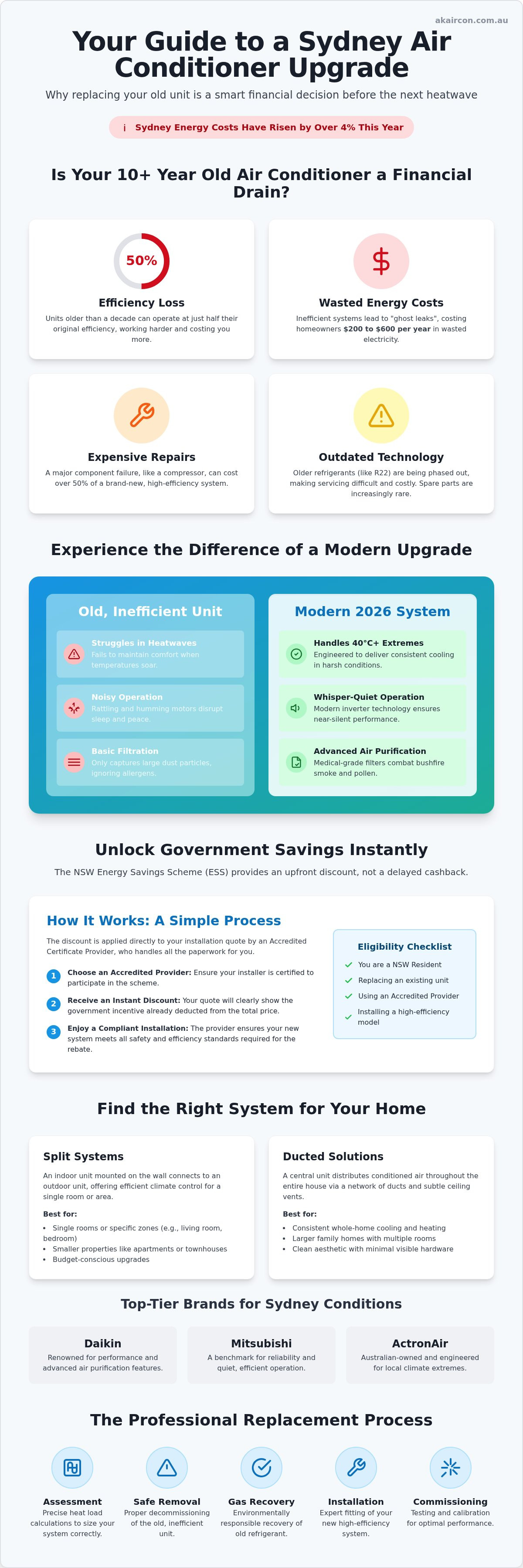
Many Sydney families don't recognise that their old AC is a ticking financial time bomb. If your unit has celebrated its tenth birthday, it's likely operating at half its original efficiency. An air conditioner upgrade sydney residents invest in often pays for itself through reduced energy consumption within a few years. Modern inverter technology has advanced so rapidly that a 2026 model uses significantly less power to achieve the same cooling effect as a system from 2015, helping you avoid the 4.1% rise in Sydney energy costs reported this year.
Sydney's climate is shifting, with heatwaves becoming more frequent and humidity levels reaching new peaks. Older systems were designed for a different era. They struggle to maintain a comfortable temperature when the mercury hits 40 degrees. To understand the mechanics of these systems and why older designs fail under pressure, it's helpful to look at How air conditioning works at a foundational level. Modern units are engineered to handle these extremes while maintaining a consistent indoor environment.
We are also seeing a major transition in refrigerants. Older units using R22 or early R410A are becoming increasingly difficult to service. As these gases are phased out, the cost of a simple regas can skyrocket. Finding replacement parts for discontinued models is now a genuine headache for local residents. Deciding on an air conditioner upgrade sydney wide is now a strategic move to avoid these rising maintenance costs. If a major component like the compressor fails, the repair cost often represents 50% or more of the price of a brand-new system. This is the tipping point where repairs become a poor investment.
The Real Cost of Keeping an Inefficient System
Ageing compressors work overtime to combat Sydney's coastal humidity, leading to "ghost leaks" where electricity is consumed without providing any cooling. These hidden drains on your power bill are the "ghost in the machine" that can cost homeowners between $200 and $600 per year in wasted energy. Because many older brands have exited the Australian market, sourcing a specific circuit board for a 12-year-old unit can take weeks. You don't want to be left stranded in the middle of February while waiting for a part that may no longer exist.
Health and Comfort Benefits of Modern Filtration
Modern 2026 units do more than just cool air; they act as advanced air purification centres. For suburbs prone to bushfire smoke or high pollen counts, the medical-grade filtration in new Daikin or Mitsubishi models is a game-changer. You'll also notice a massive difference in noise levels. While an old unit might rattle and hum, keeping you awake at night, a modern split system operates at a whisper. This transition from a rattle to a whisper ensures your sleep isn't disrupted by a struggling motor, while advanced dehumidification features keep your home feeling fresh rather than sticky.
Navigating the NSW Government Air Conditioning Rebate
Understanding government incentives shouldn't require a law degree. In NSW, the primary driver for a residential air conditioner upgrade sydney is the Energy Savings Scheme (ESS). This isn't a cashback scheme where you wait months for a cheque to arrive in the mail. Instead, it's an upfront discount applied directly to your quote by an Accredited Certificate Provider. By participating in the Peak Demand Reduction Scheme as well, the state encourages a shift toward appliances that put less strain on the grid during those sweltering February afternoons.
Eligibility is straightforward but specific. To qualify, you must be a NSW resident or small business owner replacing an existing, inefficient unit with a high-efficiency model. You can't simply buy a unit from a big-box retailer and hope for a rebate later. The discount is only available through accredited providers who manage the compliance and paperwork on your behalf. This ensures the installation meets strict safety and efficiency standards. If you're unsure about your status, an air conditioning rebate eligibility check is the best place to start.
Eligible Systems for the 2026 Incentive
Not every unit on the market qualifies for government support. The focus is heavily on high-efficiency reverse cycle split systems, as these offer the best energy-to-cooling ratio for Sydney homes. While ducted air conditioning upgrades are also eligible, they must meet rigorous Minimum Energy Performance Standards (MEPS). Before you commit, consult a guide to choosing an energy-efficient model to see how star ratings impact your potential savings. Generally, the higher the star rating, the better the incentive and the lower your future electricity bills will be.
The Application Process Simplified
We've refined the path to a cooler home into three manageable steps. First, we conduct a thorough eligibility check to confirm your system qualifies under the current 2026 ESS guidelines. Second, we calculate the specific "heat load" of your room. This ensures we select a unit that is perfectly sized; a unit that is too small will overwork, while one that is too large will waste energy through frequent cycling. Finally, our team handles the professional installation and the legal decommissioning of your old unit. Safe gas recovery is mandatory. It ensures that harmful refrigerants don't escape into the atmosphere during the swap. You'll be required to sign a nomination form before the work begins to lock in your discount.
Choosing Your Replacement: Split System vs Ducted
Deciding on the right architecture for your air conditioner upgrade sydney depends largely on your property's footprint. While a high-rise apartment in Chatswood has different requirements than a sprawling family home in the Hills District, the goal remains the same: efficient, reliable cooling. Choosing the wrong system can lead to uneven temperatures or unnecessarily high running costs, so it's vital to match the technology to your specific living situation.
Installation complexity varies significantly across Sydney housing styles. A modern build typically features ample roof cavity space for ducting, whereas an older Victorian terrace house might require more creative solutions. For those without the structural capacity for large ducts, multi-split systems offer a brilliant middle ground. These allow you to connect several indoor units to a single outdoor compressor, providing individual temperature control for different rooms without a major renovation. Our team evaluates these structural factors during the initial consultation to ensure the installation is as clean and efficient as possible.
When to Choose a Split System Upgrade
Split systems are the most common choice for single-room cooling. They are particularly effective for Sydney renters who have secured landlord approval, as the installation is minimally invasive. If you're looking for a cost-effective way to cool a bedroom or a small home office, a split system is hard to beat. Under the current NSW rebate scheme, replacing an old wall-mounted unit with a modern, high-efficiency inverter model is one of the fastest ways to see a reduction in your quarterly bills. These units are easy to maintain and can be installed in a single morning, making them a popular choice for busy households.
The Case for Ducted Air Conditioning in Sydney
For those seeking the ultimate in climate control, a ducted system is the gold standard. The primary advantage is zoning. You can organise your home to cool the living areas during the day and switch to the bedrooms at night, which drastically reduces wasted energy. Sydney renovators often prefer ducted systems for their discreet aesthetics. Hidden vents in the ceiling are far less intrusive than wall-mounted units, preserving the clean lines of your interior design. From a financial perspective, a ducted air conditioner upgrade sydney homeowners choose often adds significant value to the property. A high-quality, zoned ducted system is a major selling point in the local market, offering a solid return on investment when it comes time to sell.
Top Brands for Sydney Upgrades: Daikin, Mitsubishi, and ActronAir
Selecting the right hardware for your air conditioner upgrade sydney isn't just about picking a name you recognise from a TV advert. In our professional experience, the best systems are those that have been stress-tested against the unique demands of the NSW coast. While many brands offer high energy ratings on paper, only a few maintain their efficiency when the outdoor temperature climbs past 35 degrees. We focus on brands that provide a balance of long-term reliability, spare parts availability, and the high star ratings required to qualify for the maximum government rebate.
There is often confusion between Mitsubishi Heavy Industries (MHI) and Mitsubishi Electric. While both are reputable, MHI has built a formidable reputation for award-winning reliability in Sydney homes; it is often the preferred choice for heavy-duty cooling. On the other hand, Samsung and Fujitsu have made significant strides in balancing smart home features with energy efficiency. These systems are excellent for tech-savvy homeowners who want to integrate their climate control with wider home automation platforms without sacrificing performance.
ActronAir: Designed for the Australian Climate
ActronAir is an Australian-owned brand, and that local engineering makes a massive difference during a brutal Sydney summer. Choosing an air conditioner upgrade sydney residents can rely on means looking at how units handle "heat soak." Most imported systems are tested to 43 degrees, but ActronAir units are designed to operate in temperatures as high as 50°C. This ensures that even on the hottest day of the year, your compressor won't shut down to protect itself.
One specific advantage for Sydney's narrower suburban blocks is their vertical discharge fan. Unlike traditional units that blow air out the side, often into a fence or a neighbour's wall, these units blow air upwards. This prevents the hot air recirculation that can kill efficiency in tight side-passages. We often recommend them for long-term peace of mind because local parts and support are always readily available.
Daikin and Mitsubishi: The Efficiency Leaders
Daikin remains the industry benchmark for inverter technology. Their US7 model is a particular favourite for rebate-eligible installations because it's one of the most efficient split systems on the market. It doesn't just cool; it humidifies and purifies, which is a major benefit during the humid Sydney months. Both Daikin and Mitsubishi offer sophisticated smart capabilities. This allows you to turn on your cooling while you're still on the train from the CBD, ensuring you walk into a perfectly chilled home. If you want to see which of these brands fits your budget and property layout, you can book a brand comparison consultation with our team today.
The Step-by-Step Air Conditioning Replacement Process
An air conditioner upgrade sydney homeowners undertake requires a methodical approach to ensure long-term efficiency. We begin with a site-specific consultation where we measure the "heat load" of your space. This calculation isn't just about floor area. We look at ceiling heights, window orientations, and insulation quality, which is particularly important in older Sydney terraces or heritage homes with high thermal mass. Getting this right prevents the "short-cycling" that kills compressors and inflates energy bills.
Decommissioning is the next critical phase. We don't just rip out the old unit. Our technicians perform a certified gas recovery to prevent refrigerants from escaping, which is a legal requirement in NSW. Once the old unit is safely removed, we move to installation. This involves mounting the new indoor and outdoor components, running high-quality copper piping, and ensuring the drainage is perfectly pitched. Finally, we commission the system. We test the refrigerant pressures and help you set up your smart controls so you can manage your home's climate from your smartphone.
Why Electrical Expertise Matters During an Upgrade
A common pitfall in many Sydney upgrades is overlooking the existing electrical infrastructure. A new, powerful ducted system can draw significant current, often requiring a switchboard assessment to ensure your home can handle the load safely. We check if your switchboard requires an upgrade to accommodate the new circuit breakers. Dedicated circuits are essential for air conditioning safety to prevent overloading shared household lines. Because our team holds both electrical and HVAC licences, we manage the entire integration in-house. This dual expertise eliminates the need for you to hire a separate sparky, saving you both time and the coordination headache of managing multiple trades on-site.
Post-Install: Maintenance and Warranty
Once the installation is complete, protecting your investment is our priority. We recommend setting up a seasonal maintenance schedule, ideally before the summer peak, to keep your filters clean and your efficiency high. It's also important to distinguish between your manufacturer warranty, which covers the hardware, and our installation guarantee, which covers the workmanship. Clear documentation ensures that if a problem arises, you know exactly who to call. To get started on your journey to a more comfortable home, Book your Sydney air conditioner upgrade assessment with AK Air today!
Secure Your Comfort Before the Next Sydney Heatwave
Upgrading your home's cooling isn't just about escaping the humidity; it's a strategic move to lower your long-term energy costs. By taking advantage of the 2026 NSW Energy Savings Scheme, you can replace a noisy, failing unit with a high-efficiency system from trusted brands like Daikin, Mitsubishi, or ActronAir. We've seen how a professional air conditioner upgrade sydney residents choose can transform a home's comfort while helping to lower quarterly electricity dividends. You don't have to navigate the technical jargon or government paperwork alone.
As licensed electrical and HVAC contractors, we manage every step from rebate eligibility checks to complex switchboard integration. Our team ensures your new system is perfectly sized and safely installed, giving you peace of mind for years to come. We take pride in being NSW rebate specialists who prioritise quality workmanship over quick profits. You deserve a home that stays cool and quiet, no matter how high the mercury climbs this summer.
Ready to start saving? Get a Free Quote for Your Air Conditioning Upgrade and let our expert installers help you maximise your government incentives today.
Frequently Asked Questions
How much can I actually save with the NSW air conditioning rebate in 2026?
You can secure an upfront discount of several hundred dollars depending on the size and efficiency of your new unit. For a 6kW split system, the discount applied to your quote can reach approximately $560. Because this is managed through the Energy Savings Scheme, you don't have to wait for a cashback cheque. The installer applies the reduction directly to the purchase price, making high-efficiency models more accessible for Sydney families.
Will a new air conditioner really lower my electricity bills significantly?
Upgrading to a modern energy-efficient system can save you between $200 and $600 per year on your electricity bills. Older units often operate with outdated compressors that draw excessive power during Sydney heatwaves. By choosing an air conditioner upgrade sydney residents can trust, you benefit from inverter technology that adjusts power usage based on the room's actual needs rather than running at full capacity constantly, especially with energy costs rising.
Can I replace my old ducted system with the government incentive?
Yes, you can replace an old ducted system with the government incentive, provided the new installation meets strict Minimum Energy Performance Standards. Ducted systems are eligible under the Energy Savings Scheme, but the discount amount varies based on the total energy savings achieved. It's often the best time to upgrade your ductwork and zoning controls simultaneously to ensure your entire home benefits from the latest airflow technology and more precise climate management.
How long does it take to install a replacement air conditioner in Sydney?
A standard split system replacement usually takes between three and five hours to complete. If you are upgrading to a whole-home ducted system, the process generally requires one to two full days depending on the complexity of your roof space and the number of zones being installed. Our team works efficiently to ensure your home is back to a comfortable temperature as quickly as possible with minimal disruption to your daily routine.
Do I need to upgrade my electrical switchboard for a new aircon?
You might need a switchboard upgrade if your current board is outdated or lacks the capacity for a new high-power system. Modern air conditioners require dedicated circuits to prevent overloading your home's existing electrical lines. During our initial assessment, we check your switchboard's safety and capacity. Since we hold both electrical and HVAC licences, we can perform any necessary electrical work as part of the installation process without needing external contractors.
What happens to my old air conditioning unit after the upgrade?
Your old unit is safely decommissioned and removed from your property as part of the professional installation process. We perform a mandatory gas recovery to ensure harmful refrigerants are not released into the atmosphere, which is a key requirement for the NSW rebate. The physical components are then transported to specialised recycling facilities where the metals and plastics are processed responsibly, keeping hazardous materials out of Sydney's landfill and protecting the environment.
Is a reverse cycle system better than separate heating and cooling?
A reverse cycle system is significantly more efficient than separate heating and cooling appliances. These systems can be between 300% and 600% efficient, meaning they produce much more thermal energy than the electricity they consume. With the current government push toward electrification, switching from gas heating to a high-efficiency reverse cycle air conditioner upgrade sydney is a smart way to future-proof your home while reducing your overall carbon footprint and monthly utility expenses.
How do I know if my current air conditioner is "inefficient" enough for a rebate?
If your unit is more than ten years old or uses the phased-out R22 refrigerant, it is almost certainly inefficient enough to qualify for a replacement incentive. Other signs include a noticeable rise in your quarterly electricity bills or the unit struggling to reach your desired temperature during a typical Sydney summer. An accredited installer can perform an eligibility check to confirm if your specific model meets the criteria for a government-supported upgrade.
Important Information
This article provides general information only. Air-conditioning requirements, installation costs, energy savings and rebate eligibility vary between properties and systems. NSW program rules, certificate values and eligible models may change. Contact AK Air Conditioning & Electrical Quality Service Pty Ltd for a property-specific assessment and confirmation of current eligibility before making a purchase or installation decision.


