
Is that $800 repair bill for your decade-old unit actually a down payment on next summer's total breakdown? For many homeowners across Bankstown and Greater Sydney, the decision to keep an ageing system running often feels like a gamble against the rising cost of living. It's frustrating to watch your electricity bills climb every month while your current system struggles to maintain a comfortable temperature during a January heatwave. You deserve a home that remains a sanctuary, not a source of financial stress or mechanical uncertainty.
We understand that you want a reliable cooling solution that won't let you down when you need it most. This guide simplifies the air conditioner repair vs replace sydney debate by providing the exact technical and financial criteria our licensed technicians use to evaluate system health. You'll discover how to assess the long-term value of your current unit against the immediate benefits of a modern, high-efficiency upgrade under current NSW energy standards.
We will explore the 'Rule of 5,000' for repair costs, the impact of recent NSW energy rebate schemes on your investment, and why your home's electrical switchboard is just as important as the outdoor condenser. This overview provides a clear path toward lower monthly running costs and a more dependable cooling system for the 2026 summer season.
Key Takeaways
- Apply the "50% Rule" to determine if a repair is a sound investment or if your money is better spent on a modern, high-efficiency replacement.
- Explore how the 2026 NSW Energy Savings Scheme (ESS) can help offset the cost of upgrading your system, depending on your property and installation type.
- Identify critical "red flag" symptoms like compressor failure or chronic refrigerant leaks that indicate your current unit has reached the end of its reliable life.
- Learn why the 10 to 12 year mark is the critical threshold for Sydney systems and why older, non-inverter units are becoming a financial liability.
- Find out why a professional diagnostic assessment is the only way to accurately resolve the air conditioner repair vs replace sydney dilemma for your specific property.
The Sydney Air Conditioning Dilemma: Why 2026 is Different
The 2026 energy landscape in New South Wales has changed the financial math for many families. While a simple repair used to be the default choice, the rising cost of electricity means that keeping an inefficient, non-inverter system running is often a significant financial liability. We see many homeowners struggling with the air conditioner repair vs replace sydney dilemma when their unit starts blowing lukewarm air during a 40-degree afternoon in Bankstown. It is a stressful situation, especially when you are worried about the next quarterly bill or a total system failure in the middle of a heatwave.
Intermittent faults are particularly frustrating for residents in Western Sydney. You might find your system works perfectly at 9:00 am but cuts out precisely when the afternoon heat peaks. These issues often signal that the internal electronics or the compressor can no longer handle the thermal load. Modern 2026 units use "smart" climate control and variable-speed inverters that older units simply cannot match. This technology allows the system to communicate with your home network, providing real-time efficiency data and ensuring the unit never works harder than it needs to, which provides a level of reliability that legacy systems lack.
Rising Electricity Costs and System Efficiency
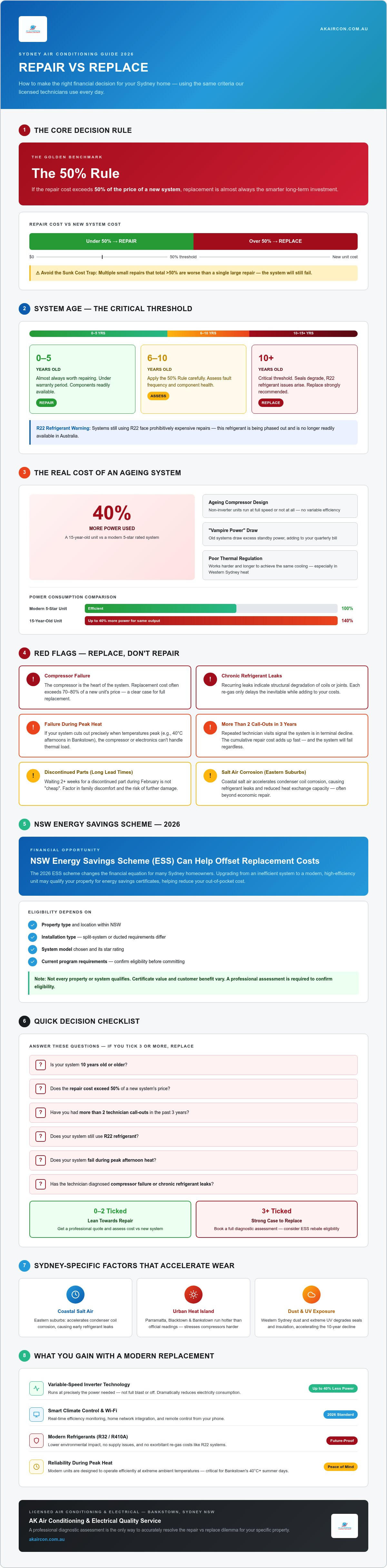
Efficiency isn't just a technical specification; it's a measurable daily cost. A 15-year-old air conditioning system can consume up to 40% more power than a modern 5-star rated unit because of aging components and outdated compressor designs. These legacy models often suffer from "vampire power" draw and poor thermal regulation, meaning they work harder for longer just to achieve the same cooling effect. To put this in perspective, the Seasonal Energy Efficiency Ratio (SEER) measures how effectively a system cools your home relative to the electricity it consumes over a typical Sydney summer season.
Sydney Environmental Factors: Salt Air and Heat Stress
Sydney's unique geography presents distinct challenges for mechanical equipment. In the Eastern suburbs, salt air from the coast accelerates corrosion on outdoor condenser coils, leading to refrigerant leaks and reduced heat exchange capacity. Meanwhile, in areas like Parramatta and Blacktown, the "urban heat island" effect creates localised temperatures significantly higher than official readings. Dust and high ambient heat put extreme pressure on the compressor's health. This is why following a comprehensive air conditioning maintenance plan is essential to protect your investment from these local environmental stressors. Without regular care, the debate over whether to repair or replace often arrives years earlier than expected.
The Decision Matrix: When to Repair vs Replace
Making an informed decision about air conditioner repair vs replace sydney requires looking beyond the immediate invoice. We recommend using the "50% Rule" as your primary benchmark. If the cost of a single repair exceeds half the price of a brand-new, high-efficiency system, investing that money into a replacement is almost always the smarter long-term move. This logic helps you avoid the "sunk cost fallacy", where you spend hundreds on small fixes every few months, only to have the entire system fail anyway during the next heatwave.
Parts availability also plays a significant role in this decision. While we are authorised dealers for premium brands, sourcing legacy components for older ActronAir or Daikin models can sometimes involve long lead times. If your home is without cooling for two weeks in February while waiting for a discontinued part, the "cheaper" repair suddenly becomes very expensive in terms of family discomfort. Tracking the frequency of faults is essential; if you've called a technician more than twice in the last three years, the system is telling you it's reaching the end of its reliable life.
The 10-Year Threshold Explained
Internal seals and insulation within the outdoor unit begin to degrade significantly after a decade of Sydney's harsh UV exposure and extreme temperature swings. This wear often leads to microscopic refrigerant leaks or electrical insulation breakdown. This age also coincides with the industry shift away from R22 refrigerant. If your old system still uses R22, repairs become prohibitively expensive because the gas is no longer imported for general use. Modern inverter technology provides much more consistent comfort and lower noise levels than old fixed-speed compressors, making the 10 to 12 year mark the ideal time to consider an upgrade.
Calculating the True Cost of Repair
The sticker price of a repair rarely tells the whole story. You must also consider the hidden costs such as call-out fees, refrigerant top-ups, and the high probability of potential follow-up visits as other aged components fail. A "band-aid" fix might get you through the week, but it doesn't offer the peace of mind that comes with a new five-year manufacturer warranty. We provide honest, transparent assessments to help you avoid unnecessary air conditioning repairs in Sydney. If you're currently weighing up these costs, you can request a professional diagnostic report from our team to see which path offers the best value for your property.
NSW Air Conditioning Rebates: A Game Changer in 2026
The financial side of the air conditioner repair vs replace sydney decision has shifted significantly due to the NSW Energy Savings Scheme (ESS). In 2026, the focus on reducing peak grid demand means that upgrading a failing unit is often more affordable than a major technical repair. These incentives are designed to encourage homeowners to move away from high-consumption legacy models toward high-efficiency technology. By choosing a rebate-eligible system, you can significantly offset the initial capital cost of a replacement, making it a far more attractive option than sinking money into a 12-year-old unit that will likely break down again.
It's vital to understand that these benefits aren't automatic. To qualify, the installation must be performed by an authorised installer working with an Accredited Certificate Provider. This ensures the system meets strict energy-saving standards and that the old, inefficient unit is properly decommissioned and recycled. Not every model on the market qualifies; the scheme specifically targets systems that deliver genuine energy reductions under Sydney's specific climate conditions. We help our clients navigate these requirements to ensure they select a system that maximises their potential benefit.
Eligibility Criteria for Sydney Homeowners
Eligibility primarily depends on replacing an existing, inefficient air conditioner with a more advanced model. The value of the certificate or benefit is often tied to the new unit’s energy star rating; the more efficient the system, the greater the potential value. Because programs change and specific property requirements apply, you should check your NSW air conditioning rebate eligibility before you commit to an expensive repair. This step ensures you don't miss out on financial support that could make a brand-new system the more economical choice for your property.
The Long-Term ROI of an Energy-Efficient Upgrade
Beyond the initial rebate, the long-term return on investment is substantial. For a typical family home in Bankstown, switching from an old fixed-speed unit to a 5-star inverter system can lead to noticeable reductions in quarterly power bills. Over a five-year period, these savings can add up to a significant portion of the unit's original price. Additionally, a modern, quiet system from premium brands like Mitsubishi Heavy Industries or Daikin adds tangible value to your property. Prospective buyers and tenants in the 2026 market prioritise energy efficiency and reliable climate control, making a rebate-backed replacement a sound financial strategy for your home’s future.
Red Flags: Signs Your AC is Beyond a Simple Fix
Recognising the warning signs of a terminal system failure can save you from throwing good money after bad. Identifying these red flags early is the first step in resolving the air conditioner repair vs replace sydney dilemma for your property. While a minor rattle might only require a simple adjustment, other symptoms suggest that the core components are reaching their breaking point. If your unit emits a pungent, burnt odour or makes a persistent grinding sound, it often indicates a motor failure that is no longer economical to fix.
The most significant red flag is compressor failure. As the "heart" of the system, the compressor is responsible for circulating refrigerant and maintaining the pressure needed for cooling. When this component dies, the repair cost is typically so high that a full replacement becomes the only logical path. Similarly, if your air conditioner starts tripping your safety switches frequently, it is a sign of a serious internal electrical fault. Ignoring these electrical warnings is dangerous, as they can lead to further damage to your home's wiring or even pose a fire risk during peak operation.
The Danger of "Re-gassing" Old Systems
Many homeowners are tempted by a quick "re-gas" when their system stops cooling effectively. However, a loss of refrigerant always indicates a structural failure, such as a crack in the copper pipework or corroded evaporator coils. Simply topping up the gas without fixing the leak is a temporary and environmentally harmful solution, as the refrigerant will eventually escape back into the atmosphere. The cost of legacy gases is also rising rapidly due to environmental phase-outs. We always advise that a professional leak test is a far better investment than a simple top-up, as it reveals whether the system is actually worth saving.
Electrical Safety and Your Switchboard
Modern, high-efficiency air conditioning units are far more technologically advanced than the models installed fifteen years ago. These systems often require a dedicated circuit and a modern switchboard to handle the specific power loads and sensitive electronics. Running a new, powerful unit on old, brittle wiring or an outdated fuse box creates a significant risk of electrical failure. This is where our dual expertise provides a distinct advantage for Sydney residents. Our licensed electricians can manage the entire electrical integration safely, ensuring your switchboard is up to current NSW standards before the new unit is commissioned.
Making the Right Choice for Your Sydney Property
Choosing between a quick fix and a major investment isn't always easy. While we've discussed the technical red flags and financial benchmarks, the final air conditioner repair vs replace sydney decision often comes down to the specific layout and usage of your property. A "guess-and-check" approach from an unlicensed handyman might seem cheaper initially, but it lacks the depth of a professional diagnostic service. We provide a transparent report that weighs the cost of parts and labour against the projected energy savings of a modern system, giving you a clear roadmap for your home's comfort.
Every property has different requirements. For instance, a high-rise apartment or a unit in Bankstown typically benefits from a high-efficiency split system, whereas a sprawling family home in Western Sydney might require a more robust ducted solution. We don't believe in one-size-fits-all answers. Instead, we look at your current ductwork, the capacity of your electrical switchboard, and your typical cooling habits to recommend a solution that ensures reliability for the upcoming 2026 summer.
Expert Assessment in Bankstown and Beyond
Our team at AK Air Conditioning & Electrical follows a methodical inspection process that covers every critical failure point. We don't just look at the outdoor unit; we inspect the integrity of your ductwork and the safety of your electrical connections. As authorised dealers for premium brands like ActronAir, Mitsubishi, and Daikin, we have the specialised knowledge to identify whether a legacy component is truly failing or if a simple adjustment can extend its life. If your current unit is over 12 years old, we highly recommend booking a split system aircon installation assessment to compare the costs of keeping your old system versus upgrading to a rebate-eligible model.
Conclusion: Peace of Mind for 2026
The financial math often supports a replacement when you factor in the NSW Energy Savings Scheme and the immediate reduction in your quarterly power bills. Investing in a new system provides you with a fresh manufacturer warranty and the latest inverter technology, removing the fear of a mid-summer breakdown. It's about more than just temperature control; it's about the safety and efficiency of your home's electrical infrastructure. You should always use a licensed professional for all air conditioning repairs in Sydney to ensure the work meets Australian standards. Contact our team today for a comprehensive quote that considers both your repair options and your eligibility for a high-efficiency upgrade.
Securing Your Home Comfort for the 2026 Summer
Deciding on the best path for your home cooling involves balancing immediate repair costs against long-term energy efficiency and electrical safety. By applying the 50% rule and respecting the 10-year threshold, you can avoid the expensive cycle of repeat breakdowns. The availability of NSW energy rebates in 2026 makes upgrading to high-efficiency systems from premium brands like Daikin or Mitsubishi more accessible than ever before.
Navigating the air conditioner repair vs replace sydney decision is much simpler with a professional partner by your side. Our team of licensed electrical and air conditioning technicians provides the technical clarity you need to make an informed choice. As authorised dealers serving Bankstown and Greater Sydney for years, we ensure your cooling system and your switchboard are perfectly matched for the peak summer load.
Choosing the right solution today guarantees a reliable, cost-effective sanctuary for your family throughout the coming year. We are here to help you move forward with confidence and professional support.
Frequently Asked Questions
How much does a typical air conditioner repair cost in Sydney?
Repair costs depend on the nature of the fault, the age of the unit, and the required spare parts. A minor electrical fix or sensor replacement is naturally less expensive than a major component failure. You should also consider the call-out fee and the hourly labour rate of a licensed technician. We provide transparent assessments to help you understand the full cost before any work begins on your air conditioning system.
Can I still get parts for a 15-year-old air conditioner?
Sourcing components for a 15-year-old system is increasingly difficult as manufacturers phase out support for legacy models. While some generic parts might be available, specific internal electronics or custom compressor components for older units are often discontinued. This scarcity leads to long lead times and higher prices. If your unit is this old, the difficulty in finding parts is a clear sign that a replacement is a more reliable long-term solution.
Will a new air conditioner really lower my Sydney electricity bills?
Upgrading to a modern unit can significantly reduce your running costs compared to an older, non-inverter system. Modern systems use variable-speed inverter technology that adjusts the cooling output based on the room temperature, preventing the energy-heavy stop-start cycles of legacy models. This efficiency is a key factor in the air conditioner repair vs replace sydney debate, especially with the higher electricity tariffs expected throughout the 2026 summer season.
What is the 50% rule for air conditioning repairs?
The 50% rule is a financial benchmark used to determine if a repair is worth the investment. If the estimated cost of fixing your current unit exceeds 50% of the price of a brand-new, high-efficiency replacement, then buying a new system is the wiser choice. This rule helps homeowners avoid sinking money into a system that is likely to develop further faults within a short period, ensuring your funds are used effectively.
Does the NSW rebate apply to all air conditioner brands?
The NSW rebate scheme focuses on high-efficiency, energy-saving models rather than specific brand names. While premium brands like Daikin, Mitsubishi Heavy Industries, and ActronAir often have eligible models, each specific unit must meet strict energy performance standards to qualify. Eligibility also depends on your property type and the decommissioning of an old system. We can check your specific model to see if it meets the current 2026 program requirements.
How long does a full air conditioning replacement take to install?
A standard split system replacement usually takes between four to six hours to complete safely. Ducted system installations are more complex and generally require a full day or more, depending on the access to your roof space and the condition of existing ductwork. Our process includes the removal of the old unit, the installation of the new system, and a thorough testing of the electrical connections to ensure everything meets Australian safety standards.
Is it worth repairing a system that uses R22 gas?
Repairing an R22 system is rarely a sound financial decision in 2026 because this refrigerant gas is no longer imported for general use. The limited supply of reclaimed R22 makes any "re-gassing" or leak repair prohibitively expensive. Additionally, R22 systems are significantly less efficient than modern units using eco-friendly gases. If your system still uses this legacy refrigerant, we strongly recommend considering a replacement to avoid ongoing mechanical and financial issues.
Why does my air conditioner keep tripping the safety switch?
A tripping safety switch often indicates a serious electrical fault, such as a grounded compressor, a short circuit in the wiring, or moisture entering the outdoor unit. It is a protective measure designed to prevent electrical fires or shocks. Because we are licensed electricians as well as AC technicians, we can diagnose whether the issue lies within the air conditioning unit itself or your home's switchboard, ensuring a safe and permanent resolution.
Important Information
This article provides general information only. Air-conditioning requirements, installation costs, energy savings and rebate eligibility vary between properties and systems. NSW program rules, certificate values and eligible models may change. Contact AK Air Conditioning & Electrical Quality Service Pty Ltd for a property-specific assessment and confirmation of current eligibility before making a purchase or installation decision.


