
Imagine waking up to a 40-degree Sydney scorcher only to find your vents blowing lukewarm air while a faint, musty smell drifts through your home. For many homeowners in Bankstown and across Greater Sydney, this isn't just a hypothetical scenario; it's a costly reality when systems aren't properly maintained. Booking a professional ducted air conditioning service in Sydney is about more than just comfort. It's a strategic investment in the preservation of your home's most expensive appliance.
We understand the frustration of rising electricity bills and the nagging worry that your unit might fail exactly when you need it most. This guide provides a comprehensive roadmap to help you master essential maintenance tasks and understand the professional requirements needed to keep your system running at peak efficiency all year round. You'll learn how to improve your indoor air quality, lower your running costs, and significantly extend the lifespan of your ducted system. We will walk you through a practical checklist covering everything from simple DIY filter care to the technical inspections that require a licensed specialist to ensure your home stays cool and safe.
Key Takeaways
- Protect your system from Sydney’s high humidity and coastal salt air by understanding how these local factors cause mould growth and component corrosion.
- Master a safe DIY maintenance routine for your vents and filters while learning why professional electrical safety checks are vital for your home’s protection.
- Find out exactly what to expect during a professional ducted air conditioning service in Sydney, from refrigerant level testing to ARCtick-certified component inspections.
- Learn how to spot when an aging system is "cactus" and discover how the NSW rebate program can help you replace an inefficient unit with a high-efficiency model.
- Beat the rush and ensure your system is heatwave-ready by booking your maintenance with local Bankstown specialists before the Sydney summer peak hits.
Why Maintenance for Air Conditioning Units is Vital in Sydney
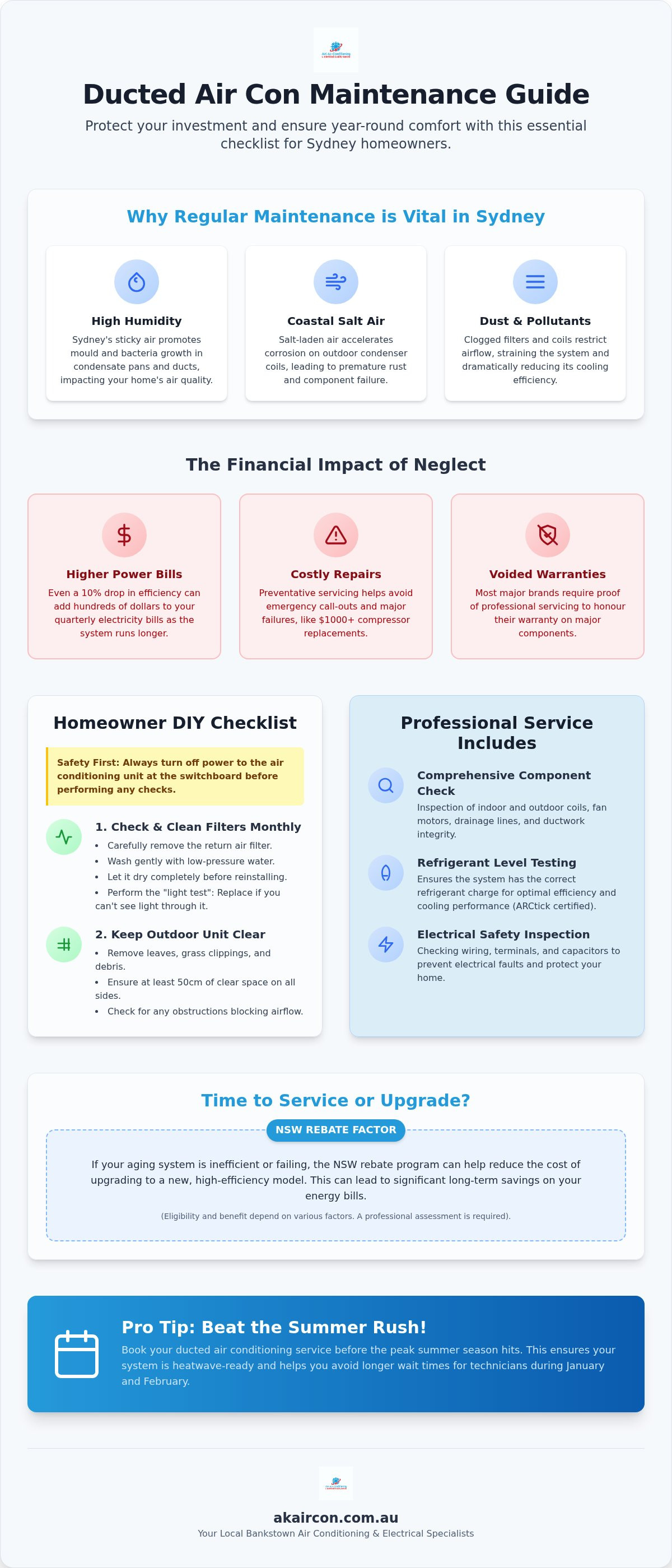
Sydney’s climate presents unique challenges for Heating, ventilation, and air conditioning (HVAC) systems. Our high humidity levels, particularly during the sticky summer months, often lead to moisture pooling in undrained condensate pans. When water sits, mould and bacteria quickly follow, which then circulate through your home's vents and compromise your indoor air quality. Beyond the health risks, coastal residents must deal with salt air that aggressively corrodes outdoor condenser coils, leading to premature rust and component failure. Even if you live inland in areas like Bankstown, the combination of extreme heat and airborne pollutants can take a heavy toll on your unit's internal mechanics. Preventative maintenance is the primary way to avoid the $1000+ compressor failures that often occur during the most inconvenient times.
Combating Sydney’s Humidity and Dust
In Sydney’s Western suburbs, dust is a constant battle for ducted systems. As dust builds up on filters and internal coils, your unit has to work harder to pull air through the system. This restricted airflow puts immense strain on the fan motor and reduces the cooling capacity of the entire house. Many homeowners fall into a "set and forget" mindset, assuming that because the unit is running, it's healthy. However, the relationship between humidity and dust creates a thick sludge that can block internal drainage lines, leading to ceiling leaks and expensive water damage. A regular ducted air conditioning service sydney ensures these internal components are cleaned and cleared before they become a liability to your home's structure.
The Financial Impact of Neglect
Ignoring your system doesn't just risk a breakdown; it hits your hip pocket every month. Even a 10% drop in operating efficiency can add hundreds of dollars to your quarterly electricity bill because the system runs longer cycles to reach your desired temperature. The cost difference between a routine ducted air conditioning service sydney and an emergency repair is substantial. While a scheduled service is a controlled, predictable expense, an emergency call-out during a January heatwave often involves premium rates and long wait times for parts. It's also vital to remember that most major manufacturers, such as Daikin or Mitsubishi, require documented proof of professional servicing to honour their warranty. Without a clear service history from a licensed technician, you might find yourself footing the entire bill for a major component failure that should have been covered.
The Essential Homeowner’s DIY Maintenance Checklist
While a comprehensive ducted air conditioning service sydney requires technical expertise for complex internal components, there are several safety-focused steps you can take to keep your system humming between professional visits. Whether you have a recent ducted air conditioning installation or an older unit, basic upkeep prevents minor issues from spiralling into major repairs. Before you start any inspection or cleaning task, the most critical safety rule is to turn off the power at the main isolator switch or your home's switchboard. Never attempt to open or clean a unit while it is live.
Cleaning and Replacing Return Air Filters
The return air filter is your system's first line of defence against Sydney dust and allergens. During peak summer or winter months, you should check your filter every month. To clean it, unclip the filter frame, which is usually located in a central hallway ceiling, and slide the mesh filter out. Wash it gently with a low-pressure hose or lukewarm soapy water, then allow it to dry completely in the shade. Before sliding it back in, perform the "light test": hold the filter up to a bright light or the sun. If you can't see light passing clearly through the mesh, it's still clogged or the material has degraded. While cleaning is effective for a time, filters eventually lose their structural integrity. If you notice holes, fraying, or persistent odours even after a thorough wash, it's time to arrange a professional replacement.
Maintaining the Outdoor Condenser Unit
Your outdoor unit needs room to breathe to dump heat efficiently. On a quarterly basis, clear away fallen leaves, grass clippings, and garden debris from around the base. Aim for at least 50cm of clear space on all sides to prevent airflow obstructions that force the motor to work harder. While you're there, look closely at the metal fins on the coils. In Sydney's coastal environment, keep an eye out for "pitting" or white, powdery residue. These are early signs of salt-air corrosion that can eventually lead to gas leaks. If you notice significant bending of the fins or deep rust, these are issues that need to be addressed during your next scheduled ducted air conditioning service sydney.
If you're also managing a property with a split system aircon installation, these outdoor unit checks are just as vital. If you're unsure about the condition of your components after your DIY check, it's worth getting a professional assessment to ensure everything is in top shape for the coming season.
What a Professional Ducted Air Conditioning Service Includes
While DIY checks are helpful for basic upkeep, a comprehensive ducted air conditioning service sydney involves technical tasks that require specialised training and legal certifications. Under Australian law, any technician handling refrigerant must hold a national ARCtick licence. This ensures they follow strict environmental regulations to prevent gases from escaping into the atmosphere. Professionals also bring advanced diagnostic tools to the job, such as manifold gauges for precise pressure readings and thermal cameras to detect hidden airflow blockages or electrical hotspots. For a deeper look at brand-specific maintenance requirements, you can refer to our Ducted Air Conditioning Service Sydney guide.
Refrigerant Levels and Gas Leak Detection
Refrigerant gas is the lifeblood of your system's cooling performance. If gas levels are low, your unit won't just struggle to cool your home; it will consume significantly more power while trying to reach the set temperature. A professional technician doesn't just "top up" the gas; they use electronic leak detectors to identify micro-leaks within the copper piping. Sealing these leaks is essential to comply with environmental regulations regarding refrigerant handling in Australia, as venting gas is illegal and harmful to the environment. Maintaining the correct pressure ensures the compressor operates within its design limits, preventing premature wear.
Electrical Component and Zone Motor Inspection
Safety is the cornerstone of every professional visit. Our technicians test capacitors, contactors, and all internal electrical connections to ensure they are drawing the correct current and haven't been damaged by heat or pests. Loose electrical connections are a leading cause of AC fires, so checking every terminal is a non-negotiable safety step. We also inspect the zone motors, which are the small engines that open and close the dampers in your attic to direct air to specific rooms. If a zone motor fails or sticks, you'll end up with "dead spots" in the house where no air flows, regardless of what the thermostat says.
Ductwork Integrity and Hygiene
The hidden network of ducts in your attic or crawl space often holds the secret to poor efficiency. We inspect the entire run for air leaks where ducts may have detached over time and look for "crushed" sections where the flexible piping has been compressed by storage items or tight spaces. Hygiene is equally vital for your family’s health. We sanitise the indoor coils and condensate pans to prevent "Dirty Sock Syndrome", a common issue where bacteria growth creates a foul, damp odour through the vents. This ducted air conditioning service sydney process ensures the air circulating through your home is clean, fresh, and free from mould spores.
When to Service vs. When to Upgrade: The NSW Rebate Factor
Even with the most diligent maintenance routine, every ducted system eventually reaches a point where repairs are no longer a sound investment. In Sydney's demanding climate, the typical lifespan of a ducted unit is between 10 and 15 years. While a routine ducted air conditioning service sydney can keep a mid-life system running smoothly, it can't fix the underlying mechanical inefficiencies of an obsolete model. An aging unit often becomes "cactus" when its core components, like the compressor or heat exchanger, begin to fail. Replacing these parts on an old machine is often throwing good money after bad, especially when modern, high-efficiency models are now available through the NSW Energy Saving Scheme (ESS).
Identifying an Inefficient System
Knowing when to stop repairing and start replacing is key to avoiding "bill shock." If your system requires frequent repairs just to get through a single season, or if you notice loud, grinding noises coming from the outdoor unit, it's likely reaching the end of its life. Skyrocketing electricity bills are another major red flag; older units simply can't match the energy efficiency of 2026 inverter technology. We often recommend the "50% rule" to our clients in Bankstown and surrounding suburbs. If the cost of a single repair exceeds half the price of a new unit, it's time to upgrade. A professional health check during your next ducted air conditioning service sydney can provide the data you need to make this decision with confidence.
NSW Energy Saving Scheme (ESS) Basics
The NSW Government's rebate programs are designed specifically to encourage the replacement of old, power-hungry units with energy-efficient models. By upgrading to a modern Daikin or Mitsubishi system, you may be eligible for significant upfront discounts that reduce the total cost of your investment. Eligibility for these incentives depends on your property type, location, and the specific system model you choose. For a detailed breakdown of how the program works this year, read our NSW Air Con Rebate guide. Replacing an inefficient unit doesn't just lower your running costs; it also ensures your home remains a sanctuary during extreme Sydney heatwaves.
To find out if your property is a candidate for an upgrade under the current guidelines, you should check your air conditioning rebate eligibility with an authorised provider.
Booking Your Ducted Air Conditioning Service in Sydney
Timing is everything when it involves home climate control. Waiting until the first 40-degree day in January to book your ducted air conditioning service sydney is a recipe for frustration, as technician schedules fill up weeks in advance during the summer peak. By arranging your maintenance during the milder spring months, you ensure your system is primed for the heavy lifting ahead. At AK Air Conditioning & Electrical Quality Service, we bring a methodical approach to every inspection, ensuring your unit doesn't just run, but operates at the high electrical and mechanical standards required for long-term reliability. Whether you are in Bankstown, Liverpool, or Parramatta, our local team is ready to help you avoid the stress of a mid-summer breakdown.
Why Local Sydney Expertise Matters
Sydney's diverse housing stock requires a nuanced understanding of how different structures handle airflow. A brick veneer home in the South-Western suburbs has different thermal properties and ducting requirements than a classic weatherboard cottage or a modern multi-storey townhouse. Our technicians understand these local architectural variations and how they impact ducting runs and insulation needs. We also stay up to date with local council requirements regarding outdoor unit placement and noise levels, ensuring your installation remains compliant with community standards. Being based in Bankstown allows us to provide responsive service to our neighbours, bringing a level of accountability that only a local, family-operated business can offer.
Preparing for Your Service Appointment
To help our technicians perform the most thorough ducted air conditioning service sydney possible, a small amount of preparation goes a long way. Ensuring clear access to the indoor return air vent and the outdoor condenser unit allows us to begin inspections immediately. If your system's indoor fan coil unit is located in the attic, please ensure the manhole access is clear of furniture or storage items. It is also helpful to have a list of any specific concerns ready, such as:
- Individual rooms that feel warmer than others (potential "hot spots").
- Strange whistling or rattling noises coming from the vents.
- Zones that don't seem to respond to the wall controller.
- Any recent "musty" smells that have appeared after rain.
Our commitment to safety means we don't just look at the cooling components; we inspect the entire electrical heartbeat of your system. As licensed electrical and AC technicians, we handle everything from complex wiring to refrigerant management with professional confidence. We are authorised dealers for leading brands like Daikin, Mitsubishi, and ActronAir, which means we understand the specific engineering of your unit better than a generalist. Taking the time for a professional assessment now is the most effective way to protect your home's comfort and your family's indoor air quality for the years to come.
If you want to ensure your system is ready for the next Sydney heatwave, we invite you to reach out for a comprehensive system assessment.
Secure Your Home's Comfort Before the Next Heatwave
Maintaining your ducted system is more than just a seasonal chore; it's a vital step in protecting your property and ensuring your family's health in Sydney's unique climate. By combining regular DIY filter care with a professional ducted air conditioning service sydney, you can avoid the stress of unexpected breakdowns and the burden of inflated energy bills. Whether you are managing a family home in Bankstown or a rental property in Parramatta, proactive care is the only way to guarantee peak performance during a 40-degree heatwave.
As licensed electrical contractors and authorised dealers for industry leaders like Daikin and Mitsubishi Electric, we have spent years helping Sydney residents maintain reliable climate control. We understand the technical requirements and the local environmental factors that impact your unit's longevity. If your system is approaching the end of its lifespan, we can also help you navigate the NSW rebate programs to find a high-efficiency replacement that fits your property's needs.
Don't wait for the mercury to rise before checking your system. Take control of your home's comfort today and enjoy the peace of mind that comes with a professionally maintained and efficient ducted system.
Frequently Asked Questions
How often should I have my ducted air conditioning serviced in Sydney?
You should book a professional ducted air conditioning service in Sydney at least once every 12 months. For homes in busier areas like Bankstown or Parramatta, where dust and pollutants are higher, a bi-annual check before summer and winter is often better. Regular servicing ensures your unit operates efficiently during peak demand. It also helps identify minor electrical or mechanical issues before they lead to a complete system failure during a heatwave.
Can I clean my ducted air conditioning vents myself?
Yes, you can safely clean the exterior of your ducted air conditioning vents using a vacuum with a brush attachment or a damp cloth. This helps maintain airflow and prevents dust from circulating. However, you shouldn't attempt to clean deep inside the ductwork or the internal fan coil unit. These tasks require specialised tools and a licensed technician to ensure you don't accidentally puncture the duct lining or damage sensitive sensors.
Why is my ducted air conditioner blowing warm air?
A ducted system blowing warm air is usually caused by a blocked return air filter, low refrigerant levels, or a faulty compressor. If your filters are clean, the issue is likely a gas leak or an electrical fault in the outdoor unit. In these cases, you'll need a ducted air conditioning service in Sydney to diagnose the problem. A licensed technician will check for leaks and ensure the refrigerant levels meet the manufacturer's specifications.
How much does a professional air conditioning service cost in Sydney?
The cost of a professional service depends on the size of your system and the specific tasks required. A routine maintenance check is generally more affordable than a comprehensive deep clean that involves sanitising internal coils and clearing complex drainage lines. While industry rates vary, the investment in regular maintenance is always lower than the cost of emergency repairs. You should contact a local specialist for a specific quote tailored to your system's age.
Will regular maintenance help me qualify for the NSW air con rebate?
Regular maintenance itself doesn't qualify you for a rebate, but it helps determine if your current system is too inefficient to keep. The NSW Energy Saving Scheme focuses on replacing old, power-hungry units with high-efficiency models. If a technician finds your system is beyond its useful life, they can assess your eligibility for an upfront discount. These rebates depend on your property type, location, and the specific energy-efficient system being installed.
What is the best time of year to book an AC service?
The best time to book an AC service is during the "shoulder" seasons, which are Spring (September to November) and Autumn (March to May). Booking during these months ensures your system is ready for the extreme Sydney temperatures before they arrive. It also means you won't have to wait for weeks in a queue, as technicians are often fully booked with emergency repairs during the peak of summer and winter.
Why does my ducted air conditioner smell like wet socks?
This odour, often called "Dirty Sock Syndrome," is caused by a build-up of bacteria and mould on the indoor evaporator coils or in the condensate drain pan. Sydney's high humidity creates the perfect environment for these microorganisms to grow when moisture doesn't drain properly. A professional service includes sanitising the coils and clearing the drainage lines with specialised anti-bacterial treatments. This process removes the smell and significantly improves your home's indoor air quality.
Is it worth repairing a 15-year-old ducted system?
Generally, it isn't worth investing in major repairs for a 15-year-old system. Most ducted units have a lifespan of 10 to 15 years in Sydney. Older models use significantly more electricity and often rely on obsolete refrigerants that are expensive to source. If your repair bill is high, you're better off exploring an upgrade. Modern systems offer better zoning control and may qualify for NSW rebates, making them a more cost-effective long-term solution.
Important Information
This article provides general information only. Air-conditioning requirements, installation costs, energy savings and rebate eligibility vary between properties and systems. NSW program rules, certificate values and eligible models may change. Contact AK Air Conditioning & Electrical Quality Service Pty Ltd for a property-specific assessment and confirmation of current eligibility before making a purchase or installation decision.


