
It's a sweltering Saturday afternoon in Greater Western Sydney, and while the mercury hits 42 degrees outside, your vents are blowing nothing but lukewarm air. Instead of the crisp, cool relief you expect, you're staring at a cryptic blinking light on your wall controller and wondering if your electricity bill is about to skyrocket. We understand that ducted air conditioning problems often strike at the worst possible moment, leaving your family's comfort in jeopardy. You aren't alone in this frustration, as many local homeowners find their aging systems struggling to keep pace with our increasingly intense NSW heatwaves.
This troubleshooting guide is designed to give you back control over your home climate. We'll help you identify common faults, explain those confusing error codes, and provide simple DIY fixes that could save you a service call. You'll also learn how to determine if your unit is simply reaching the end of its life. Most importantly, we'll explore how the 2026 NSW Energy Savings Scheme (ESS) provides upfront discounts that can make upgrading to a high-efficiency system significantly cheaper than continuing to repair a failing one. By the end of this article, you'll know exactly whether to reach for the user manual or start looking at a rebate-supported replacement.
Key Takeaways
- Learn how to identify common ducted air conditioning problems like lukewarm air or uneven cooling and discover simple DIY maintenance tasks that can quickly restore your home's comfort.
- Understand the technical difference between a minor setting error and serious faults like refrigerant leaks that require a dual-licensed professional to resolve safely and permanently.
- Discover how the 2026 NSW Energy Savings Scheme (ESS) offers upfront discounts for high-efficiency upgrades, often making a new system more affordable than repairing an outdated unit.
- Learn why professional zoning and heat load mapping are essential for ensuring every room in your Sydney home remains at a consistent temperature during extreme summer heatwaves.
- Gain clarity on when to attempt a 10-minute filter clean and when it is time to call in a specialist to protect your system from long-term damage and high running costs.
Common Symptoms of Ducted Air Conditioning Problems
Sydney's climate is notoriously demanding on home infrastructure. One week we are battling 40-degree humidity in Western Sydney, and a few months later, we are relying on the same unit to keep us warm during a crisp morning. When your system starts underperforming, it's rarely a total mystery; the symptoms are usually right in front of you. Recognising these signs early can be the difference between a simple service and a complete system failure.
The most frequent sign of ducted air conditioning problems is a system that hums along but fails to actually change the room temperature. In a reverse cycle setup, this often indicates a struggle with the heat exchange process. Understanding the fundamental principles of HVAC systems helps clarify why this happens. If the refrigerant isn't flowing correctly or the coils are clogged with local dust, the unit cannot move heat effectively between the indoors and outdoors. It's working hard, but achieving very little.
You might also notice "hot spots" where the master bedroom feels like a fridge while the kitchen remains a sauna. This typically points to a zoning issue or a crushed duct in the roof cavity. Similarly, strange "dirty sock" smells suggest bacterial growth on the indoor coils, often caused by the high humidity levels we see across the Sydney basin. If you hear a rattling in the ceiling or a heavy buzzing from the outdoor unit, it's time to investigate. These sounds often signal that a minor vibration is about to turn into a mechanical failure.
The "Ghost in the Machine": Error Codes
Modern wall controllers from brands like Daikin or ActronAir are quite sophisticated. When a light starts flashing or a code like "E1" or "UA" appears, it's easy to feel overwhelmed. These error codes are actually the system's way of preventing permanent damage by shutting down before a small sensor fault destroys the expensive compressor. A flashing light often points to a simple communication error or a blocked filter rather than a dead system. Knowing how to read these codes allows you to provide our technicians with vital information before we even arrive at your door.
Water Leaks and Ceiling Stains
Sydney summers bring intense humidity, which means your aircon pulls litres of water out of the air every hour. If the condensate drain becomes blocked by dust or debris, that water has nowhere to go but down. A yellow stain on your plasterboard is a clear warning sign that shouldn't be ignored. Most professional installations include a safety tray under the indoor unit as a last line of defence. However, if you see water dripping from your eaves or ceiling, the primary drain is likely compromised. Distinguishing between a plumbing leak and aircon condensation is vital; if the drip only occurs when the cooling is running, your aircon is the culprit.
Technical Culprits: Why Your System is Underperforming
While symptoms are easy to spot, the underlying technical causes of ducted air conditioning problems are often hidden deep within the roof cavity or the outdoor condenser unit. Identifying these root causes requires a methodical approach, as a single performance issue can stem from several different mechanical or electrical failures. In Sydney's high-pressure environment, hardware is pushed to its limits, making certain faults far more common than others.
Restricted airflow is the primary efficiency killer in NSW homes. While a clogged return air filter is a frequent culprit, the issue often lies with the ductwork integrity. In many older Sydney properties, rodents find their way into the roof space and chew through the flexible ducting. Even a small tear or the failure of aging duct tape can cause a system to lose up to 30% of its conditioned air into the roof cavity. This forces the unit to work significantly harder, driving up electricity bills while failing to cool your home.
Refrigerant leaks are another serious concern. It's a common misconception that air conditioners need "gassing up" as part of regular maintenance. A ducted system is a sealed loop; if the refrigerant level is low, there is a leak that must be found and repaired. Simply topping up the gas is a temporary band-aid that ignores the environmental impact and the eventual return of the fault. Similarly, electrical components like capacitors and circuit boards are vulnerable, especially after the intense summer storms we experience across the Sydney basin. A power surge can easily fry a sensitive control board, leading to a complete system lockout.
The "Sydney Block" Airflow Challenge
Sydney's unique urban landscape creates specific installation hurdles. In suburbs like Balmain or Paddington, narrow side-access means outdoor units are often squeezed into tight spaces against fences. This restricts the unit's ability to discharge hot air effectively, leading to "recirculation" where the unit sucks its own hot exhaust back in. For coastal residents in Bondi or Cronulla, salt-air corrosion can eat away at the aluminium fins of the outdoor coil, reducing heat transfer. In these scenarios, we often suggest vertical discharge units that blow air upwards to bypass narrow boundary restrictions.
Inverter Technology and Component Failure
Modern inverter systems from brands like Mitsubishi Electric or Daikin use sophisticated electronics to vary motor speeds, which is excellent for energy efficiency but adds complexity. During Sydney’s "Peak Demand" periods, the local electrical grid can experience fluctuations that stress these aging inverter boards. Sensors throughout the system monitor the delicate balance of the reverse cycle process; if a single thermistor fails, the entire unit may shut down to protect the compressor. If your system is struggling to maintain the set point, our team can provide a professional diagnostic assessment to identify whether a simple sensor replacement could save your system.
Before you commit to a professional service call, it's worth performing a few basic checks. Many ducted air conditioning problems are actually caused by simple setting errors or minor maintenance oversights that don't require specialised tools. Start with your wall controller. It's surprisingly common for a family member to accidentally switch the "Mode" to "Fan Only" while trying to adjust the temperature. In this mode, the indoor fan runs, but the outdoor compressor never engages, meaning you'll get plenty of air movement but no actual cooling or heating.
Next, examine your physical environment. Dust and pet hair accumulate quickly in Sydney homes, especially during high-pollen seasons. A blocked return air filter chokes the system, leading to icing on the coils or a complete shutdown. Outside, ensure the condenser unit isn't buried under garden debris. In leafier suburbs like Wahroonga or Turramurra, fallen leaves and twigs can easily obstruct the fan. Finally, check your electrical switchboard. Sometimes a power surge during a Sydney storm can trip the dedicated AC circuit breaker, which is a simple switch-back-on fix.
The 10-Minute DIY Checklist
If your system is behaving strangely, follow these three steps before calling for help. First, clean your return air grille filter. Slide the filter out, gently vacuum the mesh, or wash it with lukewarm water if it's particularly greasy. Ensure it is completely dry before reinserting it to prevent mould growth. Second, check for "Zone" conflicts. Ensure the vents are actually open in the rooms you're using. Finally, try a "Hard Reset". Locate the isolator switch near your outdoor unit, turn it off for five minutes, and then turn it back on. This often clears minor software glitches in the control boards.
When to Stop: Why You Need a Licensed Sydney Technician
While DIY checks are helpful, certain tasks are strictly for professionals. In Australia, it's a legal requirement to hold an ARCtick licence to handle refrigerants or open the gas lines. Attempting to "top up" gas yourself is illegal and dangerous. Because ducted systems involve complex high-voltage wiring, choosing a provider like AK Air with both HVAC and Electrical licences ensures all repairs meet NSW safety standards. A professional is also required to measure Static Pressure. Static Pressure is the resistance to airflow within your ductwork; only a technician with a manometer can measure this correctly to ensure your fan motor doesn't burn out prematurely.
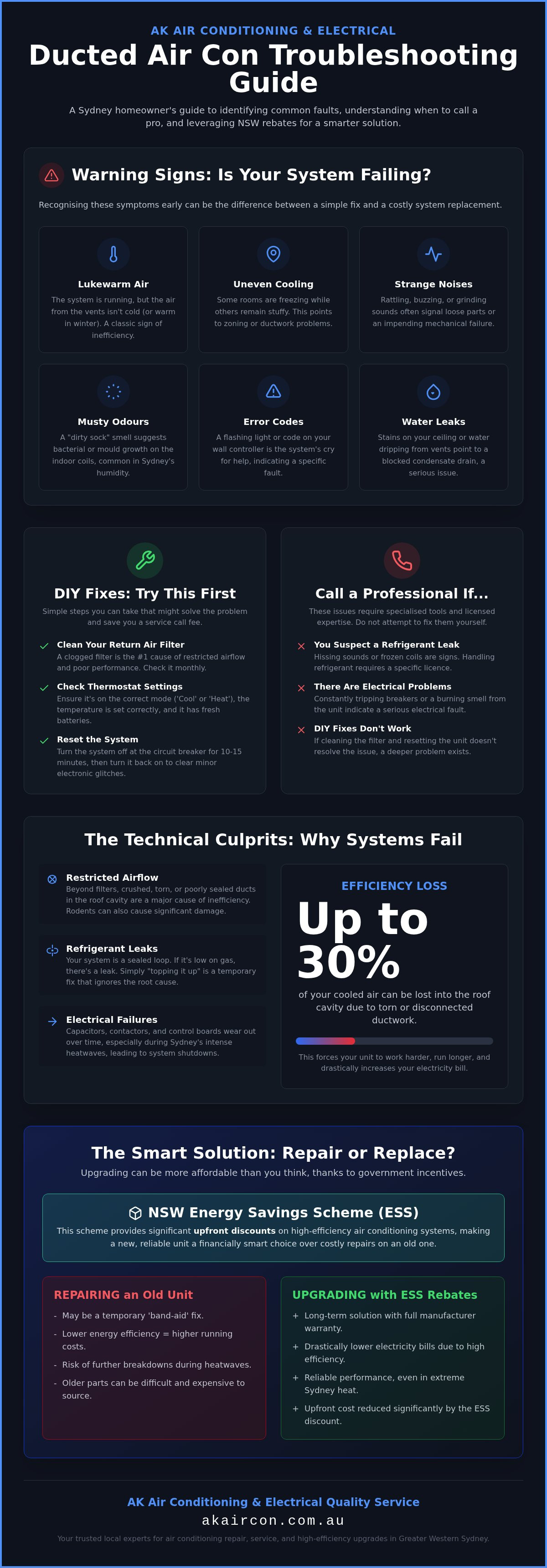
The Sydney Solution: NSW Rebates for Problem Systems
Persistent ducted air conditioning problems often signal that a system has reached the end of its economic life. If your unit is over 12 or 15 years old, the cost of specialized parts and labour for recurring repairs can quickly exceed the actual value of the hardware. Repairing a failing compressor on an aging model is frequently a case of throwing good money after bad. In these scenarios, the smartest "fix" isn't another service call, but a strategic upgrade that leverages current government incentives.
The NSW Peak Demand Reduction Scheme (PDRS) and the Energy Savings Scheme (ESS) were created to help Sydney homeowners transition to more efficient technology. These programs provide significant upfront discounts when you replace an old, energy-hungry unit with a modern high-efficiency system. Research indicates that high-efficiency ducted systems can attract discounts between A$1,000 and A$1,200 depending on the system type and size. This financial support makes the initial investment much more manageable while solving your reliability issues permanently.
Modern inverter technology is the cornerstone of these upgrades. Unlike old fixed-speed motors that constantly cycle on and off at full power, an inverter ramps its speed up or down to match the exact cooling requirement. This precision doesn't just improve comfort; it can slash Sydney electricity bills by up to 40%. When you factor in the reduced running costs and the upfront rebate, the return on investment for a new system often pays for itself much faster than you might expect.
Claiming Your NSW Air Conditioning Rebate
Claiming your rebate shouldn't be a headache for your family. Eligibility typically requires replacing an existing, inefficient air conditioner with a model that meets strict energy-performance standards. Our team at AK Air handles the complex eligibility checks and all the required installation paperwork on your behalf. Since the scheme rules were updated in September 2025 and expanded in July 2026 to include larger residential systems, 2026 has become the "Goldilocks zone" for Sydney residents to secure maximum value before any future policy shifts.
Upgrading to ActronAir or Daikin
Choosing the right replacement brand is vital for long-term peace of mind. We focus on the "Big Three" for Sydney conditions: Daikin, Mitsubishi Heavy Industries, and ActronAir. While all are world-class, ActronAir holds a distinct advantage for those living in Greater Western Sydney. Their hardware is Australian-designed to operate effectively in 50°C heat, whereas many imported units begin to throttle their performance once the temperature climbs past 43°C. To find out which system suits your home, you can use AK Air’s rebate eligibility check for a free assessment of your current setup.
If your system is struggling to keep up with the summer heat, don't wait for a total breakdown. Contact our team today to discuss how we can use the current NSW rebates to provide a more reliable, cost-effective cooling solution for your home.
The Installation and Repair Journey with AK Air
Every successful repair or installation starts with a meticulous site inspection. We don't simply look at your wall controller; we map your Sydney home’s specific heat load. This involves assessing window orientations, ceiling heights, and insulation quality to ensure the system is perfectly sized for your environment. We also carefully evaluate roof access, which is often a challenge in older Sydney terraces or modern townhouses. This level of detail ensures that the solutions we provide are permanent, rather than a temporary fix for recurring ducted air conditioning problems.
Intelligent airflow design is the key to solving the "hot room" dilemma common in many local households. Through custom zoning, we can direct the cooling exactly where it is needed, preventing the energy waste associated with cooling unoccupied spaces. Our "Quality Service" promise means we treat your home with respect. Our technicians arrive on time, work efficiently, and ensure that the installation site is left spotless. We understand that a clean, professional install is just as important as the technical performance of the unit itself.
Prevention is always more cost-effective than an emergency repair. By following a structured maintenance schedule, you can prevent 90% of future ducted air conditioning problems. Regular checks allow us to identify minor issues, such as a slightly worn fan belt or a small electrical surge, before they escalate into a total system failure during a February heatwave. A well-maintained system runs more quietly, uses less power, and provides a much longer service life for your investment.
Designing for Sydney Living
Multi-storey homes in Sydney present unique challenges because heat naturally rises. Upstairs bedrooms often require dedicated zoning and specialised sensor placement to remain comfortable without over-cooling the ground floor. We also pay close attention to noise compliance. Sydney councils are increasingly strict about decibel levels at boundary lines; we ensure your outdoor condenser is positioned and installed to meet all local regulations. The final step in our journey is "Commissioning", where we balance the entire system and test it under load to guarantee the long-term health of your reverse cycle unit.
Why Sydney Families Trust AK Air Conditioning & Electrical Quality Service
Our dual AC and Electrical expertise is a significant advantage for our clients. Because we hold both licences, we can perform complex fault finding on both the mechanical and electrical components of your system in a single visit. This makes our service faster, safer, and more comprehensive. We remain committed to premium, reliable brands including Daikin, Mitsubishi, and ActronAir, ensuring that every component we install is built to last. If you are ready for a more reliable home climate, you can organise your Sydney ducted air conditioning service or repair with AK Air Conditioning & Electrical Quality Service today.
Securing Long-Term Comfort for Your Sydney Home
Addressing ducted air conditioning problems doesn't have to be a source of ongoing stress for your family. Whether you've identified a simple filter blockage or a complex inverter fault, understanding the root cause is the first step toward restoring a reliable home climate. Modern systems from Daikin, Mitsubishi, and ActronAir offer superior performance in our local conditions, especially when paired with the financial incentives currently available through NSW energy rebate programs. Choosing the right path between a repair and a rebate-supported upgrade ensures your home remains efficient and cost-effective for years to come.
As licensed Sydney Electrical and HVAC contractors, we provide the dual expertise required to diagnose and resolve even the most stubborn faults safely. Our status as NSW energy rebate experts means we don't just fix your hardware; we help you maximise your financial savings. Book your free Sydney ducted aircon rebate eligibility check with AK Air today to see how a high-efficiency upgrade could slash your running costs. You deserve a home that remains a cool sanctuary through every Sydney summer, and we are ready to help you make that a reality.
Frequently Asked Questions
Why is my ducted air conditioning blowing warm air in summer?
If your unit blows warm air, it's usually due to a refrigerant leak or a failed compressor. Modern systems are sealed loops; they shouldn't lose gas unless there's a physical fault. Other ducted air conditioning problems causing this include blocked condenser coils or a thermostat accidentally set to "Fan" instead of "Cool". Because Western Sydney heatwaves put extreme pressure on hardware, these components are often the first to fail during peak summer months.
Is it cheaper to repair or replace my old ducted system in Sydney?
Replacing an old system is often more cost-effective if the unit is over 12 years old. While a repair might seem cheaper today, an aging system will likely face recurring faults and high running costs. In 2026, the NSW Energy Savings Scheme provides upfront discounts of up to A$1,200 for high-efficiency ducted upgrades. This incentive, combined with energy savings of up to 40% from modern inverter technology, typically delivers a much better long-term return.
How much does a typical ducted aircon repair cost in Sydney?
Industry labour rates for Sydney HVAC technicians typically range between A$80 and A$110 per hour in 2026. The total cost depends on the complexity of the fault and the specific parts required, such as a new inverter board or fan motor. While we don't provide exact figures without a site inspection, we always focus on transparency. Using a dual-licensed electrical and air conditioning specialist ensures the diagnosis is accurate, preventing the cost of unnecessary parts.
Can I claim the NSW air conditioning rebate for a repair?
No, the NSW air conditioning rebate is strictly for the supply and installation of new, energy-efficient systems. It's designed to reduce peak electricity demand by removing old, inefficient hardware from the grid. The incentive is applied as an upfront discount on your quote by an accredited provider rather than a cash-back payment for maintenance. If your current system is frequently breaking down, an upgrade is the only way to access these government-supported savings.
Why are some rooms in my house colder than others with ducted aircon?
Uneven temperatures are usually caused by poor zoning design or physical damage to the ductwork in your roof. If your master suite is freezing while the kitchen stays hot, the system's static pressure might be unbalanced, or a rodent may have chewed through a flexible duct. Professional heat load mapping and custom zoning are essential for Sydney homes with multiple levels or large open-plan areas to ensure consistent comfort across every room.
How often should I clean the filters in my ducted system?
You should clean your return air filters every three to six months to maintain optimal airflow. In leafier Sydney regions or areas with high construction activity, more frequent cleaning may be necessary to prevent dust buildup. Clogged filters are a primary cause of ducted air conditioning problems, as they force the fan motor to work harder, increasing your electricity consumption and eventually leading to icing on the indoor coils or a system lockout.
My ducted aircon is making a loud rattling noise; should I turn it off?
Yes, you should turn the system off immediately if you hear a loud rattling or grinding noise. These sounds often indicate a mechanical failure in the indoor fan motor or a loose component within the roof cavity ductwork. Continuing to run the unit could cause permanent damage to the compressor or result in a much more expensive repair. A quick inspection by a licensed technician can usually identify the source before a minor vibration becomes a major failure.
What is the best ducted air conditioning brand for Western Sydney heat?
ActronAir is widely considered the best brand for the extreme 50°C heatwaves often seen in Western Sydney. Unlike many imported units that struggle once temperatures exceed 43°C, ActronAir’s Australian-designed hardware is specifically engineered for our harsh climate. Daikin and Mitsubishi Heavy Industries are also excellent premium choices, offering exceptional reliability and sophisticated inverter technology that handles the fluctuating Peak Demand periods common across the NSW electrical grid.
Important Information
This article provides general information only. Air-conditioning requirements, installation costs, energy savings and rebate eligibility vary between properties and systems. NSW program rules, certificate values and eligible models may change. Contact AK Air Conditioning & Electrical Quality Service Pty Ltd for a property-specific assessment and confirmation of current eligibility before making a purchase or installation decision.


