

Choosing a Mitsubishi Electric split system Sydney homeowners can rely on starts with matching the system to the room and the way you use it. The model matters, but so do the indoor and outdoor unit positions, electrical requirements and layout of your property.
Product specifications are useful for comparing models, but they can’t show whether a proposed setup will work well in your space. A bedroom used overnight, a busy living area and a home office have different needs. The right choice should make sense on paper and suit the conditions at your home or business.
This guide explains which product details to compare and what a site assessment should consider before installation. AK Air Conditioning & Electrical Quality Service supplies and installs Mitsubishi Electric systems across Bankstown and surrounding Sydney suburbs. We connect product selection with practical site planning and licensed and compliant installation by licensed and insured technicians, helping you move from comparing models to planning a setup for your property.
Key Takeaways
- A split system is generally suited to one room or a defined area. Start by deciding which spaces you want to heat and cool.
- Compare current manufacturer specifications for the exact model, including capacity, controls and noise information.
- A larger-capacity unit isn’t automatically the right fit. The room, its layout and how you use it all matter.
- A site assessment helps plan indoor and outdoor unit positions, access and the requirements of your property.
- Choosing a Mitsubishi Electric split system Sydney homeowners can install with confidence starts with matching the system to the space and planning the installation locally.
Mitsubishi Electric Split System Sydney: Is It the Right Type of Air Conditioning for Your Space?
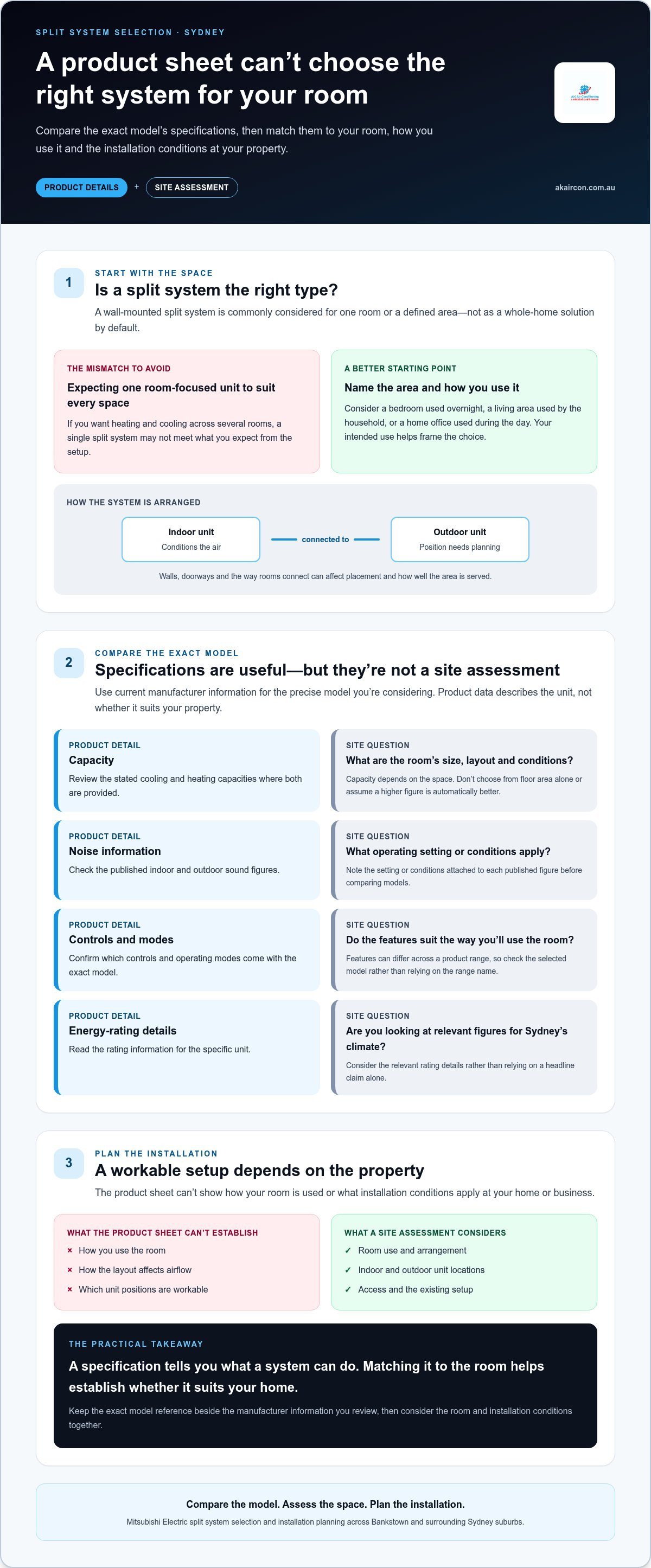
A split system has an indoor unit that conditions the air and an outdoor unit connected to it. A wall-mounted split system is commonly considered for one room or a defined area, rather than as a whole-home solution by default. If you want heating and cooling across several rooms, consider whether a single room-focused system meets your needs or whether a different setup would suit the property better.
Start with how you use the space. You might want to condition a bedroom overnight, a living area where the household spends time, or a home office used during the day. The layout matters as well: walls, doorways and the connection between rooms can affect where the indoor unit can go and how well the area is served. A brand name alone can’t determine whether a system suits your home.
When a wall-mounted split system may suit a Sydney property
A wall-mounted split system may suit you when your priority is one room or a clearly defined area. A Bankstown bedroom and a Parramatta living area, for example, can have different uses, layouts and placement options. Before settling on this system type, consider available wall space, the room arrangement and a suitable outdoor unit position. These details help connect your comfort needs with a workable installation plan.
Consider how the room connects to the rest of the home, too. An open living area relates to nearby spaces differently from a bedroom behind a door. This doesn’t settle the question on its own, but it helps clarify what you expect the system to do. Air conditioning systems come in different formats, and the right fit depends on the space and intended use, not just the product category.
What to understand before comparing Mitsubishi Electric systems
Specifications and features vary by model, so compare the current manufacturer information for the exact system you’re considering. Product data describes the unit, but it doesn’t establish whether it suits your property. A site assessment considers the room and installation conditions, including indoor and outdoor unit locations, access and the existing setup.
This distinction matters when you’re considering a Mitsubishi Electric split system Sydney home. A model’s listed capacity and features are useful comparison points, but they don’t replace an assessment of the room. Avoid choosing by product name alone or assuming one system will suit every space. AK Air Conditioning & Electrical Quality Service’s split system installation guide explains how installation planning fits into the process.
Before comparing models, note which room you want to condition, how you use it and what you expect from the system. This gives you a practical starting point for comparing manufacturer details and planning a site-specific setup with an installer.
How to Read Mitsubishi Electric Split System Specifications Without Guessing
A product name can help you find a system, but it won’t tell you whether it suits your room. Compare current manufacturer specifications for the exact model and treat each figure as a guide to the unit’s stated performance, not as a recommendation for your home.
Which product details should you compare?
Capacity describes how much heating or cooling a system is designed to provide. The right capacity depends on the space and its conditions, so don’t choose from floor area alone or assume that a higher figure is automatically better. An installer’s assessment can help relate the manufacturer’s data to the actual room.
For a useful comparison, check these details in the manufacturer’s current product information:
- Capacity: Review the stated cooling and heating capacities. Compare both where the selected model’s specifications provide them.
- Noise information: Check the published indoor and outdoor sound figures. Note the operating setting or conditions each figure relates to.
- Controls and modes: Confirm which controls and operating modes come with the exact model. Features can differ across a product range.
- Energy-rating details: Read the rating information for the specific unit and consider the relevant figures for Sydney’s climate, rather than relying on a headline claim alone.
Keep the model reference beside the information you review. Similar product names don’t guarantee identical specifications, and manufacturers can update their ranges. Check the latest manufacturer material before making a decision.
Why the product sheet cannot assess your installation site
A specification sheet describes the equipment. It can’t show how you use the room, how its layout affects airflow or what installation conditions apply at your property. A room used mainly for sleeping may bring different priorities from a living space used throughout the day. Wall construction, access and possible unit positions also need to be considered separately from the unit’s published figures.
A specification tells you what a system can do; matching it to the room helps establish whether it suits your home. This distinction prevents a product comparison from turning into guesswork and gives you a clearer basis for discussing model options and site requirements with an installer.
AK Air Conditioning & Electrical Quality Service supplies and installs Mitsubishi Electric systems across Sydney. To discuss how the product details relate to your property, request an installation assessment.
Mitsubishi Electric Split System Sydney: What to Compare Before You Commit
A recognised brand can be a starting point, but it can’t determine which system suits a particular room. Compare the exact model’s current specifications with how you use the space and the conditions at your property. The Mitsubishi Electric split system Sydney homeowners choose should suit the intended room and installation site, not just look suitable in a catalogue.
Compare the system with the room and household routine
Think about who uses the room and when. A bedroom may be occupied mainly overnight, while a living area might be used by several people at different times. A small business may have staff, customers or equipment that affect how the space is used. Room dimensions are a useful starting point, but they don’t cover every factor that can shape a site assessment.
Use the table to organise your priorities, then compare manufacturer information for the models you’re considering. A larger capacity isn’t automatically a better choice. Capacity needs to be considered alongside the space and installation conditions; choosing by size alone can overlook what matters about your room.
Brand choice versus a suitable installation
Choosing Mitsubishi Electric answers a brand preference, not every question about model selection or placement. Mitsubishi Electric and Mitsubishi Heavy Industries are separate brands, so comparing them is different from matching a specific system to a specific site. If you’re weighing up those brands, the existing comparison article can help with that part of your research.
Installation planning belongs in the decision too. Indoor unit position, outdoor unit location and access can affect which setup is practical at your property. AK Air Conditioning & Electrical Quality Service connects product selection with site-specific split-system planning, taking the comparison beyond catalogue details to the conditions at your home or business.
Planning a Mitsubishi Electric Split System Installation Across Sydney
A well-planned installation connects your system choice with the conditions at your property. The process moves from understanding the space to assessing the site, selecting a suitable system and planning the installation. For a Mitsubishi Electric split system Sydney home or business, this accounts for practical details a product listing can’t show, including unit positions, access and the existing setup.
- Discuss the space. Explain which room you want to condition, how it’s used and what you need from the system. Mention anything that could affect placement, such as a preferred wall or nearby outdoor area.
- Assess the site. A qualified professional considers the room layout, possible indoor and outdoor unit positions, access and the property’s existing setup. They also assess the electrical and installation requirements.
- Select a system. Use the room’s intended use and assessment findings alongside current manufacturer specifications to identify a suitable option.
- Plan the installation. Confirm proposed unit locations and practical arrangements before work begins, so the plan reflects the property rather than an assumption based on a product page.
What a site assessment should take into account
The assessment starts with the room, including its use, layout and possible indoor unit positions. The outdoor unit also needs a suitable location, and access varies between properties. A home in Bankstown may have different placement and access conditions from a Revesby unit or a Liverpool business. The assessment establishes what is practical at each property.
Existing conditions matter. The installer reviews the setup already in place and considers the electrical and installation requirements for the proposed system. This is a professional assessment, not a decision based only on room dimensions or your preferred unit position. If the property has access or placement constraints, those can inform the installation plan and system selection.
How professional installation supports a considered choice
Product selection and installation planning work together. AK Air Conditioning & Electrical provides licensed and compliant installation, with licensed and insured technicians carrying out the relevant work. This connects your system choice to site conditions, rather than treating installation as a separate detail after you’ve chosen a model.
AK’s split-system installation service includes supply and installation. A site-specific assessment then helps shape the plan around your property and the room you want to condition.
Arrange Mitsubishi Electric Split System Supply and Installation in Sydney
After comparing product details, connect your preferred direction with the conditions at your property. AK Air Conditioning & Electrical supplies and installs Mitsubishi Electric air-conditioning systems, with installation planning shaped around the space and site. This helps you move from comparing options to discussing what may suit your home or business.
AK serves Bankstown and nearby Sydney suburbs, including Yagoona, Greenacre, Punchbowl, Bass Hill, Condell Park, Revesby, Padstow, Panania, Chester Hill, Auburn, Parramatta, Liverpool, Fairfield, Strathfield, Campsie, Blacktown, Seven Hills and Lalor. Whether you’re a homeowner, landlord or property manager, a few details about the property give the assessment a useful starting point. You don’t need to settle every technical choice before getting in touch.
What to share when requesting an assessment
Describe the property and the room you want to condition. Explain how you use the space and what you’d like the system to do. If you’re arranging work for a rental or managed property, include any practical access arrangements or preferences relevant to the site.
Include known constraints, such as limited space for an outdoor unit or restricted access to a proposed installation area. Mention any existing air-conditioning equipment, too. These details help frame the discussion, but they don’t replace a site assessment or settle the final system choice in advance.
- Property type and suburb
- Room or area to be conditioned, and its usual purpose
- Known access or placement constraints
- Any existing air-conditioning equipment relevant to the proposed work
With this context, a qualified professional can assess the site and discuss a suitable next step. The final model and installation plan should be based on the property and its requirements.
A local next step for Sydney homeowners and property managers
AK supplies and installs Mitsubishi Electric systems, with licensed installation. This gives you a local business to connect product selection with the installation process. The assessment can account for your property’s requirements rather than relying on product information alone.
If you’re arranging a new system or planning an upgrade, bring your room details and questions about the proposed setup to the conversation. AK works across Bankstown and nearby Sydney areas, including Parramatta and Liverpool, supporting local homeowners and property managers as they plan split-system installations.
For an assessment or quotation for your property, contact AK Air Conditioning & Electrical.
Take the Next Step Towards a Setup That Fits
A Mitsubishi Electric split system Sydney decision is easier when you treat the assessment as a planning conversation, not a test of your product knowledge. You don’t need to arrive with a model chosen. Instead, consider which room matters most, how you use it through the day and any practical preferences you’d like included in the plan.
If household members, tenants or staff also use the space, consider their priorities. A short shared list can help clarify what matters and guide a discussion about what will suit the property. This gives you a useful basis for weighing up options without relying on a product name or feature list alone.
Start with the details you already have, then refine the plan through a professional discussion. A considered setup begins with a clear sense of what matters to you.
Contact AK Air Conditioning & Electrical to plan a Mitsubishi Electric split-system installation for your property.
Frequently Asked Questions
Is a Mitsubishi Electric split system suitable for a Sydney home?
It may suit your home, but suitability depends on the room, property layout, selected model and installation conditions. A system planned for a bedroom may need a different assessment from one planned for a frequently used living space. Compare current manufacturer specifications, then arrange a site-specific assessment. The brand name alone can’t establish that a particular model will suit every Sydney property.
Can a Mitsubishi Electric split system provide both heating and cooling?
Some models can provide both, but reverse-cycle capability depends on the exact unit. In a reverse-cycle system, the same equipment can heat or cool a space by transferring heat in different directions. Check the current manufacturer specifications for the model you’re considering rather than assuming all models have the same functions. A professional can also consider whether the system’s stated capabilities suit your room and intended use.
How do I choose the right Mitsubishi Electric split system capacity?
Choose capacity in relation to the room and how you use it, not from floor area alone. A room’s shape, connection to adjoining spaces and regular use can all affect the assessment. Start by comparing the capacity in current product specifications, then discuss your space with an installer. There isn’t a universal capacity formula or model recommendation that fits every property.
Can I replace an existing split system with a Mitsubishi Electric system?
Replacement may be possible, but the new model and installation plan need to suit your property. Don’t assume the existing equipment, pipework or electrical arrangements will transfer unchanged. A different model or unit position may affect the installation work. A professional assessment of the existing system and site is the practical first step before deciding on a replacement.
Does every Mitsubishi Electric split system qualify for a NSW air-conditioning rebate?
No. Not every property or system qualifies. Eligibility and customer benefit depend on the property, location, installation type, system model and current program requirements. Check current NSW Government information about the Energy Savings Scheme before making a decision, and don’t assume approval. For more background, consult the related NSW air-conditioning rebate guide and have eligibility assessed against current scheme rules.
How often should a Mitsubishi Electric split system be serviced?
Follow the service guidance for your exact model and consider how often the system runs and its condition. Keep routine user care, such as following the manufacturer’s cleaning instructions, separate from work that needs a technician. If the system develops an issue or needs professional attention, AK’s air-conditioning service and repair information explains the support available.
Important Information
This article provides general information only. Air-conditioning requirements, installation costs, energy savings and rebate eligibility vary between properties and systems. NSW program rules, certificate values and eligible models may change. Contact AK Air Conditioning & Electrical Quality Service Pty Ltd for a property-specific assessment and confirmation of current eligibility before making a purchase or installation decision.


