
What if an installer holds a licence, but it doesn’t cover every part of the job? Choosing a licensed air conditioning installer NSW residents can trust means looking beyond a directory listing. The licence needs to match the work, and refrigerant handling has its own national credentials.
It’s reasonable to want clear answers before arranging an installation, especially if refrigerant work or new electrical work is involved. NSW’s licensing framework can seem complicated, but you can make a more informed decision by checking which credentials apply to the tasks in your project.
This guide explains the difference between a NSW Fair Trading licence and an Australian Refrigeration Council refrigerant-handling licence, where electrical compliance fits in, and how to check credentials through official channels. You’ll also learn what to clarify for a split system, multi-split or ducted installation.
AK Air Conditioning & Electrical Quality Service installs air conditioning systems for homes and businesses in Bankstown and surrounding Sydney suburbs. We consider the property, the work involved and compliance requirements so you can discuss your installation with a clear understanding of the next steps.
Key Takeaways
- A licensed air conditioning installer NSW homeowners choose should hold credentials that match the work being performed.
- Check what each licence or credential covers rather than relying on a directory listing or a general claim.
- The right system and installation approach depend on the property, site conditions and project requirements.
- AK Air Conditioning & Electrical Quality Service installs split, multi-split and ducted systems for homes and businesses in Bankstown and nearby Sydney suburbs.
- Knowing what to ask about the installation can help you prepare for a clear discussion about your property and air conditioning needs.
Why a licensed air conditioning installer matters in NSW
An air conditioner is a significant installation, and the work needs to suit the property. A system may be split, multi-split or ducted, but installing and connecting it involves work covered by NSW licensing requirements. A licensed air conditioning installer NSW customers engage should hold a NSW licence or certificate that covers the tasks they’ll perform.
Licensing gives you a practical starting point for understanding who is authorised to carry out regulated air conditioning and refrigeration work. It can also help clarify responsibility for work that may involve associated electrical wiring. A credential isn’t a promise of perfect workmanship or a particular result, but checking that it matches the task helps you make a more informed decision.
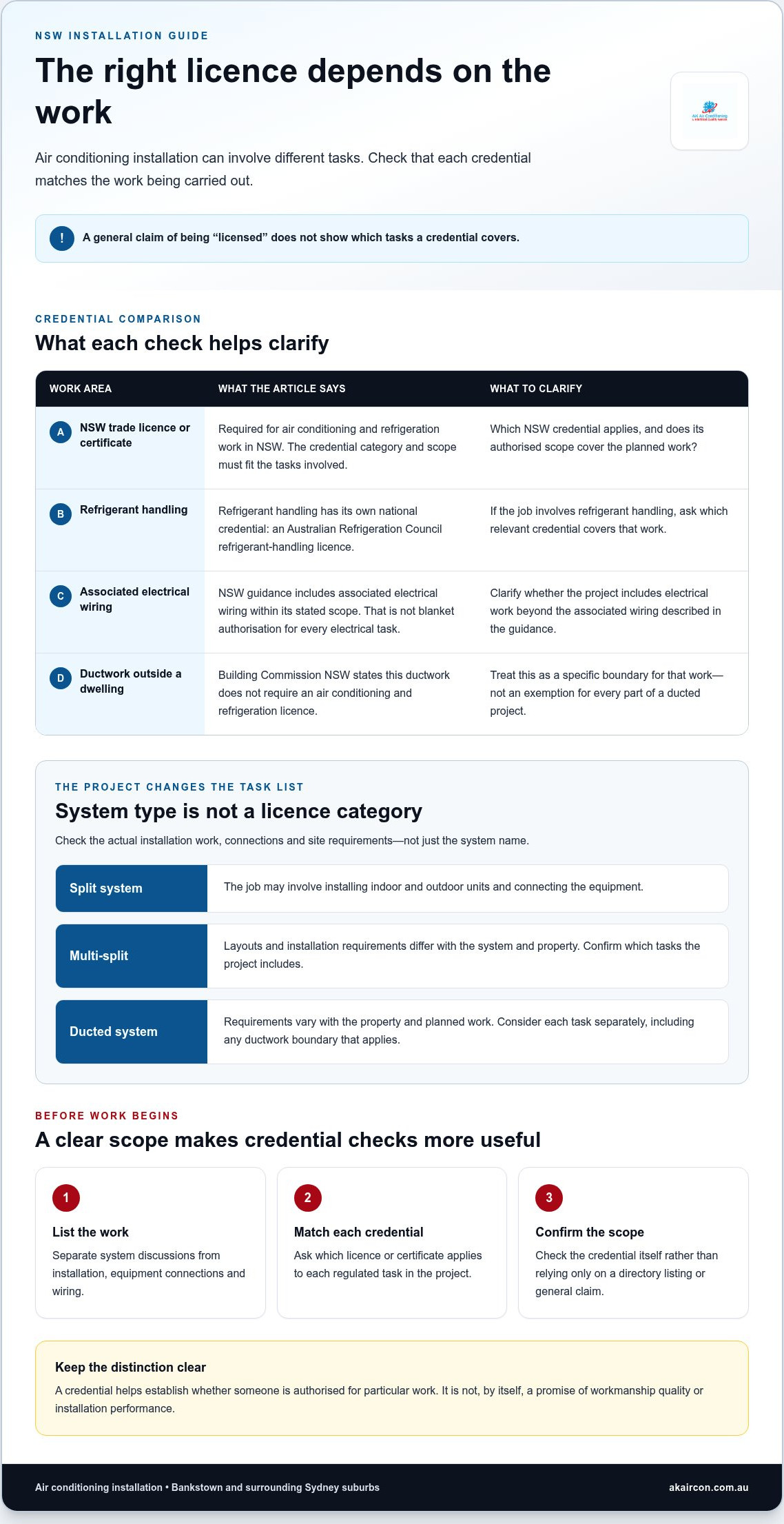
Building Commission NSW states that a licence or certificate is required to carry out air conditioning and refrigeration work in NSW. The applicable category depends on the scope of the work. A general claim of being “licensed” doesn’t, by itself, tell you which tasks the credential covers.
Which air conditioning work needs a NSW licence or certificate?
NSW Government guidance requires an appropriate licence or certificate for air conditioning and refrigeration work, including relevant installation, maintenance and servicing. It identifies a narrow exception for self-contained, single-phase plug-in domestic air conditioners. The guidance also includes associated electrical wiring within its stated scope. The exact credential category matters: the work being done must fit its authorised scope.
For your project, separate the system discussion from the work itself. Talking through system options or possible locations is not the same as carrying out installation work, connecting equipment or completing associated wiring. If a project involves electrical tasks beyond the stated scope of an air conditioning credential, the relevant electrical authorisation requirements also matter.
What can licensing mean for your installation?
For a split system, the job may involve installing indoor and outdoor units and connecting the equipment. Multi-split and ducted projects have different layouts and installation requirements, so the tasks can vary with the property and system. A split system installation should be considered in relation to the work planned, not just the equipment name.
Understanding how air conditioning works can help explain why equipment, connections and site conditions matter. General information doesn’t replace the right trade credentials. Licensing applies to regulated work, not every conversation about comfort, room coverage or possible placement.
Before work begins, clarify what the proposed job includes and which parts involve regulated installation or wiring. This gives you a clearer basis for checking the relevant licence category and understanding how the project will be handled. Licensing supports compliance and informed decisions, but it doesn’t, on its own, guarantee the quality or performance of an installation.
NSW air conditioning licence requirements: understand the work scope
For a planned installation, the useful question isn’t simply whether someone says they’re licensed. It’s whether their NSW credential covers the tasks in your project. Building Commission NSW guidance distinguishes air conditioning and refrigeration work from other building work, and the relevant licence or certificate depends on the category and scope of the work.
In plain terms: A NSW air conditioning and refrigeration licence or certificate is a state credential for specified air conditioning and refrigeration work. It is not a blanket authorisation for every trade, every electrical task or all mechanical services work.
Key principle: Building Commission NSW guidance makes clear that the licence must match the work being carried out. A general claim of being licensed doesn’t establish that a credential covers a particular task.
Air conditioning, refrigeration and mechanical services are not identical scopes
These areas can overlap, but their licence scopes aren’t interchangeable. NSW guidance recognises an overlap between air conditioning and refrigeration work and some mechanical services work. Work outside that overlap may call for a separate, relevant licence. This distinction matters if an installation includes building services beyond the air conditioning system itself.
There’s also a specific boundary for ductwork: Building Commission NSW states that duct work outside a dwelling does not require an air conditioning and refrigeration licence. That point relates to the licence requirement for that work. It doesn’t mean every other part of an air conditioning project is exempt. Consider the actual tasks rather than treating “ducted” as a single licence category.
Associated electrical work and other credentials
NSW licensing guidance includes associated electrical wiring within the stated scope of air conditioning and refrigeration work. That doesn’t mean the credential authorises every kind of electrical work. The tasks and applicable authorisation still matter, particularly if a project involves electrical work beyond the associated work described in the guidance.
Keep state licensing separate from refrigerant credentials. The NSW licence or certificate relates to the relevant trade work in NSW. The Australian Refrigeration Council (ARC) administers national refrigerant-handling licensing. That credential addresses refrigerant handling and does not replace NSW licensing or any separate electrical authorisation that may apply.
For example, a split, multi-split or ducted installation may involve several tasks, and credentials should be considered against each task’s scope. A broad label such as “licensed installer” doesn’t tell you which categories or activities are covered. A more useful check is to identify the proposed work, then compare it with the relevant licence or certificate category in official NSW guidance.
AK Air Conditioning & Electrical plans installations around the site, the work required and compliance. If you’re planning an installation and want to discuss the project, contact our Sydney team.
How to assess licensing and credentials for an air conditioning job
Credentials are easiest to understand when you match each one to the task it covers. A NSW trade licence or certificate, a national refrigerant-handling licence and electrical authorisation relate to distinct areas of work. Don’t treat one credential as proof that every part of an installation is covered.
| Credential | What it relates to | What to keep in mind |
|---|---|---|
| NSW air conditioning and refrigeration licence or certificate | Specified air conditioning and refrigeration work under NSW requirements. | The category and scope need to fit the work being performed. |
| ARC refrigerant-handling licence | Handling fluorocarbon refrigerants under the national framework administered by the Australian Refrigeration Council. | It is separate from a NSW trade licence or certificate. |
| Electrical authorisation | Electrical work, subject to the applicable NSW requirements and the scope of any relevant trade credential. | Associated electrical wiring appears in NSW air conditioning and refrigeration licensing guidance, but that shouldn’t be read as blanket authority for all electrical work. |
NSW licence or certificate versus refrigerant credentials
These credentials aren’t interchangeable approvals. Building Commission NSW describes the state licence or certificate for relevant air conditioning and refrigeration work. The Australian Refrigeration Council administers national refrigerant-handling licences. If a job involves handling refrigerant, the relevant national credential applies to that work; it doesn’t replace the NSW requirement for the trade work.
That distinction helps make sense of a licensed air conditioning installer NSW claim. The useful detail is which credential applies to the tasks in your proposed installation, not simply whether a profile displays a licensing label. Any explanation of air conditioning electrician licensing in Sydney should also distinguish NSW trade requirements from other credentials.
Electrical work and a licensed installation
NSW guidance includes associated electrical wiring in the stated scope of air conditioning and refrigeration licensing. It doesn’t mean that credential covers every electrical task. The work planned and the relevant authorisation both matter, so don’t treat a single licence as general approval for all work around a property.
AK Air Conditioning & Electrical considers the site and work scope when planning an installation. For a split system air conditioning installation, the tasks involved depend on the project. Considering the proposed work alongside the relevant credentials gives you a clearer picture of how the installation is intended to proceed.
What to expect from an air conditioning installation in Bankstown and Sydney
A well-planned installation starts with the property, not a one-size-fits-all system. The rooms you want to cool or heat, how you use the space and the building’s layout all help shape the options. AK Air Conditioning & Electrical works with residential and commercial customers across Bankstown and surrounding Sydney suburbs.
From site needs to an installation plan
The process starts with your requirements and the details of the site. Explain what you need, then discuss an installation plan that takes account of the property and work involved.
- Discuss the site. Explain whether the project is for a home, rental property or small business, which areas need air conditioning, and any relevant preferences or site considerations.
- Assess the requirements. The property layout and intended use help determine what type of system may suit the project. A single room may call for a different approach from several rooms or a whole home.
- Plan the system and installation. The proposed system and installation approach are tailored to the property. A split system may suit a particular room, while a multi-split can serve multiple areas. For whole-home coverage, ducted air conditioning installation may be considered as part of the project plan.
- Complete the installation. The installation follows the agreed scope, with attention to the site and relevant compliance requirements.
Each property is different. The appropriate system and installation details depend on the building and project, so a plan for a compact home won’t necessarily suit a larger residence or a business with different room-use needs. If you’re exploring a room-based option, this split system installation guide for Sydney homes can help you understand the service in context.
This step-by-step approach makes it easier to discuss what the installation includes before work proceeds. It keeps the focus on the job at hand: the site, system choice, installation scope and compliance. A licensed air conditioning installer NSW customers engage should consider the actual project rather than assume one system or installation method suits every building.
Local service across Bankstown and nearby suburbs
AK serves homes and businesses in Bankstown and surrounding suburbs, including Yagoona, Greenacre, Punchbowl, Bass Hill, Condell Park, Revesby, Padstow, Panania, Chester Hill, Auburn, Parramatta, Liverpool, Fairfield, Strathfield, Campsie, Blacktown, Seven Hills and Lalor. A homeowner may be planning air conditioning for a living area, a landlord may be arranging an upgrade for a rental property, or a small business may need a system suited to its working space. In each case, the property and intended use guide the installation discussion.
To make the first conversation useful, describe the building, the rooms or areas involved, and whether you’re considering a split, multi-split or ducted system. That gives the team a clear starting point for discussing the project and site requirements.
Book a licensed air conditioning installer with AK in Sydney
AK Air Conditioning & Electrical Quality Service Pty Ltd provides residential and commercial air conditioning installation across Sydney, with a local base in the Bankstown area. If you’re arranging a new system for your home, rental property or business, AK can plan an installation around the property and the work involved.
Services include split, multi-split and ducted air conditioning systems. The right option depends on the building, the areas you want conditioned and your project requirements. AK’s service strengths include licensed and insured technicians and licensed and compliant installation, with attention to the site and relevant work scope.
Installation support for homes, rentals and businesses
A home may need a system for one room, several areas or broader whole-home coverage. A rental property may have different layout and use considerations, while a small business needs an approach suited to its premises. AK discusses the property and installation requirements so the proposed system and work can be considered in context.
A split system may suit a single area; multi-split systems can serve multiple indoor areas, while ducted systems can be considered for whole-home or broader coverage. These are different installation approaches, and the property helps determine which one fits the project. You can review AK’s air conditioning supply and installation services as you consider the available system types.
AK serves Bankstown and nearby Sydney communities, including Yagoona, Greenacre and Revesby. Keeping the conversation focused on your building, intended use and system preference helps make the next steps relevant, whether you’re a homeowner, landlord, property manager or small-business operator.
Take the next step with a local team
To start a useful discussion, describe the property and its location, the rooms or areas involved, and whether you’re considering a split, multi-split or ducted system. If you already have a preferred system type or know what you want the installation to address, include that too. These details give the team a clear starting point for discussing the project and site requirements.
As a licensed air conditioning installer NSW customers can engage for residential and commercial projects, AK plans installations with attention to licensing, compliance and the property itself. The proposed work and system remain specific to the job, rather than a one-size-fits-all package.
Make your installation plans with confidence
Your next step can be a clearer conversation about the work your property needs. Before requesting an assessment, note the areas you want conditioned, whether the building is a home or business, and any system type you’re considering. This gives the discussion a practical starting point and helps keep the proposed work in focus.
As you plan, treat “licensed” as a question of scope, not just a label. A licensed air conditioning installer NSW customers engage should have credentials relevant to the work being undertaken. A clear explanation of the proposed tasks can help you understand how licensing and installation planning relate to your project.
AK Air Conditioning & Electrical can discuss your property and installation requirements with you. Bring your questions, even if you’re still weighing up the options. A considered first conversation is a useful step towards planning an installation that suits your space.
With the right information and a clear plan, you can move forward feeling more prepared.
Frequently Asked Questions
How can I check whether an air conditioning installer is licensed in NSW?
Use the official Service NSW “Check a builder or tradesperson licence” tool to look up the licence details. Search by the individual’s or business’s name, or by licence number, then review the licence status and class. Check that the category relates to the work planned rather than relying only on a directory profile or a general statement that an installer is licensed. For refrigerant handling, check the relevant ARC credential separately.
Is an ARC-related credential the same as a NSW air conditioning licence?
No. They cover different requirements. A NSW air conditioning and refrigeration licence or certificate relates to specified trade work in NSW, while an Australian Refrigeration Council (ARC) refrigerant-handling licence applies to handling regulated refrigerants under the national framework. If a job involves refrigerant work on an air conditioning system, the national credential is relevant, but it doesn’t replace the applicable NSW trade credential.
Does an air conditioning licence cover all mechanical services work in NSW?
No. A NSW air conditioning and refrigeration credential doesn’t automatically authorise all mechanical services work. Some work categories overlap under NSW guidance, but the scope is limited to the work described for that credential. If a project includes other mechanical services, such as building services beyond the air conditioning work, a separate licence may be relevant. The specific task and current official category guidance determine what applies.
Does ductwork require an air conditioning licence in NSW?
Not all ductwork is treated the same under NSW guidance. Building Commission NSW states that duct work outside a dwelling doesn’t require an air conditioning and refrigeration licence. That statement is limited to that work category; it doesn’t establish that other tasks in a ducted installation are exempt. For a project involving ductwork, consider its location and the full work scope, including associated installation tasks.
Are air conditioning licence requirements the same across Australia?
No, state and territory trade licensing requirements can differ, so a credential relevant in NSW shouldn’t be assumed to cover trade work elsewhere. Refrigerant handling is covered by a national framework administered by the ARC, but that doesn’t replace local trade or electrical requirements. If you’re planning work outside NSW, check the relevant state or territory regulator’s current rules as well as any national refrigerant credential requirements.
What information should I provide when requesting an air conditioning installation assessment?
Give the installation team the property’s suburb, whether it’s a home, rental or business, and which rooms or areas need air conditioning. Mention whether you’re considering a split, multi-split or ducted system, and whether an existing unit is being replaced. If you know of access limits or relevant layout details, include those too. This helps frame an assessment around the property and the work you have in mind.
Important Information
This article provides general information only. Air-conditioning requirements, installation costs, energy savings and rebate eligibility vary between properties and systems. NSW program rules, certificate values and eligible models may change. Contact AK Air Conditioning & Electrical Quality Service Pty Ltd for a property-specific assessment and confirmation of current eligibility before making a purchase or installation decision.


