
What if the most expensive split system aircon on the market actually ends up costing you more over time because it isn't built to handle Sydney's specific mix of coastal salt air and Western suburbs heatwaves? Many homeowners find themselves stuck with units that groan under the pressure of a 40 degree day, leading to astronomical power bills and restless, humid nights. It's a common frustration to feel like you're paying for a premium service but receiving inconsistent cooling and a noisy outdoor compressor that keeps the whole street awake.
We understand that choosing the right cooling solution is about more than just picking a brand name. It's about securing long-term reliability and quiet, year-round comfort for your family. This guide breaks down the top-performing units for 2026, focusing on energy efficiency, real-world cooling power, and overall value. We will compare industry leaders like Daikin and Mitsubishi Heavy Industries, while explaining how the latest NSW energy rebates can significantly reduce your initial investment. By the end, you'll know exactly which system will keep your home at the perfect temperature while keeping your quarterly expenses under control.
Key Takeaways
- Understand why reverse cycle technology is the most reliable way to manage Sydney's unpredictable weather while keeping your home comfortable in every season.
- Discover how a correctly sized split system aircon can slash your quarterly power bills and prevent the common mistake of overspending on unnecessary capacity.
- Compare the unique advantages of premium brands like Daikin and Mitsubishi Heavy Industries to find the perfect balance of air purification and quiet operation.
- Learn how to navigate the 2026 NSW Energy Savings Scheme (ESS) to secure upfront discounts on high-efficiency cooling upgrades for your home.
- Identify the hidden factors in a standard installation quote to ensure your new unit is fitted safely and maintains its full manufacturer warranty.
Why Split System Aircon is the Top Choice for Sydney Living
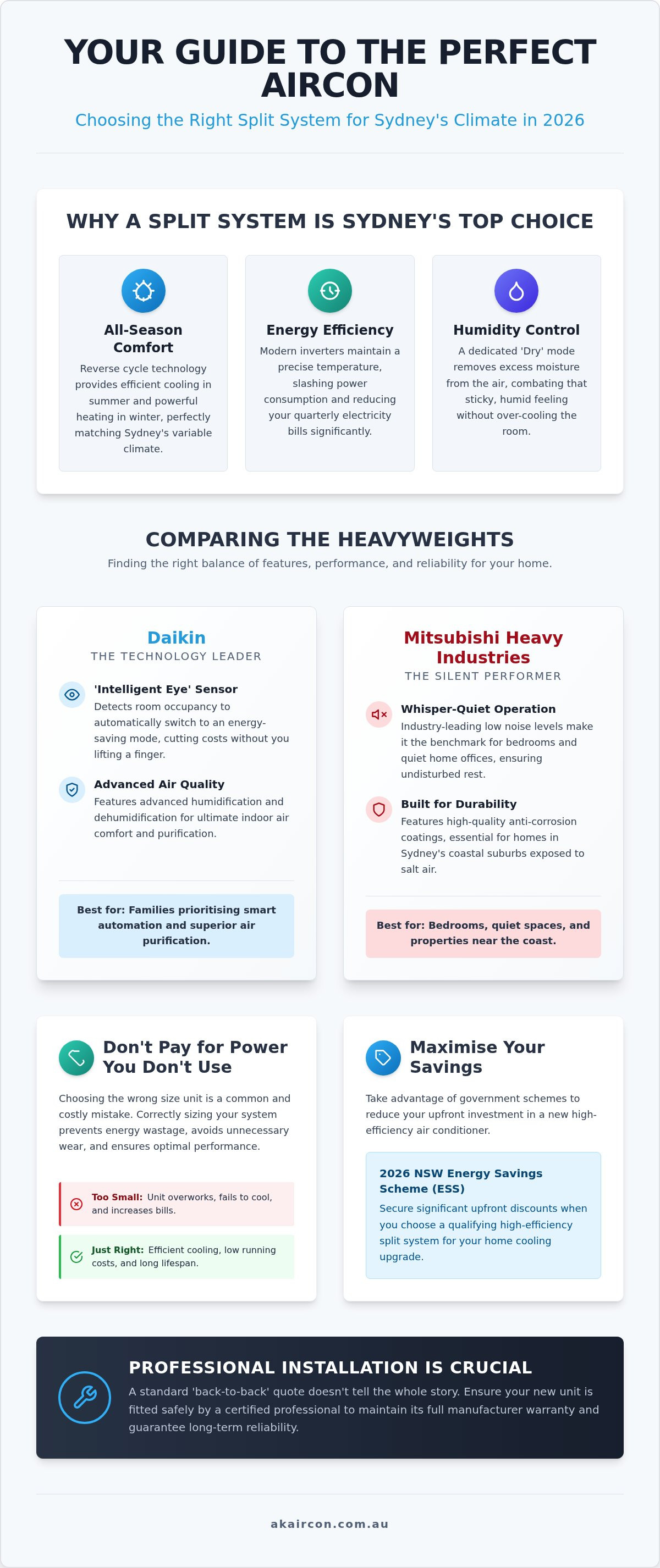
Sydney homes face a unique set of challenges. From the salt spray along the Northern Beaches to the intense, dry heat of Penrith, a standard cooling fan simply won't cut it. A split system aircon provides a tailored solution by physically separating the noisy, heat-generating compressor from the sleek indoor unit. Understanding what a split system air conditioner is helps clarify why it's so quiet; the part that does the heavy lifting sits outside, while you enjoy a near-silent breeze indoors. This design is particularly beneficial for Sydney's high-density living. Whether you're in a Surry Hills terrace or a modern Parramatta apartment, these units save valuable floor space while delivering powerful climate control.
Modern inverter technology has revolutionised how we stay cool. Older fixed-speed units operated like a light switch, being either 100% on or completely off. This created uncomfortable temperature swings and wasted significant energy. Modern inverters work more like a car's accelerator, slowing down or speeding up to maintain a precise temperature. This shift significantly reduces power consumption, helping you manage those rising quarterly bills while maintaining a consistent indoor environment.
Reverse Cycle Benefits: Cooling in Summer, Heating in Winter
Sydney's climate is famously variable. We often experience blistering February afternoons followed by surprisingly crisp July mornings. Reverse cycle technology uses a heat pump to move thermal energy rather than creating it through resistance. In winter, it extracts heat from the outdoor air to warm your lounge room. This process is far more efficient than using electric bar heaters. Another essential feature for Sydney is the dedicated dehumidification mode. During those sticky late-summer days, your split system aircon can strip moisture from the air without over-cooling the room, preventing that heavy, humid feeling indoors.
Wall-Mounted vs. Floor-Standing Units
Most Sydney residents opt for wall-mounted units because they sit high and out of the way, blending into modern interior designs. However, floor-standing models are a smart choice for specific home layouts. If you have limited wall space due to large windows or high, raked ceilings, a floor-standing unit provides easier access and excellent heating performance, as heat naturally rises from the floor level. Both styles offer adjustable louvres to customise airflow patterns. This ensures the air circulates evenly throughout the room rather than blowing directly onto you, which is vital for maintaining comfort during long periods of use.
Comparing the Heavyweights: Daikin vs. Mitsubishi vs. ActronAir
Choosing the right split system aircon involves looking beyond the sticker price. In Sydney, your ideal unit often depends on whether you're battling the salt air of the Northern Beaches or the intense, dry heat of the Western suburbs. While brands like Samsung and Fujitsu offer excellent smart integration and competitive pricing, three specific manufacturers consistently lead the market in terms of long-term reliability and performance under local conditions.
Daikin: The Technology Leader
Daikin remains a top tier choice for Sydney residents who prioritse air quality and automation. Their US7 series is particularly impressive, offering advanced humidification and dehumidification that many competitors lack. One of their standout features is the 'Intelligent Eye' sensor. This technology detects movement in a room; if you leave the lounge for more than 20 minutes, the unit automatically switches to an energy-saving mode. Once you return, it resumes your preferred settings. This feature is a significant advantage for families who want to lower power bills without constantly managing the remote. Because of their extensive dealer network, finding parts or specialised support across Sydney is generally straightforward.
Mitsubishi Heavy Industries: The Silent Performer
If you're looking for a unit to install in a bedroom or a quiet home office, Mitsubishi Heavy Industries (MHI) is often the benchmark. They're renowned for industry-leading quietness, ensuring your sleep isn't interrupted by a humming compressor. Beyond the silence, MHI units are built with a focus on durability. Their outdoor units often feature high quality anti-corrosion coatings, which is essential if you live within five kilometres of the coast where salt spray can quickly degrade cheaper components. The controls are simple and intuitive, making them a reliable choice for those who want a system that just works without a steep learning curve.
ActronAir: Engineered for the Australian Heat
ActronAir is an Australian-owned company that designs its systems specifically to handle our harsh environment. While some international brands struggle when the mercury hits 40 degrees, many ActronAir units are engineered to operate effectively in temperatures as high as 50 degrees. This makes them a superior choice for Western Sydney heatwaves. Because they're designed and often manufactured locally, their support teams understand the specific challenges of the NSW climate. If you're unsure which brand suits your home's specific layout or suburb, our team can provide expert guidance on split system air conditioning supply & installation to ensure you get the best value for your investment.
Maximising Savings with NSW Air Conditioning Rebates
Upgrading your home's climate control is a significant investment, but the initial cost shouldn't be a barrier to comfort. The NSW Government's Energy Savings Scheme (ESS) provides a practical pathway for Sydney households to transition away from old, power-hungry appliances. By replacing an inefficient unit with a modern, high-efficiency split system aircon, you can access upfront discounts that make the switch much more affordable. This incentive is designed to reduce overall pressure on the NSW power grid while helping families manage their cost of living. These are not cashback rebates; the value is applied as a discount on your quote by an Accredited Certificate Provider (ACP).
To qualify for these savings, the new unit must meet strict energy performance standards. These rebate-eligible models are typically the top-tier systems from leading brands that incorporate advanced inverter technology. As of July 1, 2026, the eligibility rules have expanded to include multi-split air conditioning systems, providing even more flexibility for larger Sydney homes. The most critical requirement is that the installation must be performed by a licensed professional who is authorised to create energy savings certificates. Attempting a DIY installation or using an unaccredited contractor will immediately disqualify you from the scheme.
How Much Can You Really Save?
The financial benefits of an upgrade are twofold: the immediate discount and the ongoing reduction in running costs. For a standard split system around 6kW in capacity, homeowners can typically expect an upfront discount ranging between $550 and $700. While this initial saving is helpful, the real value lies in the long-term energy reduction. A 7-star rated unit can save between $200 and $450 per year in electricity costs compared to an older 3-star model. This means the system often pays for itself through power bill savings within four to six years. Rebate amounts vary based on the efficiency of the new unit.
The Step-by-Step Rebate Process
Managing the paperwork is simple if you follow a logical order. First, you need to verify that your current unit is eligible for replacement; generally, it must be an older, less efficient model that is still operational. Next, you will select a high-efficiency Mitsubishi or Daikin model that meets the 2026 star rating requirements. It's essential to sign the nomination form before any work begins, as retrospective claims are not permitted under ESS rules. The final step is organising the installation and certificate of compliance with AK Air Conditioning & Electrical Quality Service. Our team handles the technical assessment and ensures all compliance documents are lodged correctly, giving you peace of mind that your warranty and rebate are both secure.
Sizing Your Split System: Don't Pay for Power You Don't Use
Sizing a split system aircon correctly is the difference between a comfortable home and a financial headache. Many homeowners believe that a smaller unit will save money, but if it's undersized for the space, it will work at maximum capacity indefinitely without ever reaching the set temperature. This leads to premature wear and inflated power bills. Conversely, an oversized unit is equally problematic. It will cool the room so quickly that it cycles off before it has a chance to dehumidify the air, leaving you in a cold but clammy environment. This 'Goldilocks' rule is essential for maintaining both comfort and equipment longevity.
In a standard Sydney home, a general starting point is to allow approximately 125 to 150 watts of cooling capacity per square metre. However, this is just a baseline. If you live in Western Sydney, where summer temperatures frequently exceed 40 degrees, you'll need additional capacity to account for the extreme heat soak. Other critical factors include ceiling heights above 2.7 metres, the quality of your ceiling insulation, and the total area of glass in the room. A large, unshaded window can drastically increase the thermal load, requiring a more powerful unit than the floor area alone might suggest.
Bedroom vs. Living Room Sizing
For most Sydney bedrooms up to 20 square metres, a 2.5kW unit is the industry standard. It provides enough power to cool the room quickly while remaining exceptionally quiet for overnight use. Open-plan living areas require more muscle, typically ranging from 5.0kW to 7.1kW depending on the layout. If your living room features north-facing glass or large sliding doors leading to a balcony, the radiant heat will be significant. In these cases, opting for a slightly higher capacity ensures the system doesn't struggle during the hottest part of the afternoon when you need it most.
The Role of Inverter Technology
Modern inverter technology is what makes precise sizing so effective. Unlike old systems that were either fully on or completely off, an inverter ramps its motor speed up or down to maintain a steady temperature. This eliminates the massive power spikes associated with starting a compressor from a dead stop, which is where most electricity is wasted. For those in areas with extreme temperature swings, some premium brands offer specialised high-ambient models. These are designed to maintain their full cooling capacity even when the outdoor temperature reaches the high 40s, ensuring your indoor comfort never wavers.
To ensure your home is fitted with the perfect unit for your specific suburb, contact our team for professional split system air conditioning supply & installation advice today.
Professional Installation: Why the 'Back-to-Back' Quote Isn't Everything
A standard 'back-to-back' installation is the baseline for most split system aircon quotes in Australia. This setup involves mounting the indoor unit on an external wall, with the outdoor compressor sitting directly behind it on a concrete slab or wall bracket. While this is the most cost-effective method, it isn't always possible for every Sydney property. Many local homes, particularly older brick veneer houses or modern multi-storey townhouses, present architectural challenges that require a more tailored approach. You might find that your preferred indoor location requires longer pipe runs, internal wall cavities, or even a condensate pump to manage drainage properly without damaging your walls.
The electrical requirements are another critical factor often overlooked in basic quotes. Modern high-efficiency systems demand a stable power supply. Depending on the age of your home's wiring, your switchboard might need an upgrade to accommodate a dedicated circuit and modern safety switches. This is a safety requirement under Australian Standards to prevent your electrical system from overloading during peak summer usage. Professional installation is also the only way to safeguard your investment. Most leading manufacturers require proof of licensed installation and documented regular servicing to keep their 5-year parts and labour warranty valid.
Choosing the Right Outdoor Unit Location
Positioning your outdoor compressor requires careful thought beyond just finding a spare patch of ground. To maximise efficiency, the unit should be installed in a shaded area away from the direct afternoon sun. If the compressor has to fight against 40 degree radiant heat before it even starts cooling your home, it will consume significantly more power. Noise is another vital consideration. Sydney councils have specific regulations regarding the proximity of air conditioning units to neighbouring windows and boundaries. Ensuring there is at least 500mm of clear space around the heat exchanger allows for adequate airflow, preventing the system from overheating and shutting down during extreme heatwaves.
The AK Air Conditioning & Electrical Quality Service Difference
We approach every installation with a focus on long-term reliability and aesthetic precision. Our team consists of dual-qualified licensed electricians and refrigeration mechanics, ensuring that both the cooling and electrical components of your split system aircon are handled by experts. We understand that your home is your most valuable asset, which is why we commit to tidy installs. This means no messy conduits, no exposed wires, and absolutely no debris left behind once the job is finished. We take the time to walk you through the operation of your new unit and explain the compliance documents required for your records. If you want a system that is installed correctly the first time, book your Sydney split system installation quote today.
Securing Your Home's Comfort for the Years Ahead
Choosing the right climate control for a Sydney home is a balance of brand performance, professional sizing, and accurate installation. The best split system aircon for your property isn't just the one with the highest star rating; it's the one that matches your suburb's specific humidity and temperature peaks. By combining high-efficiency hardware with the financial advantages of current NSW energy incentives, you can enjoy year-round comfort while actively reducing your household's energy expenditure.
Your investment deserves the protection of expert oversight. From ensuring your switchboard can handle the load to positioning your outdoor unit for maximum airflow, every detail matters for the longevity of your system. Our team is here to guide you through the technical choices and the rebate nomination process, providing a seamless transition to a modern cooling solution that stands the test of time.
Get a Professional Split System Quote from AK Air Conditioning & Electrical Quality Service today to ensure your home is ready for whatever the Sydney summer brings. We look forward to helping you make your living space a sanctuary of quiet, efficient comfort.
Frequently Asked Questions
How much does it cost to run a split system aircon in Sydney?
Running costs depend on your unit's energy rating and your specific electricity tariff. A modern, high-efficiency inverter system typically costs between $0.25 and $0.60 per hour to operate at full capacity. For a standard Sydney summer, this usually translates to roughly $150 to $300 per quarter for a single room. Choosing a 7-star rated model can save you up to $450 annually compared to older, less efficient units.
Is it cheaper to leave the aircon on all day or turn it on and off?
It is generally more efficient to leave your inverter system running at a steady temperature rather than turning it on and off frequently. When you restart a unit in a hot room, it must work at maximum power to lower the temperature, which consumes significant energy. Leaving it on allows the inverter to ramp down and maintain comfort using minimal power, preventing those expensive start-up spikes.
What is the best temperature to set my aircon for a Sydney summer?
Setting your thermostat to 24°C provides the ideal balance between indoor comfort and cost-efficiency during a Sydney summer. Every degree you drop below this point can increase your cooling costs by approximately 10%. During extreme heatwaves, aim for a 10-degree difference between the outdoor and indoor temperatures to prevent the system from overworking and to keep your quarterly power bills under control.
How often should I clean the filters on my split system?
You should clean the filters on your indoor unit every three to six months, or more frequently if you have pets or live near a busy road. Dust-clogged filters restrict airflow, forcing the motor to work harder and reducing the air quality in your home. Simply popping the front cover and vacuuming or washing the mesh filters in warm water ensures your split system aircon remains efficient and hygienic.
Can I install a split system aircon myself to save money?
No, you cannot legally install a split system aircon yourself in Australia. Installation requires a licensed refrigeration mechanic to handle the refrigerant gases and a licensed electrician for the power connections. DIY attempts void your manufacturer warranty and can lead to dangerous electrical faults or gas leaks. Professional installation ensures compliance with Australian Standards and guarantees that your system operates safely and efficiently from day one.
Does a split system aircon add value to my Sydney property?
High-quality air conditioning is a major selling point in the Sydney real estate market. Buyers often prioritise homes that offer year-round comfort, particularly in the Western suburbs where heatwaves are more intense. A professionally installed, energy-efficient system from a reputable brand like Daikin or Mitsubishi can increase your property's appeal and its market value, as it represents a significant capital improvement that the new owner won't need to fund.
What is the life expectancy of a modern Mitsubishi or Daikin unit?
A well-maintained Mitsubishi or Daikin unit typically lasts between 10 and 15 years. These premium brands use high-quality components designed to withstand the harsh Australian environment. To reach this lifespan, regular professional servicing is essential. Neglecting maintenance can lead to component failure much earlier, whereas a clean and well-tuned system will continue to provide efficient cooling and heating for well over a decade of reliable service.
Are there still NSW government rebates available for air conditioning in 2026?
Yes, the NSW Energy Savings Scheme (ESS) continues to offer upfront discounts for households upgrading to high-efficiency air conditioning in 2026. These incentives are applied directly to your quote by an accredited provider rather than being paid as a cash rebate. Eligibility depends on replacing an old, inefficient unit with a new model that meets specific energy star ratings, helping you reduce both installation costs and long-term power bills.
Important Information
This article provides general information only. Air-conditioning requirements, installation costs, energy savings and rebate eligibility vary between properties and systems. NSW program rules, certificate values and eligible models may change. Contact AK Air Conditioning & Electrical Quality Service Pty Ltd for a property-specific assessment and confirmation of current eligibility before making a purchase or installation decision.


