
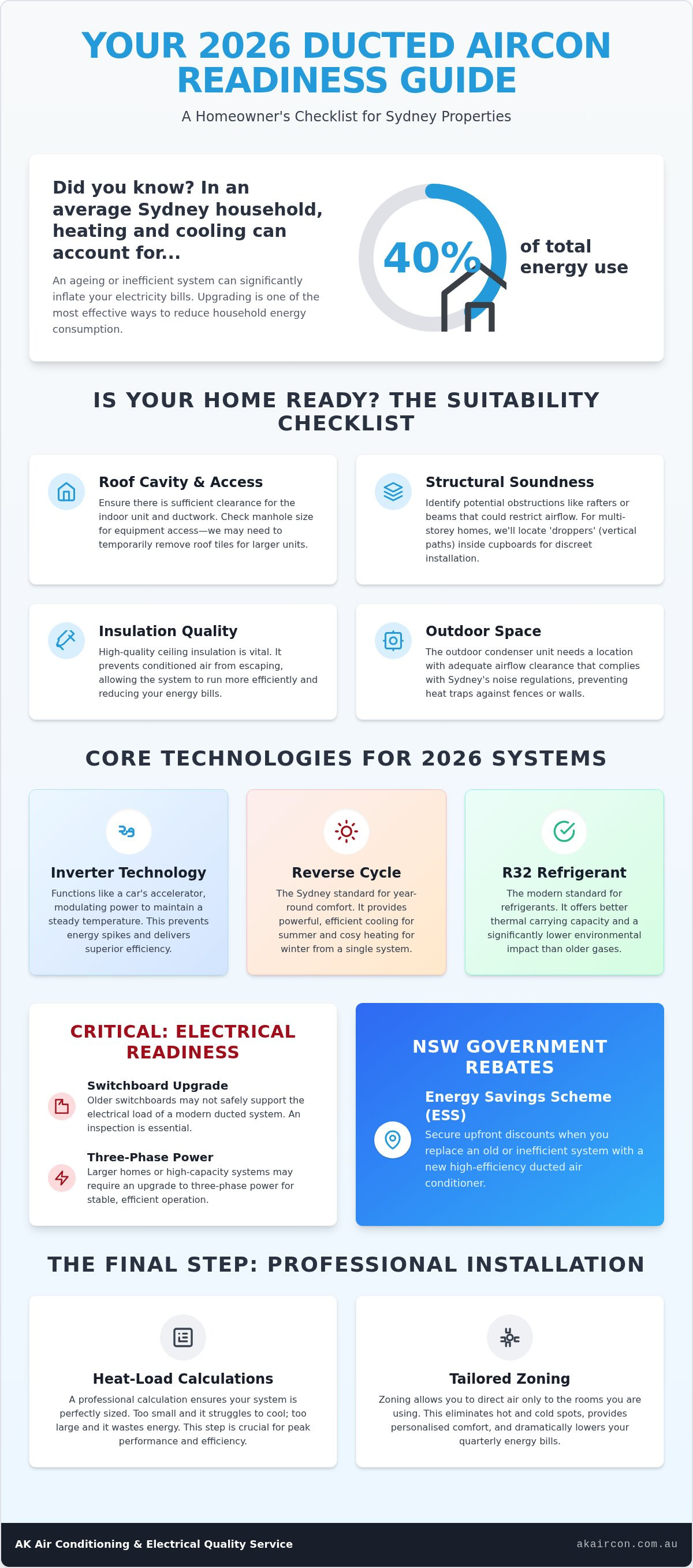
Did you know that heating and cooling appliances account for roughly 40% of the average Sydney household's total energy use? It is a staggering figure, especially if you are currently battling an ageing unit that leaves your upstairs bedrooms sweltering while your electricity bills continue to climb. You likely want the seamless, invisible comfort of a modern ducted aircon system, yet the technical jargon and shifting NSW rebate rules can feel like a genuine minefield for many homeowners.
We understand that choosing the right climate control for your home is about more than just picking a brand; it is about ensuring your electrical switchboard is ready and your zoning is optimised for the local climate. This 2026 readiness guide is designed to cut through the noise, helping you master everything from system selection to securing the latest government incentives without the stress. We will walk you through the essential steps of assessing your home's infrastructure, comparing high-efficiency models from trusted names like ActronAir and Daikin, and navigating the updated Energy Savings Scheme (ESS) rules. By the end of this checklist, you will have a clear path toward a cooler, more energy-efficient home that provides total comfort in every room.
Key Takeaways
- Learn how to assess your roof cavity and floor plan to ensure your property is physically compatible with a seamless ducted aircon installation.
- Compare leading brands like ActronAir and Daikin to find the ideal balance between quiet operation and high-performance cooling during Sydney heatwaves.
- Identify whether your home requires a switchboard upgrade or three-phase power to safely support a modern, energy-efficient climate control system.
- Navigate the 2026 NSW Energy Savings Scheme (ESS) eligibility rules to secure upfront discounts on high-efficiency system replacements.
- Understand the importance of professional heat-load calculations and tailored zoning to eliminate uneven cooling and lower your quarterly energy bills.
Is Ducted Aircon Right for Your Home? The Suitability Checklist
Many Sydney homeowners dream of a house that maintains a constant, comfortable temperature regardless of a Western Sydney heatwave. While a ducted aircon system offers this luxury through a single, discreet interface, the first step is determining if your property's architecture can support the necessary infrastructure. It is not just about floor space; it is about what is happening behind your plaster and above your ceiling. A successful installation requires a synergy between your home's layout and the system's physical requirements.
The most critical factor is your roof cavity. We need enough clearance for the indoor fan coil unit and the network of flexible ducting that distributes air to each room. If you live in an older Sydney terrace or a home with a flat roof, space is often at a premium. For multi-storey builds, we must identify vertical paths, often called droppers, to run ducts to the ground floor. These paths usually hide inside wardrobes or linen cupboards to keep the installation invisible. Additionally, your existing insulation plays a massive role. Even the most efficient system will struggle if your home lacks quality ceiling batts to trap the conditioned air. Understanding How HVAC systems work helps clarify why thermal efficiency is just as important as raw cooling power.
Roof Space and Structural Requirements
Standard indoor units are substantial pieces of equipment. You should measure your manhole access size early in the process; if it is too small for the unit to pass through, we may need to temporarily remove roof tiles or create a new access point. Our team also looks for structural obstructions like rafters or low-hanging beams that could pinch ducting and restrict airflow. For the outdoor condenser, we must select a location that meets Sydney's noise compliance regulations while providing enough clearance for the unit to breathe and shed heat effectively.
Aesthetic vs Functional Priorities
If you prefer a minimalist interior, a ducted system is the gold standard. Unlike wall-mounted split systems that occupy wall space, ducted grilles are tucked away and can be colour-matched to your ceiling. For modern homes with raked ceilings or flat roofs where a traditional cavity does not exist, we often utilise bulkhead units. These are specialised, boxed-in sections of the ceiling that house the equipment without compromising the sleek lines of your home. This approach ensures you get the "invisible" look of a premium ducted aircon installation even in challenging architectural designs.
Technical Components: Understanding the Ducted System
A ducted aircon system is a sophisticated network of components designed to work in total harmony. It is essentially a split system on a much larger scale, consisting of two primary units connected by insulated refrigeration pipes. The indoor fan coil unit, which we typically hide within your ceiling cavity, is the heart of the operation. It draws air from your living spaces, filters it, and then conditions it before pushing it back through the ductwork. Outside, the condenser unit manages the heavy lifting of heat exchange. In Sydney's often cramped residential blocks, it's vital to choose between a vertical or horizontal discharge unit. Horizontal units blow air sideways, making them perfect for narrow side passages, while vertical units discharge air upwards to prevent heat from being trapped against fences or walls.
Reverse Cycle and Inverter Technology
Reverse cycle technology is the gold standard for Sydney homes because it provides efficient cooling for humid summers and powerful heating for crisp winters. Most modern systems now utilise inverter technology, which functions like a car's accelerator. Instead of constantly switching on and off, the system modulates its power output to maintain a steady temperature. This prevents the energy spikes associated with older, non-inverter models. Additionally, 2026 systems predominantly use R32 refrigerant, which offers better thermal carrying capacity and a significantly lower environmental impact than previous gases. For a detailed breakdown of these technical specifications, the CHOICE buying guide offers excellent impartial advice on performance metrics.
Zoning Systems and Airflow Control
The true efficiency of a ducted system lies in its ability to direct air only where it is needed. This is achieved through motorised dampers, which act as electronic valves within the ducting. While standard zoning might group all bedrooms into one single block, advanced smart zoning allows for individual room temperature control. This means you don't have to waste energy cooling an empty guest wing or a formal dining room during the day. By precisely controlling which dampers are open, you can significantly reduce your quarterly energy bills while maintaining peak comfort in the rooms you are actually using.
Your interaction with these technical components happens through the control interface. While wall-mounted touchscreens are the traditional choice, most premium systems now offer full smartphone integration. This allows you to adjust your zones or turn the system on while you are commuting home from the city. If you're unsure which technical configuration best fits your property's layout, our team can help you organise a professional site survey to design a tailored solution.
The Brand Comparison Checklist: ActronAir, Daikin, and Mitsubishi
Choosing the right brand for your ducted aircon installation is a decision that impacts your comfort for the next 15 to 20 years. In Sydney, we face unique challenges, from the salty air of the Eastern Suburbs to the blistering 45°C+ summer peaks in the West. Not all international brands are engineered to handle these extremes. We focus on three industry leaders that consistently deliver reliability and performance in local conditions.
Why Local Context Matters for Brands
ActronAir stands out because it is an Australian-owned company that designs and builds its systems specifically for our harsh climate. While many imported units struggle when the mercury hits 40°C, ActronAir systems are engineered to operate effectively even in 50°C heatwaves. Their vertical discharge condensers are particularly effective in tight Sydney side-passages where heat buildup often causes other units to fail. If your priority is a system that won't quit during a record-breaking February afternoon, this is a top contender.
Daikin remains the premium choice for high-end residential renovations. They are renowned for industry-leading air filtration and exceptionally quiet operation, making them ideal for bedrooms and quiet suburban streets. Mitsubishi Heavy Industries (MHI), on the other hand, is the "workhorse" of the industry. MHI systems are celebrated for their robust engineering and mechanical reliability. Understanding the difference between Mitsubishi Electric and Heavy Industries is essential; while both are excellent, MHI often prioritises heavy-duty components that excel in demanding environments. Regardless of the brand, we always check for local Sydney spare parts availability to ensure any future repairs are handled without long wait times.
Smart Features and Integration
Modern climate control is about more than just a thermostat on the wall. The latest systems from these top brands offer full integration with smart home ecosystems like Google Home and Amazon Alexa. This allows for seamless voice commands to adjust temperatures or zones. Energy monitoring is another vital feature in 2026. Many new interfaces provide real-time data on your power usage, helping you identify exactly how much it costs to run your system during peak periods. Smartphone apps allow you to pre-cool your living room while you are still on the commute from the CBD, ensuring you walk into a perfectly chilled home. These tools turn a standard air conditioner into a proactive part of your home's energy management strategy.
Electrical Readiness: The Often-Forgotten Checklist
Installing a ducted aircon system involves more than just lifting a unit into your roof. It is a major electrical upgrade that places significant demand on your home's power supply. Many Sydney homes, especially older ones in established suburbs, were never designed to support the load of a large modern climate control system. Overlooking your electrical infrastructure can lead to tripped circuits, damaged equipment, or even safety hazards. We ensure that your home's "nervous system" is just as capable as the new unit we are installing.
Single-Phase vs Three-Phase Power
The first item on your electrical checklist is determining your current power supply. Most standard Australian homes run on single-phase power, which is usually sufficient for smaller ducted systems. However, once you move into high-capacity units, typically those 14kW and above, three-phase power becomes a requirement. Three-phase power provides a more stable and efficient energy flow, which is essential for the heavy-duty compressors found in larger systems. If your home currently only has single-phase, upgrading your mains connection is a necessary step. While this adds to the initial project scope, it ensures your system runs reliably without flickering the lights every time the compressor kicks in.
Safety and Compliance Standards
Every new ducted aircon installation must have a dedicated circuit back to your main switchboard. This circuit requires a specialised RCD (Residual Current Device) or safety switch to protect your home from electrical faults. Under the AS/NZS 3000 Wiring Rules, these installations are strictly regulated to ensure they meet modern safety benchmarks. DIY electrical work is not just dangerous; it is illegal and will void your unit's warranty. Our dual-licensed team manages both the refrigeration and the electrical side of the job, which eliminates the need for you to coordinate between two different trades.
Before the installation begins, we inspect your switchboard for available circuit capacity and the presence of modern safety switches. If your board is full or uses old-fashioned ceramic fuses, we will recommend a switchboard upgrade as part of the installation process. This proactive approach prevents future headaches and ensures your household's total electrical demand remains within safe limits. To ensure your home is fully prepared for a high-efficiency upgrade, you can book an electrical readiness check with our licensed experts today.
NSW Rebates and Installation: Final Action Checklist
Completing your ducted aircon journey requires a final focus on the financial incentives and the physical installation process. By this stage, you have assessed your home's suitability, selected a premium brand like ActronAir or Daikin, and verified your electrical capacity. The final steps involve securing your government discount and ensuring the installation itself meets the highest professional standards. This phase is where the technical planning translates into long-term household comfort and lower running costs.
Maximising the NSW Air Conditioning Rebate
The NSW Government Energy Savings Scheme (ESS) provides a significant opportunity for Sydney residents to reduce the initial cost of high-efficiency climate control. Unlike traditional cash-back offers that require months of waiting, the ESS functions as an upfront discount provided by accredited installers at the point of sale. To be eligible in 2026, you must be replacing an old, inefficient system with a new model that meets strict energy star rating requirements. From 1 July 2026, the ESS rules have been updated to include a wider range of high-capacity systems, making it easier for large Sydney homes to qualify for these incentives. AK Air Conditioning & Electrical handles all the complex rebate paperwork for you, ensuring the discount is applied directly to your invoice without any administrative burden on your end.
Booking Your Professional Sydney Installation
A successful installation hinges on a precise heat-load calculation performed during a professional site survey. This survey considers your home's orientation, window sizes, and insulation levels to ensure the system is neither underpowered nor unnecessarily large. On the day of installation, you can expect our team to use drop sheets and floor protection to maintain the cleanliness of your home. A standard ducted aircon installation for a typical family home usually takes one to two days to complete, depending on the complexity of the duct runs.
The process concludes with a comprehensive commissioning report. This involves testing refrigerant pressures, checking for air leaks in the ductwork, and verifying that every zone receives the correct airflow. We also walk you through your new control interface to ensure you can confidently manage your zoning and smart features. To maintain peak performance, we recommend a simple maintenance schedule that includes cleaning return air filters every three months and an annual professional service. Taking these final steps ensures your system operates at maximum efficiency for years to come. Book your Sydney ducted aircon site survey with AK Air Conditioning today to start your journey toward a more comfortable home.
Secure Your Home's Climate Future Today
Investing in a ducted aircon system is a significant step toward transforming your home's liveability and long-term energy efficiency. We've covered the essential groundwork, from ensuring your roof cavity and electrical switchboard are ready for the load to selecting high-performance brands like ActronAir, Daikin, and Mitsubishi Heavy Industries. By aligning your choice with the 2026 NSW Energy Savings Scheme (ESS), you can secure a modern, high-efficiency system while significantly reducing your upfront costs through point-of-sale discounts.
As dual-licensed aircon and electrical experts, we provide the technical precision required for both the HVAC unit and the necessary power upgrades. We take pride in handling the rebate paperwork for you; this ensures your transition to whole-home comfort is as seamless and transparent as possible. Our team specialises in creating tailored zoning plans that eliminate uneven cooling and lower your quarterly running costs. Whether you're in a classic terrace or a modern multi-storey build, the right preparation makes all the difference. Comfort is within reach.
Get a Free Quote for Ducted Aircon Installation in Sydney
Frequently Asked Questions
How much does ducted air conditioning cost to run in Sydney?
Running costs vary based on your home's size and how effectively you use zoning. On average, heating and cooling account for roughly 40% of total household energy use in Australian homes. By utilising smart zones and setting efficient temperatures, you can keep daily costs manageable. Modern inverter systems are specifically designed to modulate power, preventing the expensive energy spikes that were common in older, non-inverter units.
Can I install ducted aircon in an existing double-storey home?
You can certainly install a system in an existing double-storey home, though it requires strategic planning. We typically install the indoor unit in the roof cavity and use vertical "droppers" to reach the ground floor. These ducts are often hidden inside wardrobes or linen cupboards to maintain a clean aesthetic. Our site survey identifies the most discreet paths to ensure whole-home comfort without compromising your interior design.
Is ducted air conditioning more efficient than split systems?
Ducted systems are generally more efficient when you need to condition multiple rooms or the entire house simultaneously. While a single split system is cheaper for one small room, running several individual units at once consumes more power than one centralised unit with smart zoning. A modern ducted aircon installation allows you to direct airflow precisely where it is needed, which significantly reduces wasted energy in unoccupied spaces.
How many zones can I have in a standard ducted system?
A standard residential installation typically includes between four and eight zones. This allows you to separate living areas from bedrooms or isolate guest rooms that aren't used daily. High-end controllers can manage even more individual zones, providing granular control over your home's climate. We help you design a zoning plan based on your family's routine to ensure you aren't paying to cool empty spaces or unused wings.
How often does a ducted aircon system need servicing?
We recommend a professional service once every twelve months to ensure your system operates at peak efficiency. This annual check-up involves inspecting refrigerant levels, testing electrical connections, and cleaning the outdoor condenser. Between these visits, you should clean your return air filters every three months. Keeping the filters clear prevents the motor from overworking and helps maintain the indoor air quality throughout your Sydney property.
What is the best temperature to set my ducted aircon for efficiency?
Setting your ducted aircon to 24°C in summer and between 18°C and 20°C in winter provides the best balance of comfort and energy efficiency. Every degree you drop in summer can increase your cooling costs by approximately 10%. Maintaining a consistent, moderate temperature allows the inverter technology to modulate power effectively, which is much cheaper than constantly turning the system on and off to chase extreme settings.
Does ducted air conditioning add value to my Sydney property?
Quality climate control is a highly sought-after feature that typically increases the market appeal and value of a Sydney property. Buyers often prioritise homes with "invisible" whole-home cooling over those with multiple bulky wall units. A professionally installed system from a reputable brand serves as a long-term asset, providing both immediate comfort for your family and a competitive edge when it comes time to sell.
What is the NSW government air conditioning rebate for 2026?
The 2026 NSW rebate is provided as an upfront point-of-sale discount through the Energy Savings Scheme (ESS). This is not a cash-back claim but a reduction applied directly to your invoice by an accredited provider. Eligibility depends on replacing an inefficient old unit with a high-efficiency model. Since July 2026, the scheme has expanded to include more system types, making it an ideal time to upgrade your home's infrastructure.
Important Information
This article provides general information only. Air-conditioning requirements, installation costs, energy savings and rebate eligibility vary between properties and systems. NSW program rules, certificate values and eligible models may change. Contact AK Air Conditioning & Electrical Quality Service Pty Ltd for a property-specific assessment and confirmation of current eligibility before making a purchase or installation decision.


