
Imagine it’s a sweltering 40-degree afternoon in Western Sydney and you’ve just realised your aircon is blowing nothing but lukewarm air. That sinking feeling in your stomach is usually followed by a quick glance at your bank balance, fearing a massive repair bill or a complex thermostat issue you can’t solve. Dealing with an air conditioner not cooling sydney homes is a common frustration, especially when our coastal salt air and extreme heatwaves push systems to their absolute limit.
We understand that your priority isn’t just a technical explanation; it’s getting your living room back to a liveable temperature without breaking the bank. At AK Air Conditioning & Electrical Quality Service, we focus on providing clear, professional guidance rather than high-pressure sales. This guide will help you identify whether your unit needs a simple DIY filter clean or a licensed technician to handle a refrigerant leak. You’ll also learn how to navigate the 2026 NSW Energy Savings Scheme rules to see if a rebate-eligible replacement is actually cheaper than a major repair. From troubleshooting common faults to understanding local repair costs, we’ve got the answers you need to restore your home’s comfort today.
Key Takeaways
- Identify simple user errors, such as incorrect thermostat modes or clogged filters, that might be the reason for your air conditioner not cooling Sydney property before booking a technician.
- Recognise the warning signs of mechanical failure, including the 'hissing' sounds of a refrigerant leak or the visible effects of coastal salt corrosion on your outdoor condenser coils.
- Understand how Sydney’s extreme temperatures, particularly in the western suburbs, can cause undersized units to struggle and what you can do to manage the cooling load.
- Apply the '50% Rule' to determine if a repair is worth the investment or if it's more cost-effective to upgrade to a modern, rebate-eligible system.
- Discover how current 2026 NSW Energy Saving Scheme rebates can provide significant upfront discounts on high-efficiency replacements from brands like Daikin and Mitsubishi.
Quick Checks: Why Your Air Conditioner Isn't Cooling Your Sydney Home
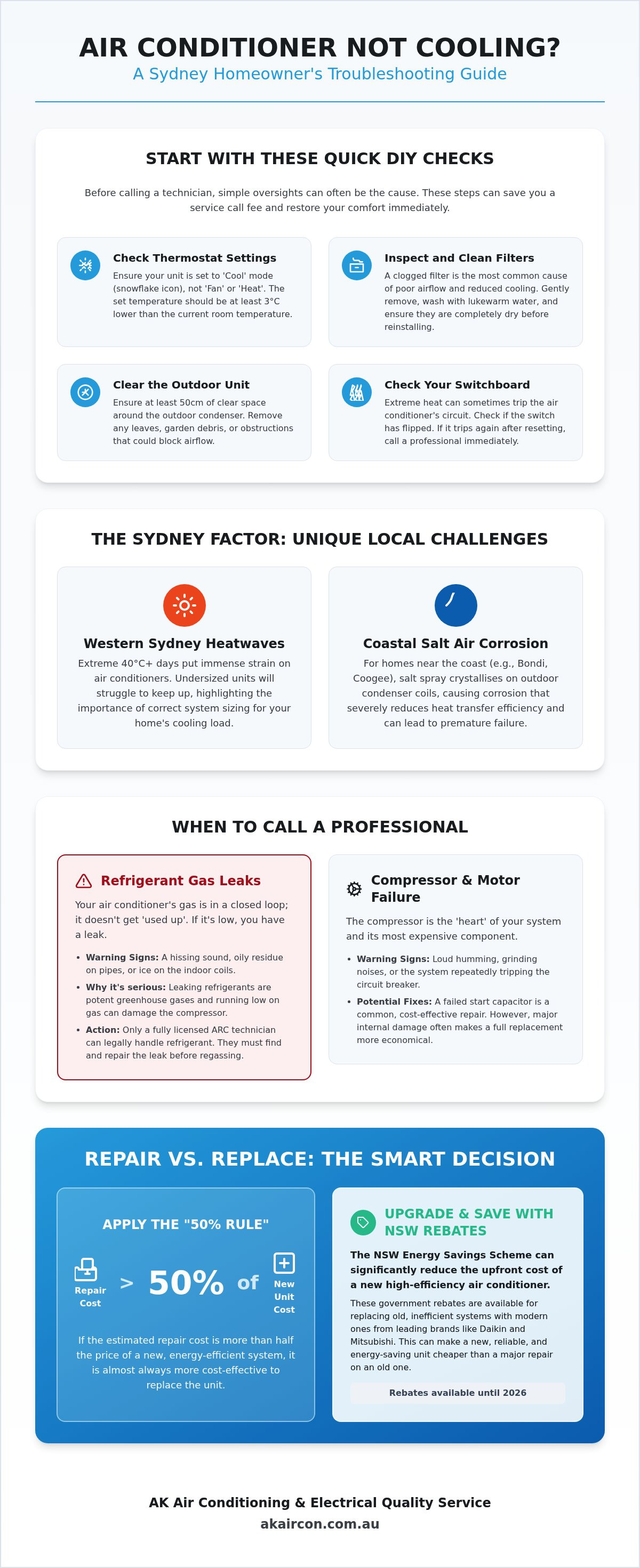
Before you worry about the cost of a major repair, it's worth performing a few basic checks. Quite often, the reason for an air conditioner not cooling Sydney homes isn't a mechanical failure but a simple setting or maintenance oversight. Taking ten minutes to inspect your system can save you the cost of a service call and restore your comfort immediately.
Thermostat Settings and Mode Selection
It sounds obvious, but the first thing to check is your remote or wall controller. Ensure the system is set to 'Cool' (usually represented by a snowflake icon) and not 'Fan Only' or 'Heat'. For the compressor to kick in, the set temperature needs to be at least 3 degrees lower than the current room temperature. If your home feels muggy during a humid Sydney afternoon, you might be tempted to use 'Dry Mode'. While this removes moisture, it doesn't provide the same cooling power as 'Cool Mode'.
Understanding how air conditioners work reveals that the system must actively engage the refrigeration cycle to move heat out of your home. If your remote screen is faint or unresponsive, try replacing the batteries. A weak signal can sometimes prevent the indoor unit from receiving the command to start the cooling cycle, even if the display looks active.
Visual Inspection of Indoor and Outdoor Units
Sydney dust, pollen, and pet hair can quickly choke your system's airflow. When air can't pass through the indoor unit, the cooling capacity drops significantly. You can safely manage this by following these steps:
- Gently lift the front panel of your split system.
- Slide out the mesh filters and inspect them for a grey layer of dust.
- Wash them in a laundry tub with lukewarm water and a mild detergent.
- Ensure they are completely dry before sliding them back into place.
- Check the indoor coils; if you see ice build-up, turn the unit off immediately as this indicates a severe airflow restriction or a gas issue.
The outdoor unit needs just as much attention. In coastal areas like Bondi or Coogee, salt spray can crystallise on the condenser fins, while in Western Sydney, garden debris and dry leaves often pile up around the base. Ensure there is at least 50cm of clear space around the outdoor unit so it can breathe. Finally, check your home's switchboard. On scorching days, the high power demand can occasionally trip a circuit. If the aircon circuit has flipped to 'Off', try resetting it once. If it trips again immediately, stop and seek professional help to avoid damaging the electronics.
Mechanical Faults: From Refrigerant Leaks to Faulty Compressors
When basic troubleshooting doesn't restore the chill, the problem usually sits within the mechanical heart of the system. For an air conditioner not cooling Sydney properties effectively, the culprit is often a breach in the refrigeration cycle or a component failure. These issues require a technical eye to prevent a small fault from turning into a total system write-off.
Refrigerant Gas Issues and Regassing
Think of refrigerant gas as the 'blood' of your aircon. It's a heat-transfer medium that circulates in a closed loop. A common misconception among homeowners is that gas is a fuel that gets 'used up' over time. This isn't true. If your gas levels are low, you have a leak. You might notice a faint hissing sound near the indoor unit or see oily patches on the copper pipe connections.
Leaking R32 or R410A refrigerants are potent greenhouse gases. In Australia, it's illegal for anyone without a full ARC (Australian Refrigeration Council) licence to handle these substances. A licensed technician won't just 'top up' the gas; they must find and seal the leak first. If you suspect your system has lost its charge, it's best to have a professional inspect your air conditioning system before the lack of lubrication damages the compressor.
Compressor and Motor Failures
The compressor is the most expensive part of your outdoor unit. If you hear a loud humming noise but the unit won't start, you might be lucky enough to only have a failed start capacitor. This is a simple, cost-effective electrical fix. However, loud grinding noises or the system frequently tripping your safety switch are signs of a dying compressor.
Premium brands like Daikin, Mitsubishi Electric, and ActronAir rely on complex inverter circuit boards to regulate speed and efficiency. While these systems are incredibly reliable, they can be vulnerable to Sydney's occasional power surges or extreme humidity. A faulty inverter board can often be mistaken for a dead compressor, making an expert diagnosis vital. If a major component like the compressor has failed in a unit older than ten years, it's often wiser to look at NSW Government rebates to help fund a newer, more efficient replacement.
Frozen Evaporator Coils
It seems counterintuitive, but a unit blowing warm air can actually be frozen solid inside. If the heat exchange process is interrupted by low gas or restricted airflow, the indoor coils can drop below freezing. Ice then acts as an insulator, blocking all cooling. If you see ice forming on the pipes, turn the system off immediately. Running a frozen unit can cause liquid refrigerant to flood back into the compressor, leading to a catastrophic failure that usually results in a full system replacement.
The Sydney Factor: How Coastal Salt and Western Heat Affect Cooling
Sydney’s unique geography creates two distinct environmental battlegrounds for HVAC systems. While residents in the Eastern Suburbs battle salt-induced decay, those in Western Sydney face extreme temperatures that test the mechanical limits of even the best units. Understanding these local factors is essential when diagnosing an air conditioner not cooling Sydney property, as the solution often depends on your specific postcode.
Corrosion Protection for Coastal Homes
If you live in Manly, Cronulla, or the Eastern Suburbs, your outdoor unit is constantly exposed to salt-laden air. This salt acts as a catalyst for decay, specifically targeting the delicate heat exchange fins. Galvanic corrosion is an electrochemical reaction that occurs when the copper piping and aluminium fins of your condenser are exposed to an electrolyte like salt spray, causing the metals to eat away at each other. This process thins the metal, reduces heat transfer, and eventually leads to refrigerant leaks.
To combat this, we recommend units equipped with 'Blue Fin' or 'Gold Fin' epoxy coatings. These protective layers act as a barrier against the salt. For beachfront properties, a simple habit of gently rinsing the outdoor unit with fresh water from a garden hose once a month can significantly extend the life of your system. This removes the salt crust before it can start the corrosive process.
Sizing Your Aircon for the Sydney Climate
Inland suburbs like Penrith or Blacktown experience a completely different challenge. While a standard unit might be designed to operate efficiently up to 35 degrees, Western Sydney heatwaves frequently push past 45 degrees. When the ambient outdoor temperature is that high, an undersized unit simply cannot reject enough heat to cool your indoors. It will run at 100% capacity for hours, leading to high power bills and premature compressor failure.
At AK Air Conditioning & Electrical Quality Service, we don't just look at room size. We calculate the required kW based on your suburb's peak temperatures, the aspect of your windows, and your insulation levels. Using robust brands like Daikin, Mitsubishi Electric, or ActronAir ensures you have a system built for Australian extremes. A reverse cycle system is particularly effective here, providing high-efficiency cooling in summer and cost-effective heating during those crisp Sydney winter mornings.
Humidity and Local Flora
Sydney’s tropical summers often bring high humidity, which can make a unit appear to be 'sweating' or leaking. If the drainage system isn't perfectly clear, this condensation can back up. Additionally, local flora plays a part in system health. During spring and summer, Jacaranda blossoms and gum leaves can be sucked into the outdoor fan assembly. This debris blocks airflow just as effectively as a dirty indoor filter. Regularly checking the perimeter of your outdoor unit for fallen blossoms or leaf litter is a vital part of Sydney home maintenance.
Repair vs. Replace: Navigating NSW Rebates for Inefficient Systems
Deciding between a quick fix and a total upgrade is the most critical financial choice you'll make when your system fails. If you're dealing with an air conditioner not cooling sydney's humid air, the immediate temptation is to choose the cheapest repair. However, the '50% Rule' suggests that if a repair quote exceeds half the cost of a new unit, replacement is the more ethical and economical path. This is particularly relevant for systems nearing the end of their 10 to 15-year lifespan, where multiple components often begin to fail in quick succession.
The obsolescence of R22 refrigerant adds another layer of complexity. If your unit was installed before 2010, it likely uses this discontinued gas. Repairing a leak in an R22 system is often a poor investment because the gas itself is incredibly expensive and replacement parts are becoming scarce. In contrast, modern systems using R32 are far more efficient, easier to maintain, and significantly better for the environment.
NSW Air Conditioning Rebate Eligibility
The NSW Government’s Energy Saving Scheme (ESS) provides a significant incentive for Sydney households and small businesses to ditch their old power guzzlers. To be eligible, you must replace an existing, inefficient system with a new, high-efficiency model from brands like Daikin, Mitsubishi Electric, or ActronAir. These aren't cashback offers you claim months later; they are upfront discounts applied directly to your invoice by accredited providers.
As of July 2026, new rules for the ESS have updated the efficiency requirements for multi-split and large ducted systems. At AK Air Conditioning & Electrical Quality Service, we stay across these regulatory changes to ensure you get the maximum discount possible. We manage the rebate paperwork for you, removing the administrative burden so you can focus on getting your home cool again while staying within your budget.
Long-term Savings of Energy Efficient Upgrades
A new 5-star rated inverter system can reduce your cooling-related energy consumption by up to 30% to 40% compared to a decade-old model. This translates to noticeable reductions in your quarterly electricity bills from providers like Origin or EnergyAustralia. When you factor in these savings over five years, the new system often pays for itself. You can find more details on current incentives via the NSW Government rebates website.
Beyond the bill, you gain the security of a five-year manufacturer's warranty. While a repair might only come with a 90-day guarantee on the specific part replaced, a new installation ensures your entire system is protected. Modern 'smart' features also allow for remote monitoring via your smartphone, helping you catch minor issues before they lead to another air conditioner not cooling sydney failure during a heatwave. Choosing a high-efficiency replacement isn't just about today’s comfort; it’s about making your home more resilient to rising energy costs.
Professional Air Conditioning Repairs and Upgrades in Sydney
AK Air Conditioning & Electrical Quality Service has built a reputation for reliability across the Greater Sydney region. When you're stuck with an air conditioner not cooling Sydney's sweltering summer air, you need a technician who understands both the electrical and refrigeration components of your system. Our team holds comprehensive licensing in both fields, ensuring that every repair is safe, legal, and performed to Australian standards. We don't believe in guesswork. Our 'Service First' approach means we prioritise a thorough diagnosis of the fault before we ever suggest a system replacement.
Whether you own a Daikin split system, a Mitsubishi Electric multi-split, or a large ActronAir ducted system, we have the brand-specific expertise required for complex repairs. We understand the nuances of inverter technology and the common failure points of premium units in our local climate. By choosing a specialist, you ensure that your warranty remains intact and that your system operates at peak energy efficiency. Our technicians are trained to identify the root cause of an air conditioner not cooling Sydney property, whether it is a simple sensor fault or a complex circuit board issue.
Our Sydney Service Area and Response Times
We provide comprehensive coverage across the city, from the busy CBD to the residential streets of Parramatta, Castle Hill, and the Sutherland Shire. During the peak summer months, we understand that a broken aircon is more than an inconvenience; it can be a health risk for vulnerable family members. This is why we maintain emergency repair availability during heatwaves to restore your cooling as quickly as possible.
During a standard AK Air Conditioning & Electrical Quality Service call, a technician will inspect the refrigerant levels, check the electrical connections, and clean the primary components. We provide an honest assessment of your unit's health and a clear, upfront explanation of any necessary repairs. Our goal is to give you peace of mind that your home's comfort is in professional hands, backed by years of local experience.
Book Your Cooling Health Check Today
The best time to service your air conditioner is before the first heatwave hits. Preventative maintenance can identify small issues, like a worn capacitor or a minor leak, before they cause a total system failure. If your unit is older and struggling to keep up, we can also perform a rebate eligibility check to see if you qualify for a discounted upgrade under the 2026 NSW Energy Saving Scheme. This process ensures you get a high-efficiency replacement that lowers your long-term running costs.
Don't spend another day in an uncomfortably hot house. Contact AK Air Conditioning & Electrical Quality Service for expert repairs and rebate checks and let our experienced team restore your home's climate control with the professional care you deserve.
Restore Your Home's Comfort Today
Navigating a Sydney summer without reliable air conditioning is more than a minor inconvenience; it's a genuine threat to your home's liveability. Whether the issue is a clogged filter, a salt-corroded condenser, or a failing compressor, identifying the root cause is the first step toward a cooler house. Remember the 50% rule and consider the 2026 NSW Energy Saving Scheme if your old unit is simply too expensive to run. Dealing with an air conditioner not cooling sydney homes requires a calm, professional approach to find the most cost-effective solution for your specific suburb.
As specialists in Daikin and ActronAir, our team of qualified electricians and refrigeration technicians provides the expert diagnosis you need. We are also authorised NSW rebate providers, helping you secure significant upfront discounts on high-efficiency upgrades that lower your power bills. We handle the technical repairs and the paperwork so you can focus on enjoying a comfortable, temperature-controlled home again.
You don't have to sweat through another sweltering afternoon. Book Your Sydney Aircon Repair or Rebate Check Now and let our experienced team restore your cooling with speed and precision. Help is just a phone call away, and we are ready to get your system back to its best.
Frequently Asked Questions
Why is my air conditioner running but not blowing cold air?
The most common reasons for this issue are restricted airflow from dirty filters or a refrigerant leak. If the fan is spinning but the air remains lukewarm, your compressor might not be engaging or the system could be low on gas. Always check your thermostat settings first to ensure the unit is actually set to 'Cool' and not just 'Fan' mode.
How much does a standard air conditioning service cost in Sydney?
Industry pricing for a service call typically includes a fixed call-out fee and an hourly rate for labour. These costs vary based on your suburb and the type of system you have, such as a split system or ducted unit. Regular maintenance is a small investment that prevents the much higher costs associated with emergency repairs or total compressor failures.
Is it worth repairing a 10-year-old air conditioner?
It depends on the specific fault and the unit's overall condition. We recommend applying the 50% rule; if the repair cost is more than half the price of a new unit, an upgrade is usually the better choice. Older systems are also significantly less efficient and often use discontinued refrigerants that are becoming increasingly expensive to source.
How do I know if my aircon needs more gas?
Symptoms of low refrigerant include lukewarm air, ice formation on the indoor coils, or a faint hissing noise from the outdoor unit. It's a common myth that air conditioners consume gas over time. Because these are sealed systems, any drop in gas levels always indicates a leak that must be sealed by a licensed technician before regassing.
Can I clean my own air conditioning filters?
Yes, cleaning your mesh filters is a simple task that every homeowner should perform every few months. This is often the easiest fix for an air conditioner not cooling sydney property. Simply lift the front panel, remove the mesh, and wash it with lukewarm water in the laundry tub. Ensure the filters are completely dry before you slide them back in.
What is the NSW air conditioning rebate and am I eligible?
The NSW Energy Saving Scheme (ESS) provides upfront discounts for households and small businesses that replace old, inefficient air conditioners with high-efficiency models. To be eligible, you generally need to be replacing an existing system with a new unit that meets specific energy performance standards. We can check your eligibility and manage the paperwork for you during your consultation.
How long does a typical aircon repair take in Sydney?
Most standard mechanical or electrical repairs, such as replacing a capacitor or a fan motor, take between one and two hours. If your system requires complex leak detection or a full compressor replacement, the job may take a half-day or require a follow-up visit. Our technicians aim to diagnose and resolve the issue in a single visit whenever possible.
Why does my air conditioner smell when I turn it on?
A musty or 'dirty sock' smell is usually caused by mould or bacteria growth on the evaporator coils or in the drain pan. This occurs when condensation doesn't drain away properly, creating a damp environment where fungi thrive. A professional hydro-clean sanitises these internal components, removing the odour and improving the air quality in your home immediately.
Important Information
This article provides general information only. Air-conditioning requirements, installation costs, energy savings and rebate eligibility vary between properties and systems. NSW program rules, certificate values and eligible models may change. Contact AK Air Conditioning & Electrical Quality Service Pty Ltd for a property-specific assessment and confirmation of current eligibility before making a purchase or installation decision.


