
The sticker on an indoor unit rarely reveals what a finished project actually requires. When putting together an air conditioning installation cost comparison Sydney homeowners often discover that quotes for identical units vary dramatically between contractors. You might wonder why one tradesperson factors in a switchboard upgrade or roof cavity work while another skips essential electrical requirements entirely.
It's frustrating to decipher conflicting trade estimates, especially when you feel uncertain about whether your floor plan suits a single split system, a multi-split setup, or whole-home ducted climate control. You deserve total clarity before work begins on your home.
This guide gives you a clear framework to evaluate quotes side by side, match cooling capacity to your specific living zones, and understand how property layouts directly influence materials and installation scope. We examine how split, multi-split, and ducted platforms compare across Sydney homes so you can choose the right cooling setup with complete confidence.
Key Takeaways
- A meaningful air conditioning installation cost comparison Sydney homeowners rely on must factor in property construction materials, roof space, and outdoor unit placement rather than equipment prices alone.
- Older switchboards across established suburbs often lack dedicated capacity, making a professional switchboard upgrade essential to complete a compliant and safe installation.
- Selecting the right layout between a single split system, multi-split setup, or ducted air conditioning installation ensures you heat and cool individual living zones without running up unnecessary electricity bills.
- Reviewing quotes for dual-trade qualifications ensures your project covers both ARC refrigerant handling and licensed electrical work under a single, accountable contractor.
- Evaluating long-term running performance against Sydney's extreme summer temperatures protects your household budget far better than choosing an undersized system with lower initial hardware expenses.
Comparing Sydney Air Conditioning Systems: Split System vs Ducted vs Multi-Split
Selecting the right climate control depends heavily on balancing your property's architectural footprint against the total area you plan to heat or cool. When evaluating an air conditioning installation cost comparison Sydney homeowners must look past simple hardware labels. Modern air conditioning systems range from targeted single-room options to complete whole-property setups, and each comes with distinct labour, material, and spatial requirements.
Single Split System Air Conditioning Considerations
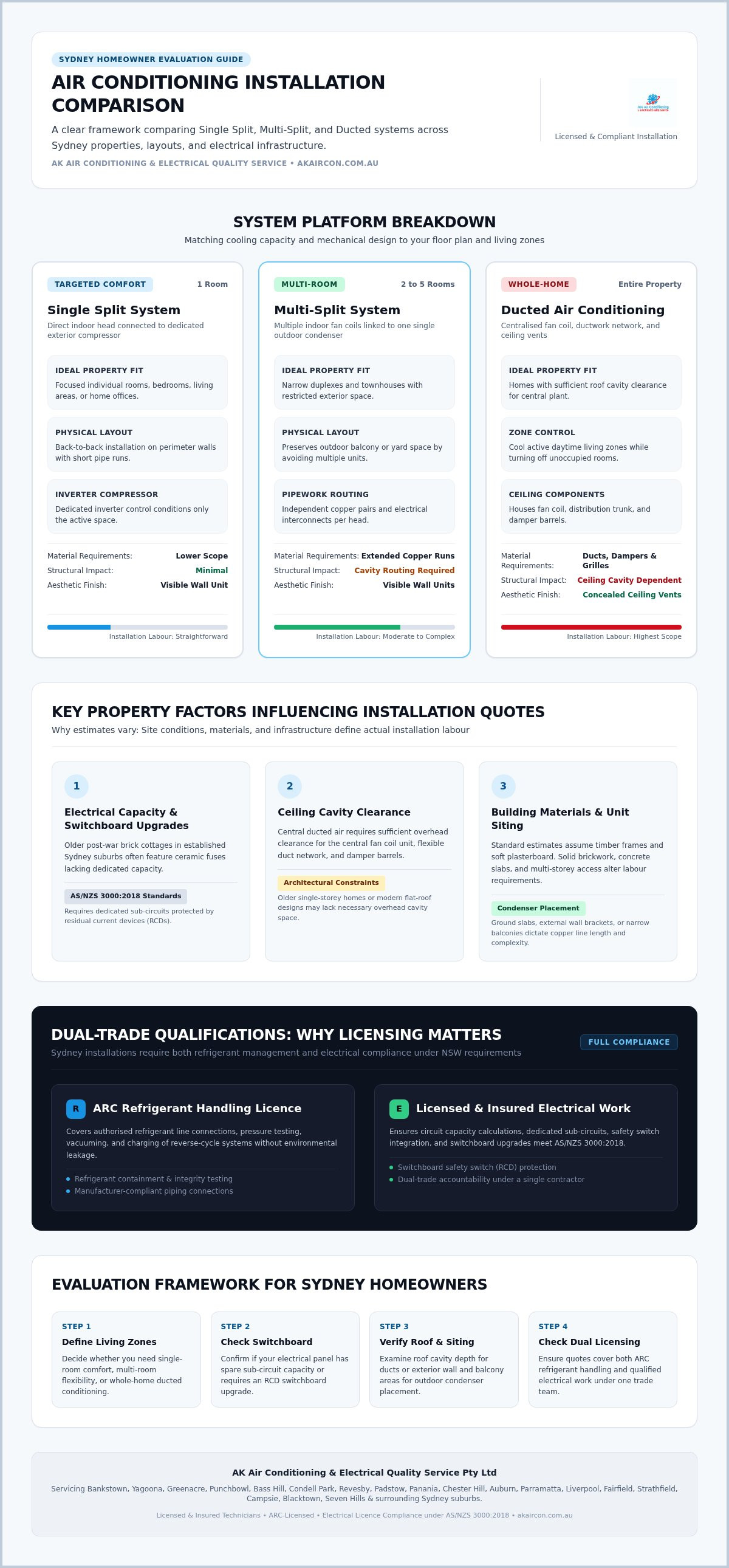
A single split system remains the most practical choice for focused comfort in individual bedrooms, living rooms, or home offices. Because the indoor unit mounts directly to a perimeter wall, the outdoor compressor sits immediately opposite on an external slab or bracket. This back-to-back layout keeps refrigerant line runs short and installation labour straightforward. Booking a split system aircon installation gives you dedicated inverter compressor control, ensuring you only condition the exact room you occupy without wasting energy elsewhere.
Multi-Split Systems for Multi-Room Configurations
Multi-split units connect several indoor fan coils across separate rooms to a single, larger outdoor condenser. This approach suits compact Sydney properties, such as narrow duplexes in Greenacre or townhouses in Condell Park, where yard space or balcony room is tight. While they eliminate the clutter of multiple exterior units, installation demands careful planning. Running independent pairs of copper pipework and electrical interconnects from every indoor head through internal wall cavities back to a single outdoor unit increases labour complexity.
Whole-Home Ducted Air Conditioning Infrastructure
Central ducted air delivers total climate control across an entire property via ceiling vents, keeping living areas visually clean. Modern ducted setups let you establish distinct zones, allowing you to cool busy daytime living areas while turning off unoccupied bedrooms. Investing in a ducted air conditioning installation requires sufficient ceiling cavity clearance for the central fan coil, duct distribution network, and damper barrels. Older single-storey properties or modern flat-roof designs may lack this overhead clearance, making careful architectural assessment essential.
To help guide your initial assessment, consider how these platforms differ across typical residential installations:
- Single Split System: Best for individual zones, lower material requirements, minimal structural impact, visible wall unit.
- Multi-Split System: Conditions two to five rooms, preserves exterior space, requires complex internal pipe routing, visible wall units.
- Ducted System: Delivers complete whole-home coverage, requires dedicated roof cavity space, concealed architectural finish, higher initial labour scope.
Completing a realistic air conditioning installation cost comparison Sydney wide means weighing these mechanical differences against what your specific floor plan can physically support.
Key Property Factors Influencing Sydney Installation Quotes
Big-box retailers often advertise basic packages that assume every home features timber framing, soft plasterboard, and an outdoor compressor mounting spot just two steps away. Real homes rarely fit that mould. When carrying out an air conditioning installation cost comparison Sydney homeowners must account for building materials, age, and layout. Siting, electrical infrastructure, and structural access dictate the actual trade labour required on site, shaping the final scope far more than unit hardware alone.
Electrical Capacity and Switchboard Upgrade Requirements
Many post-war brick cottages across Bankstown, Auburn, and Chester Hill still rely on older electrical switchboards fitted with ceramic fuses. Modern reverse cycle platforms, particularly larger ducted systems, require a dedicated sub-circuit protected by residual current devices (RCDs) under AS/NZS 3000:2018 standards. If your current switchboard cannot support the additional electrical draw, a switchboard upgrade becomes mandatory before your installation can pass safety certification. Coordinating this early prevents unexpected delays between separate trades.
Architectural Layout, Wall Construction, and Roof Cavity Access
Wall construction significantly shapes labour hours. Core-filled masonry or double brick walls in suburbs like Strathfield and Campsie require diamond core drilling equipment rather than standard hole saws. Ceiling structure plays an equally critical role for ducted configurations:
- Truss Spacing and Pitch: Low-pitch roofs restrict technician access, requiring split fan coil units or custom duct routing.
- Cathedral and Flat Roofs: Lack of roof space may rule out central ducting entirely, necessitating multi-split units or dropped plasterboard bulkheads.
- Multi-Storey Dwellings: Routing ductwork or copper lines to the ground floor requires dedicated vertical chases or external PVC trunking.
Pipe Run Distances and Outdoor Condenser Placement
Standard installations allow for short line runs between the indoor head and outdoor condenser. When your layout requires placing the outdoor unit on the opposite side of the home to satisfy council setbacks or preserve entertaining areas, additional materials come into play. Long pipe runs require extra insulated copper pair coil, UV-stabilised trunking capping, and additional refrigerant charging to maintain thermodynamic efficiency.
According to the energy.gov.au heating and cooling guide, space conditioning accounts for a substantial share of total household energy use. Correct condenser placement ensures adequate airflow across the heat exchanger coils, keeping power draw down. Factoring these physical variables into your air conditioning installation cost comparison Sydney wide ensures you receive an accurate, all-inclusive quote without unwelcome surprises on installation day.
Upfront Investment Versus Long-Term Running Efficiency
Focusing purely on bottom-line equipment expenditure is a common trap. When conducting an air conditioning installation cost comparison Sydney households should weigh initial supply expenses against long-term electricity consumption. A cheaper entry-level system often draws significantly more power every hour it operates, eroding any upfront savings within just a few sweltering summers across Greater Sydney.
Inverter Technology and Star Ratings Explained
Modern direct current (DC) inverter compressors modulate their motor speed dynamically rather than switching aggressively on and off. This variable-speed operation maintains your chosen temperature smoothly while reducing mechanical stress. You can check the Zoned Energy Rating Label (ZERL) on modern units to evaluate seasonal performance across hot, average, and cold Australian climate zones. Investing in higher star ratings noticeably limits quarterly energy bills during prolonged heat spells. For reliable seasonal temperature regulation, selecting efficient reverse cycle equipment ensures steady warmth through winter alongside crisp summer cooling.
Brand Reliability and Component Longevity in Sydney Climates
Western Sydney regularly experiences intense summer heatwaves that push outdoor machinery to its operational limits. Established manufacturers engineer their units to withstand these exact conditions:
- Coil Protection: Premium brands like Daikin, ActronAir, and Mitsubishi utilise anti-corrosion blue-fin or gold-fin treatments to prevent environmental degradation.
- High-Ambient Operation: Durable outdoor fan motors continue cooling efficiently without tripping safety cutouts when ambient temperatures exceed 40 degrees Celsius.
- Parts Availability: Established manufacturers maintain extensive local Australian spare parts networks, preventing weeks of waiting during system breakdowns.
As highlighted in the CHOICE air conditioner buying guide, looking beyond purchase tags to examine reliability data and seasonal running performance is essential for long-term value.
Assessing NSW Energy-Saving Upgrade Incentives
Under the NSW Energy Security Safeguard, homeowners upgrading from older, inefficient platforms may access upfront certificate-based discounts through accredited providers. These energy-saving upgrades lower the initial capital outlay required for qualifying high-efficiency reverse cycle units. However, eligibility, certificate value, and customer benefit depend entirely on property location, building type, existing equipment status, and specific program requirements. All qualifying work must be carried out by fully certified, licensed and insured technicians to validate compliance.
Factoring running efficiency and potential certificate discounts into your overall air conditioning installation cost comparison Sydney calculation helps you secure a platform that protects both your family's comfort and your long-term household budget.
How to Accurately Compare Quotes from Sydney Air Conditioning Installers
Lowball quotes often leave out vital structural and electrical tasks that surface as costly variations on installation day. Completing an accurate air conditioning installation cost comparison Sydney wide means checking that competing trades quote on an identical scope of work. An itemised written proposal specifies every fixture, electrical termination, and rubbish disposal fee up front.
Checking Licensing, ARC Authorisation, and Insurances
Air conditioning work in NSW bridges two distinct regulated trades. Technicians must hold an ARC licence to legally handle fluorocarbon refrigerants during pipe connection, vacuum testing, and system commissioning. Connecting the unit into your home's mains power supply demands a NSW Fair Trading electrical licence. Contractors lacking dual-trade capability often rely on uncoordinated third-party subcontractors, causing unnecessary site delays. Always check that your installer carries current public liability insurance to protect your property against accidental damage during structural wall penetrations.
Evaluating Inclusions: Back-to-Back Versus Complex Pipework
Retail package deals frequently quote on basic back-to-back parameters. These basic scopes assume the indoor head sits squarely on an external wall, with no more than a few metres of straight piping running down to the outdoor unit. Review your quotes closely to confirm they specify complete materials, including:
- Pipe and Trunking Allowances: Exact lengths of insulated copper pair coil and UV-stabilised external PVC capping.
- Mounting Hardware: Vibration-isolation rubber mounts, poly-slab foundations, or heavy-duty masonry wall brackets.
- Electrical Isolators: Weatherproof external isolator switches adjacent to the compressor unit to comply with AS/NZS 3000:2018.
- Condensate Drainage: Gravity-fed drain lines directed cleanly to ground drainage points rather than splashing across walkways.
You can assess standard inclusions across turnkey air conditioning supply and installation options to see how complete project scopes are formatted.
Warranty Coverage on Workmanship and Equipment
Distinguish clearly between the manufacturer warranty on parts and the installer's workmanship warranty. Premium brands provide five-year parts and compressor guarantees, but that coverage does not cover installation faults, such as flared joint refrigerant leaks or poor electrical terminations. Choosing an established local business that provides an air conditioner installation warranty ensures responsive support if your system requires troubleshooting down the track.
A thorough air conditioning installation cost comparison Sydney homeowners carry out must account for these compliance and warranty differences, ensuring peace of mind alongside comfortable indoor temperatures.
Securing the Right Climate Solution for Your Sydney Home
Every home presents a unique thermal profile. Carrying out an accurate air conditioning installation cost comparison Sydney wide requires factoring in building orientation, room volume, and local sun exposure alongside physical hardware choices. A system sized purely off generic floor area estimates will struggle to maintain comfort when the afternoon sun beats down on unshaded brickwork.
Tailoring Systems Across Greater Sydney Suburbs
Microclimates vary significantly across the Sydney basin. Coastal pockets benefit from regular sea breezes, whereas inland areas like Parramatta, Liverpool, and Blacktown endure intense afternoon heat and minimal natural ventilation. Homes in these Western Sydney suburbs often feature large west-facing glazing or dark tiled roofs that absorb substantial radiant heat.
Accurate sizing requires calculating precise heat load dynamics across several core property characteristics:
- Window Size and Glazing: Unshaded western windows act like radiators during peak summer afternoons, demanding higher kilowatt output.
- Ceiling Heights and Airflow: Vaulted or high ceilings increase total room volume, requiring balanced air distribution to prevent thermal stratification.
- Insulation Levels: Uninsulated roof spaces trap heat, placing heavy demands on indoor evaporator coils and flexible ducting runs.
Accounting for these thermal loads ensures your equipment cools rooms rapidly without running continuously at peak power draw.
Booking an On-Site Assessment with AK Air Conditioning & Electrical
Online calculators cannot assess the physical layout of your switchboard or determine whether your roof trusses allow optimal ducting paths. That is why an in-person site evaluation remains the single most reliable way to establish true installation scope. During an inspection, our licensed technicians assess your available mains power, measure internal clearances, and identify ideal exterior condenser placements that comply with local noise and boundary regulations.
Our dual-trade expertise across refrigeration handling and licensed electrical work means you receive clear advice covering both equipment performance and property infrastructure. You avoid the hidden variations and uncoordinated trade delays that often arise from quick desk-based quotes. When performing an air conditioning installation cost comparison Sydney homeowners achieve the greatest certainty by having a qualified professional evaluate their home in person. Contact AK Air Conditioning & Electrical to arrange an assessment tailored to your property's specific needs.
Taking the Next Step Towards Reliable Home Climate Control
Finding true value starts with looking past surface-level appliance promotions. An accurate air conditioning installation cost comparison Sydney homeowners can depend on reflects your home's unique layout, switchboard capacity, and seasonal running performance rather than just the retail unit price. Whether your floor plan calls for a single split system, an adaptable multi-split, or whole-home ducted climate control, physical site conditions dictate your final scope.
Partnering with qualified dual-trade professionals ensures your installation meets strict NSW electrical and refrigeration standards without frustrating trade delays. The team at AK Air Conditioning & Electrical brings fully licensed electrical and ARC-certified refrigeration technicians to every project across Bankstown, Parramatta, and Greater Sydney. As specialists in trusted brands like Daikin, ActronAir, and Mitsubishi, we ensure your equipment is sized accurately to keep running expenses manageable.
Investing in an expert physical assessment today provides complete quote transparency, setting your household up for dependable, energy-efficient comfort through every Sydney season.
Frequently Asked Questions
What is the difference between a back-to-back installation and a complex installation?
A back-to-back setup places the indoor unit on an external wall directly opposite the outdoor compressor, requiring minimal copper piping and straightforward electrical connections. In contrast, a complex installation involves routing refrigerant lines through internal wall cavities, ceiling spaces, or underfloor subfloors. Complex jobs frequently require scaffolding, diamond core drilling for masonry walls, and extended pipe runs, which increases labour hours and installation materials.
Can my existing electrical switchboard handle a new split system or ducted air conditioner?
Older switchboards with ceramic fuses often cannot support the dedicated electrical circuit required by modern reverse cycle systems. Australian wiring standards mandate that air conditioners have dedicated circuits with safety switch protection. During an on-site assessment, a licensed electrician reviews your switchboard's total amperage capacity and neutral links to determine if an electrical switchboard upgrade is necessary before installing the unit.
How do running efficiencies compare between split systems and ducted reverse cycle units?
Single split systems generally deliver higher localized energy efficiency because they cool only one specific room without thermal duct losses. Ducted reverse cycle units use more total power to condition larger footprints, but modern zone dampers help bridge this gap. By closing off unoccupied bedrooms or living zones, a well-designed ducted setup lets you manage electricity consumption effectively across the entire home.
Is an on-site inspection necessary before getting an accurate air conditioning quote in Sydney?
Yes, an in-person site assessment is essential for an accurate quotation. When preparing an air conditioning installation cost comparison Sydney homeowners often find that remote desktop estimates miss structural challenges like tight roof pitches, double-brick internal walls, or undersized electrical panels. A site visit allows technicians to confirm precise pipe lengths, check outdoor unit clearances, and ensure compliant switchboard capacity before issuing a fixed quote.
What credentials should I verify before hiring an air conditioning installer in NSW?
Always confirm that your installer holds two distinct trade credentials: an ARC Refrigerant Handling Licence for refrigerant pipework and vacuum testing, plus an active NSW Fair Trading Electrical Licence. In addition, check for valid public liability insurance and manufacturer certifications for brands like Daikin, ActronAir, or Mitsubishi. Working with dual-trade professionals ensures both the refrigeration and electrical connections meet Australian safety standards.
Can energy efficiency rebates help offset the investment for my system replacement?
Upfront discounts may be available through the NSW Energy Security Safeguard when replacing older, inefficient cooling equipment with eligible reverse cycle systems. However, energy-saving rebate eligibility, certificate value, and customer benefits depend on your property type, existing setup, system model, and current program rules. All qualifying upgrades must be completed by an authorised installer rather than applied for after the installation.
Why do installation quotes vary so significantly between different Sydney homes?
Installation requirements vary because every house features different construction materials, roof cavities, and power infrastructure. During an air conditioning installation cost comparison Sydney residents notice that single-storey weatherboard homes require far less labour than double-brick two-storey dwellings in suburbs like Parramatta or Auburn. Differences in pipe distances, access equipment needs, and whether switchboard upgrades are included account for most variations between contractor proposals.
Important Information
This article provides general information only. Air-conditioning requirements, installation costs, energy savings and rebate eligibility vary between properties and systems. NSW program rules, certificate values and eligible models may change. Contact AK Air Conditioning & Electrical Quality Service Pty Ltd for a property-specific assessment and confirmation of current eligibility before making a purchase or installation decision.


