
Holding onto an ageing cooling unit to save money often achieves the exact opposite. If you have noticed uneven temperatures across your living spaces and brutal spikes in your seasonal power bills, planning an inefficient air conditioner replacement NSW homeowners can rely on has likely crossed your mind. You already know how frustrating it is when an older unit groans through peak summer heat or bitter winter nights, only to deliver weak airflow and inflated quarterly accounts. Sorting through confusing marketing claims about supposedly free systems or worrying whether your existing switchboard can cope with new hardware makes the decision feel overwhelming.
You deserve clear facts rather than sales hype. In this 2026 upgrade guide, you will learn how to verify whether your cooling system is truly obsolete, how upfront discounts under the NSW Energy Savings Scheme actually work, and how to select an energy-efficient reverse cycle replacement properly sized for your home. We walk through the essential electrical and safety checks that ensure your new setup runs reliably throughout every season.
Key Takeaways
- Spot the clear warning signs of a failing cooling unit, from persistent warm spots during extreme heatwaves to unexplained spikes in power consumption.
- Understand how modern inverter technology maintains stable comfort while eliminating the heavy start-up power surges common in legacy fixed-speed compressors.
- Clarify government incentive rules to verify whether your home qualifies for an inefficient air conditioner replacement NSW discount under current energy-saving schemes.
- Discover why accurate heat-load calculations and home switchboard inspections are critical before settling on a replacement system size.
- Learn what separates a compliant installation from a shortcut, including mandatory refrigerant recovery by licensed and insured technicians.
Telltale Signs Your Sydney Home Has an Inefficient Air Conditioner
Recognising when an old cooling unit is approaching the end of its serviceable life helps you avoid sudden breakdowns during scorching weather. Many households across Western Sydney put up with declining performance, assuming a noisy outdoor fan or tepid airflow is just normal wear. In reality, these are direct mechanical warnings that a system is consuming excess energy while delivering diminished comfort. Understanding modern Heating, ventilation, and air conditioning (HVAC) engineering shows why older hardware deteriorates so rapidly under extreme thermal loads.
To see what an upgrade process looks like beyond a simple swap, watch this practical overview:
When evaluating whether to book an inefficient air conditioner replacement NSW service, look for physical warning indicators across your indoor and outdoor units:
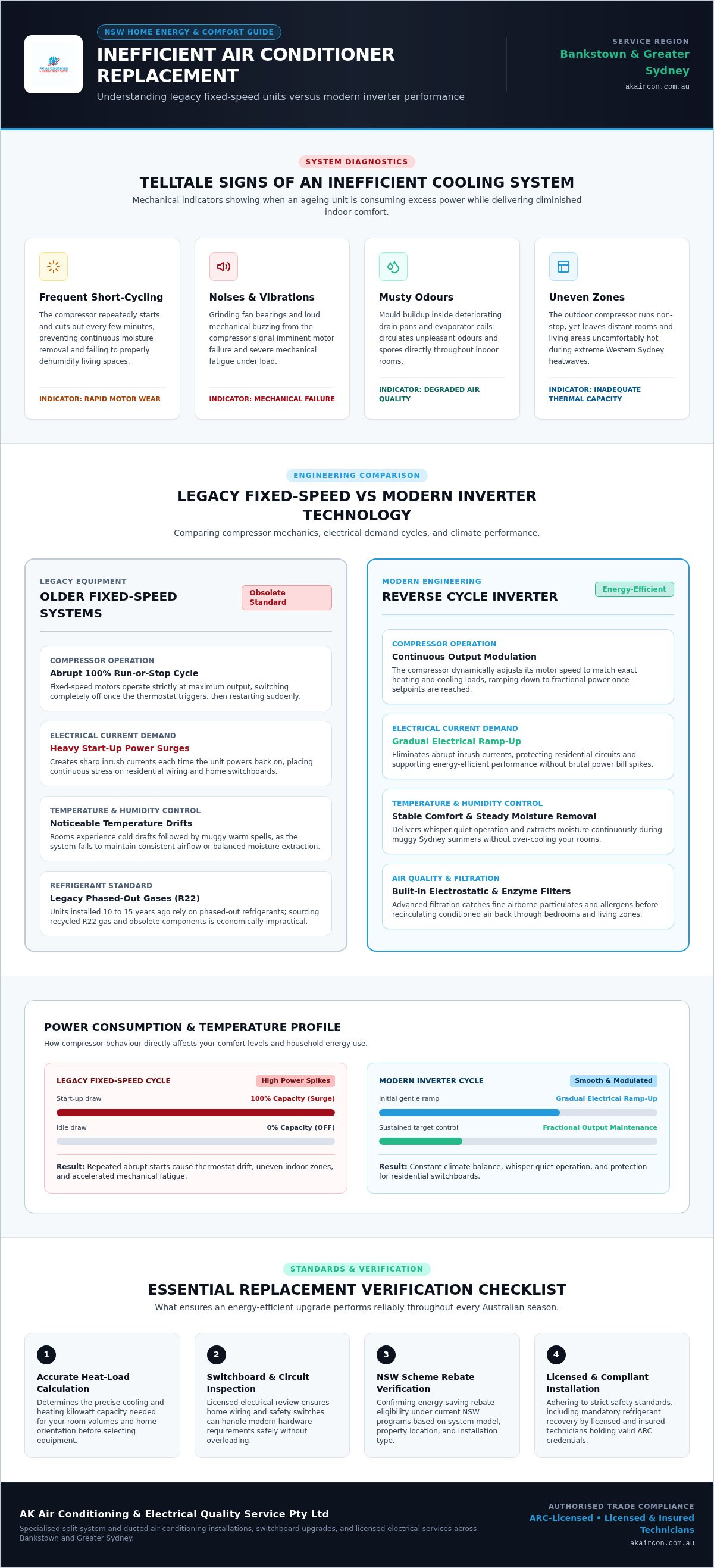
- Frequent short-cycling: The compressor constantly cuts in and out every few minutes, failing to dehumidify the room.
- Mechanical noises and vibrations: Grinding fan bearings or loud buzzing from the compressor indicate imminent motor failure.
- Persistent musty odours: Mould buildup within deteriorating drain pans and coils circulates spores throughout your home.
- Uneven indoor zones: The unit runs continuously yet leaves distant living spaces uncomfortably hot during heatwaves.
Escalating Power Bills and Declining Temperature Control
A sudden jump in quarterly electricity accounts without an increase in run-time is a classic red flag. As internal compressor components wear down, they draw significantly higher electrical current to generate the same cooling output. During extreme summer heat, older systems simply cannot achieve the set temperature on your thermostat. Clogged evaporator coils and tired blower motors further restrict circulation, degrading indoor air quality and putting constant strain on your home wiring.
Obsolete Refrigerants and Constant Mechanical Repairs
Systems installed 10 to 15 years ago frequently rely on legacy refrigerants like R22, which have been phased out due to environmental regulations. Sourcing recycled R22 gas or obsolete replacement circuit boards is exceedingly expensive, making ongoing patch-ups economically impractical. Reviewing your recent air-conditioning service inspection report will clarify whether repeated part failures signal that an inefficient air conditioner replacement NSW homeowners opt for is the sensible, permanent remedy.
Comparing Old Cooling Units Against Modern Inverter Technology
The gap between older cooling equipment and modern reverse cycle engineering comes down to how compressors operate. Legacy systems rely on fixed-speed motors that run at 100% capacity before shutting off entirely once the thermostat is satisfied. Every time the indoor temperature drifts, the compressor kicks back on with an abrupt draw of power. Completing an inefficient air conditioner replacement NSW homeowners plan today transitions the home to inverter technology, where the compressor continuously modulates its output to match the precise heating or cooling demand of your space.
Modern inverter systems also deliver distinct advantages beyond temperature control:
- Smooth modulation: The compressor ramps down to fractional power once target conditions are reached, maintaining whisper-quiet operation.
- Superior humidity control: Steady airflow extracts moisture continuously during muggy Sydney summers without over-cooling rooms.
- Advanced air filtration: Built-in electrostatic and enzyme filters catch fine airborne particulates and allergens before air circulates back into your bedrooms.
- Gradual electrical ramp-up: Inverters eliminate heavy inrush currents, protecting residential wiring from repetitive electrical shock.
Fixed-Speed Compressors Versus Variable-Speed Inverters
Fixed-speed units behave like an engine that only operates flat-out or completely switched off. This aggressive cycling causes jarring room temperature swings of two to three degrees, leaving you feeling chilly one minute and stuffy the next. In contrast, variable-speed inverters gently idle at low speeds once target comfort is established. By eliminating heavy stop-start surges, an inverter system operates far more predictably, providing stable comfort across open-plan living zones and quiet environments for sleeping.
Understanding Zoned Energy Rating Labels in New South Wales
When assessing new models, the mandatory Australian Zoned Energy Rating Label provides an accurate picture of seasonal efficiency. The label splits Australia into three distinct climate zones: Hot, Average, and Cold. Greater Sydney sits within the Average climate zone, meaning you should evaluate the star rating in that specific middle band rather than looking at a single national figure.
Each additional star rating on the label equates to roughly a 15% to 25% reduction in electricity consumption for units of equivalent output. Comparing both heating and cooling stars lets you choose equipment matched to local weather patterns. If you need assistance matching star ratings to your home layout, you can speak with our licensed team for honest guidance on selecting a compliant inverter model.
Navigating NSW Air-Conditioning Rebate Eligibility for Upgrades
Government energy incentives can significantly lower the barrier to upgrading an ageing cooling system, but misleading online marketing has left many Sydney households sceptical. Claims of completely free air conditioner installations flood social media, yet genuine government initiatives operate under strictly defined criteria. In New South Wales, residential upgrade discounts run primarily through the Energy Savings Scheme (ESS), where the incentive functions as an upfront deduction on your quote rather than a cash refund sent after the fact.
To qualify for an inefficient air conditioner replacement NSW discount under these schemes, your project must follow a compliant process:
- Step 1: Check property suitability: The property must be an existing home or small business premises with a functional, inefficient cooling system currently installed.
- Step 2: Confirm replacement criteria: The existing unit must meet the age and performance thresholds defined under current NSW energy regulations, rather than being an empty space requiring a brand-new first-time install.
- Step 3: Select an approved unit: The replacement model must meet strict Minimum Energy Performance Standards, typically drawn from approved product lists from brands like Daikin or ActronAir.
- Step 4: Engage licensed and insured technicians: Work must be carried out by qualified installers operating with an authorised Accredited Certificate Provider (ACP).
- Step 5: Settle the mandatory co-payment: You must sign compliance paperwork and pay the required customer contribution to finalise the certificate creation.
Criteria for Household Energy-Saving Upgrades in NSW
Incentives are designed solely for replacing existing, working hardware with high-efficiency alternatives, meaning brand-new builds and empty rooms do not qualify. Certificate values fluctuate based on geographic location, system capacity, and the tested efficiency rating of the new model. Because rules can change, reviewing our detailed guide to claiming the NSW air con rebate will help you confirm whether your specific system meets the latest requirements before booking work.
Why Mandatory Co-Payments and Certified Installers Protect You
A legitimate inefficient air conditioner replacement NSW program strictly enforces a mandatory co-payment paid by the customer. Any contractor advertising a completely free replacement is either ignoring program guidelines, cutting corners on electrical safety, or installing discontinued hardware that fails to meet current performance rules. Engaging an accredited provider ensures that your installation receives a proper Certificate of Compliance for Electrical Work, protecting your manufacturer warranty and your home insurance cover.
Planning Your Replacement: Sizing, Switchboards, and Layout
Selecting the right replacement involves far more than simply checking floor area. A properly executed inefficient air conditioner replacement NSW project requires a thorough assessment of your building structure, electrical infrastructure, and daily living patterns. Homes across Bankstown and neighbouring suburbs feature diverse architectural styles, from double-brick builds to lightweight timber-frame extensions. Each layout absorbs and retains heat differently during peak summer conditions.
Before specifying a system size, a qualified technician calculates thermal load based on key environmental factors:
- Ceiling insulation and roof design: Missing or degraded insulation dramatically accelerates heat transfer through ceiling plaster.
- Window orientation and glazing: Large west-facing windows without external shading generate intense radiant heat loads on summer afternoons.
- Ceiling volume and layout: High ceilings, stairwells, and open-plan hallways demand higher airflow volume to circulate conditioned air effectively.
- Air infiltration: Older homes with drafty floorboards or loose door seals require careful sizing to offset ongoing ambient air leakage.
Sizing Split System and Ducted Options for Local Climates
Undersized units run continuously at maximum speed, driving up electricity usage while failing to reach set temperatures during heatwaves. Oversized units cool spaces too rapidly without running long enough to pull humidity from the air, leaving rooms feeling clammy. For single rooms, home offices, or individual bedrooms, a split system aircon installation delivers responsive, room-by-room comfort. For whole-home climate management, a ducted air conditioning installation allows you to divide the house into distinct zones, directing airflow only to occupied areas.
Assessing Electrical Safety and Switchboard Capacity
Upgrading to modern reverse cycle technology frequently highlights issues in older electrical infrastructure. Many homes built several decades ago still feature ceramic fuses and outdated sub-boards that cannot safely handle the electrical draw of modern heating and cooling systems. Contemporary safety standards require dedicated circuit protection and modern residual current devices (safety switches). Having an air conditioning electrician evaluate your switchboard ensures your domestic power supply can support the new unit safely without nuisance tripping.
Organising a Licensed and Compliant Installation in Greater Sydney
Executing an inefficient air conditioner replacement NSW homeowners can rely on involves strict technical protocols on installation day. Swapping an obsolete cooling unit is never just a matter of mounting fresh equipment onto existing brackets. A high-performing system depends entirely on proper pipework geometry, clean refrigerant line evacuation, and safe electrical connections. Cutting corners during the physical installation compromises overall efficiency and drastically shortens compressor lifespan.
Every licensed and compliant installation requires systematic technical execution across several key areas:
- Refrigeration line flushing and pressure testing: Nitrogen pressure testing ensures copper lines are free of micro-leaks before charging the circuit.
- Vacuum dehydration: Deep evacuation removes ambient moisture and non-condensable gases from pipework to prevent internal chemical contamination.
- Drainage gradient verification: Condensate lines must maintain continuous downward fall to prevent water damage to ceilings or wall cavities.
- Outdoor condenser siting: Placing the outdoor unit off the ground on vibration-dampening mounts in a well-ventilated, shaded zone maximises heat dispersal.
The On-Site Assessment and Safe Decommissioning Process
Under Australian environmental protection law, recovering legacy synthetic greenhouse gases is mandatory. An ARC-licensed technician must reclaim the old unit's refrigerant into dedicated recovery cylinders for authorised destruction rather than venting it into the atmosphere. The team positions your new outdoor unit away from direct, harsh afternoon sunlight and cleans up all decommissioned hardware. Once the replacement is secured and wired, you receive an official Certificate of Compliance for Electrical Work confirming the installation satisfies Australian Standards.
Protecting Your Investment with Preventative Servicing
Ongoing care preserves your unit's energy star rating and keeps operational noise to a whisper. A structured preventative maintenance plan carried out by licensed and insured technicians ensures operating pressures, indoor barrel fans, electrical terminals, and safety isolators receive annual inspections. Regular filter cleans by the homeowner, paired with professional checks, safeguard your manufacturer warranty and keep energy consumption minimal across every season. Ready to replace your ageing cooling system? Contact AK Air Conditioning for an assessment today.
Take Control of Your Home Comfort and Energy Efficiency
Upgrading an obsolete cooling system gives you back control over indoor temperatures while preventing seasonal energy spikes. Planning an inefficient air conditioner replacement NSW homeowners can rely on means looking past misleading promotional claims, sizing equipment accurately for Sydney's climate, and verifying that your domestic wiring meets current safety regulations.
At AK Air Conditioning & Electrical Quality Service, our fully licensed and insured technicians hold both air conditioning and electrical licences alongside national ARC accreditation. Whether you need a single-room split system or whole-home ducted zoning, we supply and install leading systems from Daikin, Mitsubishi, Fujitsu, and ActronAir, carrying out necessary switchboard upgrades under one roof.
Investing in modern reverse cycle heating and cooling ensures your family stays comfortable through scorching summer heatwaves and crisp winter mornings alike.
Frequently Asked Questions
How do I know if my old air conditioner is too inefficient to keep running?
Your system is likely inefficient if it runs constantly without reaching your set temperature, produces steep quarterly energy bills, or requires frequent mechanical repairs. Units older than 10 to 15 years rely on obsolete compressors and outdated refrigerants. Arranging a professional inspection helps confirm whether an inefficient air conditioner replacement NSW homeowners book will prevent recurring repair costs and lower seasonal energy demands across your property.
Can every Sydney homeowner claim an air-conditioning rebate in NSW?
No, eligibility varies based on your property, location, and the specific equipment you replace. Government incentives under schemes like the NSW Energy Savings Scheme apply to replacing functional, inefficient systems in existing homes, not newly built premises. The replacement unit must also meet approved energy efficiency thresholds, and the upgrade must be completed by an accredited installer to generate valid energy certificates.
Why is a mandatory co-payment required for energy-saving rebate upgrades?
A mandatory co-payment is legally required under government energy-saving programs to ensure compliance, valid certificate creation, and consumer protection. This required contribution confirms that the property owner approves the work and prevents rogue traders from installing cut-price, non-compliant equipment under false free claims. Paying a compliant co-payment guarantees you receive legitimate trade documentation, including a Certificate of Compliance for Electrical Work, protecting your warranties.
What is the difference between an inverter and an older fixed-speed air conditioner?
Fixed-speed units operate on an all-or-nothing cycle, running at maximum power until shutting off, which creates harsh power surges and temperature swings. Inverter air conditioners continuously vary their compressor motor speed to match room demand. Once the room reaches the desired temperature, the inverter idles gently, keeping the space comfortable while drawing significantly less power than older stop-start systems.
Will I need to upgrade my electrical switchboard when replacing an old unit?
You will likely need a switchboard upgrade if your Sydney home still relies on old ceramic fuses or lacks dedicated safety switches. Modern reverse cycle air conditioners require dedicated circuit breakers and residual current devices to meet current Australian safety standards. A dual-licensed technician inspects your switchboard during assessment to ensure your electrical sub-board can safely support the increased capacity of your replacement system.
How long does a standard residential air conditioner replacement take?
A straightforward single-split system replacement typically takes between three to five hours to complete. Replacing a whole-home ducted air conditioning system usually takes a full day, depending on ductwork condition, roof cavity access, and switchboard requirements. During this time, technicians safely decommission the old hardware, test the existing infrastructure, install the new indoor and outdoor components, and commission the entire system.
What happens to the old unit and toxic refrigerants during removal?
Australian environmental law requires that an ARC-licensed technician reclaims all chemical refrigerant into sealed recovery bottles before removing the system. Venting fluorocarbon refrigerants into the air is illegal and damages the ozone layer. After refrigerant recovery, technicians disconnect the electrical wiring and dismantle the indoor and outdoor hardware. Metal components and decommissioned materials are then transported to authorised recycling depots for compliant, environmentally responsible disposal.
Important Information
This article provides general information only. Air-conditioning requirements, installation costs, energy savings and rebate eligibility vary between properties and systems. NSW program rules, certificate values and eligible models may change. Contact AK Air Conditioning & Electrical Quality Service Pty Ltd for a property-specific assessment and confirmation of current eligibility before making a purchase or installation decision.


