
If your air conditioner still cools the room, is there a reason to maintain it before a fault appears? Yes. The benefits of regular aircon maintenance include checking the system’s condition and identifying developing issues before they affect comfort, especially when Sydney’s hot weather puts your unit to work.
Maintenance can’t prevent every fault or guarantee lower energy use, but it can give you a clearer picture of how your system is operating. You can also help keep airflow clear by caring for accessible filters according to the manufacturer’s instructions. A professional service can assess the unit and explain any issues that may need attention.
This guide covers what routine maintenance can realistically achieve, how it differs from repairs, and which changes may call for professional attention. It also explains practical care for split, multi-split and ducted systems, with local servicing from AK Air Conditioning & Electrical Quality Service for homes and businesses around Bankstown and nearby Sydney suburbs.
Key Takeaways
- The benefits of regular aircon maintenance include checking system condition and spotting developing performance issues, but servicing can’t prevent every fault.
- Clean filters and clear airflow can support system performance. Follow your manufacturer’s instructions for routine care.
- Plan an assessment before a period when you expect to rely heavily on heating or cooling, particularly if you have noticed a change in performance.
- Know which changes, such as persistent weak airflow or unusual noises, may warrant professional attention.
- Split, multi-split and ducted systems have different layouts and maintenance needs. AK Air Conditioning & Electrical Quality Service services systems in Bankstown and nearby Sydney suburbs.
Why regular aircon maintenance matters for Sydney homes
An air conditioner may seem to work perfectly in mild weather, then struggle when the household relies on it for longer periods. Weak airflow, a new noise or uneven heating and cooling can become more noticeable as demand rises. Maintenance gives you an opportunity to have the system assessed before a performance concern becomes a bigger disruption.
The benefits of regular aircon maintenance are practical, not a promise that your system will never fail. An assessment may identify an issue that needs attention, while routine care can help keep the system operating as intended. The findings depend on the unit’s condition and what can be observed during the service.
For a general overview of how air conditioning works, see Air conditioning systems and maintenance.
How maintenance supports everyday comfort
Airflow and the condition of system components can affect how evenly air moves through a room or home. If airflow seems weaker than usual, or one area feels different from another, an assessment can help establish whether the system needs attention. This is useful during hot or cool spells, when you may run the air conditioner more often and rely on it for everyday comfort.
Why waiting for a breakdown can be inconvenient
A fault during a period of heavy use can interrupt comfort when you need heating or cooling. An earlier assessment may identify wear, an obstruction or another operating concern that warrants attention. It won’t reveal every future problem or rule out sudden faults, but it can help you understand the system’s current condition.
If your unit has changed how it operates, note what you’ve observed, such as unusual sounds, weaker airflow or inconsistent heating and cooling. These details help a technician understand the concern. AK Air Conditioning & Electrical Quality Service provides servicing and repairs for split, multi-split and ducted systems around Bankstown and nearby suburbs. Find out more about air conditioning servicing and repairs.
How aircon maintenance supports efficiency, airflow and indoor air quality
Aircon maintenance involves inspecting and caring for system components to help them operate as designed. The appropriate work depends on the system, its condition and the manufacturer’s guidance. A split system, multi-split system and ducted system have different layouts, so the same checklist won’t suit every home.
Airflow is one practical part of the assessment. Dust on a filter or an obstruction in an air pathway may reduce the amount of air moving through the system. The unit may then struggle to distribute heating or cooling as intended. Airflow changes can have other causes too, so an inspection helps establish what may be affecting the system.
Keeping accessible airflow pathways clear supports the air conditioner’s intended operation.
Airflow, filters and system performance
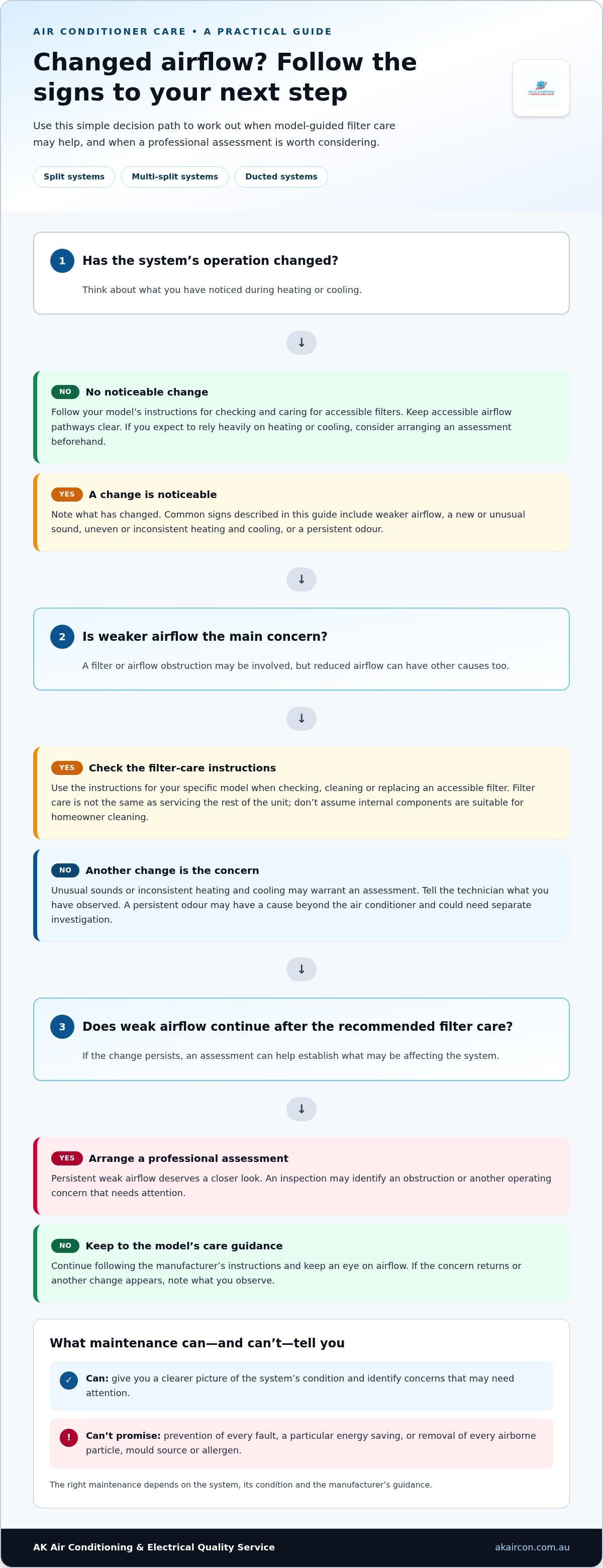
A filter catches some airborne particles before air passes through the system. Dust can build up over time, and a dirty or obstructed filter may limit airflow. You might notice weaker air from an outlet or uneven heating and cooling, though those signs can have other causes. Follow your model’s instructions when checking, cleaning or replacing a filter.
Basic filter care is not the same as servicing the rest of the unit. Don’t assume every filter can be cleaned in the same way, or that internal components are suitable for homeowner cleaning. Use the model-specific instructions rather than improvising. If reduced airflow continues after the recommended filter care, arrange an assessment.
- Check the user instructions for how to access and care for the filter.
- Notice whether airflow from the outlets changes or varies between rooms.
- Arrange an assessment if reduced airflow persists after the recommended filter care.
The benefits of regular aircon maintenance include a clearer understanding of how the system is operating. An inspection can’t promise a particular efficiency level or energy saving. The system’s condition and the technician’s findings matter.
What maintenance can and cannot do for indoor air
Dust or residue within parts of an air conditioner may contribute to airflow or odour concerns. Inspection and appropriate cleaning may address some system-related causes, but servicing doesn’t remove every airborne particle, mould source or allergen from a home. A persistent smell or indoor air quality concern may have a cause beyond the air conditioner and could need separate investigation.
Aircon servicing is not a substitute for mould remediation or medical advice. Treat an ongoing concern as a separate issue rather than assuming an air conditioner service will resolve it. Tell the technician about persistent odours or airflow changes so they can assess the system without making claims beyond what the inspection shows.
If you’ve noticed a persistent change in airflow or an unusual odour, you can contact the local team to discuss an aircon assessment.
Does regular aircon maintenance prevent breakdowns? What it can realistically do
Routine maintenance is preventive care, not a guarantee against breakdowns. A system can develop a fault between visits, and some failures may occur without an obvious warning. An assessment gives a technician an opportunity to check the system’s condition and identify concerns that may need attention.
A technician may find signs of wear, an obstruction or an operating issue. Addressing a concern early can help you understand what is happening before symptoms worsen, but maintenance can’t promise that a fault will be avoided or that future repairs won’t be needed.
Servicing can flag concerns early, but it cannot predict or prevent every failure.
Early detection is useful, but not a guarantee
An assessment is a snapshot of the system at that time. A technician can look for visible wear or blockages and assess how the unit is operating. Findings depend on the system and what can be observed or tested during the visit. Even if nothing concerning appears, a new fault may still develop later.
Think of maintenance as informed care, not a promise of uninterrupted operation, a longer system life or fewer repairs. The benefits of regular aircon maintenance depend on the equipment’s condition and what an inspection finds. Keeping service records helps you track previous concerns and explain changes in performance at a later visit.
When a symptom calls for a repair assessment
A system that starts making an unusual noise, produces weaker airflow or operates inconsistently may need more than a routine check. These signs don’t identify a fault on their own. If they persist or worsen, arrange an assessment rather than assuming standard maintenance will resolve them.
Describe what has changed and when you first noticed it. For example, note whether a sound occurs at start-up or continues while the unit runs, or whether airflow differs between outlets. These observations give the technician useful context, but you don’t need to diagnose the cause yourself.
Servicing and repair work have different purposes. Servicing assesses the system and may highlight an issue; a repair addresses a fault identified during diagnosis. The next step depends on the findings, not simply on whether the unit has received routine maintenance. For persistent symptoms, AK Air Conditioning & Electrical Quality Service provides air conditioning servicing and repairs around Bankstown and nearby Sydney suburbs.
After an assessment, ask for a clear explanation of what the technician observed and whether it calls for further work. This helps you distinguish a maintenance finding from a confirmed fault and make an informed decision. Routine checks can be useful, but they aren’t a substitute for investigating persistent or worsening symptoms.
Sydney aircon maintenance: when to book and DIY tips
There isn’t one service schedule for every air conditioner. Timing depends on the manufacturer’s instructions, how often you use the system, its age and the conditions around it. A unit used regularly for heating and cooling may have different needs from one that runs occasionally. Check the manual for model-specific guidance rather than relying on a universal interval.
It can be practical to arrange an assessment before a period when your household expects to rely more heavily on heating or cooling. That gives you time to discuss concerns before demand increases. It doesn’t guarantee that the system won’t develop a fault, but it can help you understand its condition and whether it needs attention.
Choosing a sensible time for professional attention
Consider the unit’s age, how frequently it operates and any changes you’ve noticed, alongside the manufacturer’s care instructions. Heavy use or inconsistent operation can be useful context when deciding whether to seek an assessment. Your service history can also help guide a discussion about checks that suit the system.
Simple observations between professional services
Between services, pay attention to changes rather than trying to diagnose them. Follow the manual for accessible filter care and other routine user checks, but leave internal components and technical work to a qualified technician. If the instructions don’t describe a task as user maintenance, don’t attempt it yourself.
Keep an eye out for:
- Airflow that seems weaker or less consistent than usual.
- New or unusual sounds during operation.
- Odours that persist when the system runs.
- Heating or cooling that feels uneven compared with the system’s usual operation.
These observations don’t identify a fault by themselves, but they give you useful information to share if you arrange professional attention. If a change persists or worsens, don’t rely on filter care alone to resolve it.
A simple record can make maintenance easier to plan, especially for landlords or property managers keeping track of equipment across a home. Note the date of each service, the system’s reported condition and any recommendations. Keep the manufacturer’s instructions with those records so you can refer to the correct guidance later.
Use this short sequence to organise your next steps:
- Check instructions: Find the manufacturer’s guidance for your system and follow its advice on user maintenance.
- Note symptoms: Record changes in airflow, noise, odour or consistency, including when they occur.
- Arrange an assessment: Seek professional attention if symptoms persist, worsen or fall outside the manual’s user-care guidance.
- Keep service records: Save assessment details and recommendations for future reference.
These steps help you approach care methodically. The benefits of regular aircon maintenance depend on the equipment and its condition, so use the manual and professional findings to guide decisions rather than assuming every system needs the same work.
Professional aircon maintenance in Sydney: what to expect from a local service
A professional aircon assessment should take account of your equipment, the concerns you’ve noticed and the manufacturer’s guidance. It isn’t a one-size-fits-all checklist. The aim is to assess the system’s condition and explain the findings clearly, so you can understand whether further attention may be needed.
AK Air Conditioning & Electrical Quality Service provides air conditioning servicing and repairs for residential and commercial clients across Bankstown and surrounding Sydney suburbs. The team services split, multi-split and ducted systems, with the assessment shaped by the equipment and the concerns you report.
A service assessment should suit the aircon system
Split, multi-split and ducted systems have different layouts, so their assessment needs can differ. The technician should consider the equipment type, its current condition and any symptoms you describe. Manufacturer guidance also helps inform the assessment. This keeps the discussion relevant to your system instead of assuming every unit requires identical attention.
Before the visit, note what you’ve observed and when it happens. You might mention a change in operation or a concern that appears only in a particular area. Share the system’s service history or manual if available. These details give the technician useful context without requiring you to identify the cause.
Local support for Bankstown and surrounding suburbs
AK Air Conditioning & Electrical Quality Service provides local air conditioning support in Bankstown, Yagoona, Greenacre, Punchbowl, Bass Hill, Condell Park, Revesby, Padstow, Panania, Chester Hill, Auburn, Parramatta, Liverpool, Fairfield, Strathfield, Campsie, Blacktown, Seven Hills and Lalor. The business states that its technicians are licensed and insured, and that it is ARC-licensed. These credentials are relevant when arranging air conditioning work, while the assessment itself remains focused on your equipment, its symptoms and the manufacturer’s instructions.
The benefits of regular aircon maintenance are best understood as a clearer view of system condition, not a promise that every issue will be found or prevented. A professional can explain what the assessment shows and discuss next steps based on the findings. The work required may vary with the system and its condition, so advice should relate to the unit being assessed.
If you’re arranging maintenance for a home, rental property or workplace, have the system type and any changes in operation ready to discuss. You can also share previous service information, which may help put current observations in context.
Choose a clear next step for your air conditioner
You don’t need to wait for heating or cooling to stop completely before considering your system’s condition. If you’ve noticed a change, or want to plan care in line with the manufacturer’s guidance, an assessment can help you decide what needs attention. The benefits of regular aircon maintenance are clearest when care is guided by your particular system’s condition, rather than assumptions about what every unit needs.
Before arranging an assessment, gather any available model information and service records, and note the changes you’ve observed. This gives the discussion a practical starting point and helps focus attention on your system and concerns. You can then consider the technician’s findings and decide on an appropriate next step without expecting routine servicing to prevent every future fault.
A considered approach helps you care for your air conditioner as its needs change. A clear assessment can help you make an informed decision about what to do next.
With a clearer picture of your system, you can move forward with confidence.
Frequently Asked Questions
How often should an air conditioner be professionally serviced?
Follow the service guidance in your air conditioner’s manual, as recommended timing can vary by model and conditions. How often you use the system may also matter: a unit used for heating and cooling throughout the year has a different workload from one used occasionally. If you can’t find the manual, note the make and model and discuss the recommended schedule with a technician.
Does aircon maintenance lower electricity bills?
Maintenance may address conditions that affect how a system operates, but it can’t guarantee lower electricity bills. Your bill also depends on factors such as how often you run the unit, your settings, your home and the system’s condition. If you’re concerned about consumption, compare your usage over time and ask a technician to assess the unit rather than assuming a service will produce a set saving.
Can regular aircon maintenance extend the life of a system?
Good maintenance supports informed care, but it can’t promise that a system will last longer or reach a particular lifespan. The benefits of regular aircon maintenance depend on the equipment’s condition, how it’s used and any issues found during assessment. If you’re deciding whether to maintain an older unit or consider replacement, arrange an assessment of its current condition and discuss the options in light of the findings.
What does a professional aircon service include?
The work depends on the system, its condition, your reported concerns and the manufacturer’s guidance, so there isn’t one fixed task list for every service. A professional assessment may involve checking how the unit operates and examining relevant components. Tell the technician about changes you’ve noticed and provide any service history. They can explain what they assessed and whether the findings point to maintenance or a repair.
Can I maintain my air conditioner myself?
Yes. You can carry out user care described in the manufacturer’s instructions, such as checking an accessible filter if the manual allows it. Permitted tasks differ between models, so don’t assume instructions for one unit apply to another. Leave internal components and technical work to a qualified technician. If you’re unsure whether a task is intended for the owner, check the manual before proceeding.
Should I arrange aircon maintenance before summer in Sydney?
Planning an assessment before summer can be sensible if your household expects to rely more on cooling during warmer weather. It gives you an opportunity to raise concerns before demand increases, particularly if the system has been running heavily or its condition is uncertain. There’s no universal booking date for every home, so consider the unit’s service history, how often you use it and the manufacturer’s guidance.
Why does my air conditioner smell musty when it runs?
A musty smell can be associated with moisture or residue in the air conditioner, but the odour alone can’t confirm its cause. Notice whether it starts immediately, continues throughout operation or returns after filter care permitted by the manual. Don’t try to clean internal parts unless the manufacturer identifies them as user-accessible. If the smell persists or worsens, arrange an assessment so the system can be checked.
Important Information
This article provides general information only. Air-conditioning requirements, installation costs, energy savings and rebate eligibility vary between properties and systems. NSW program rules, certificate values and eligible models may change. Contact AK Air Conditioning & Electrical Quality Service Pty Ltd for a property-specific assessment and confirmation of current eligibility before making a purchase or installation decision.


