
Simply purchasing a high-star cooling unit does not guarantee you will secure a government discount. If you are trying to work out what air conditioners are eligible for rebate nsw incentives, the criteria involve much more than just picking a popular model off the shelf.
Trying to interpret Zoned Energy Rating Labels, seasonal performance requirements, and Energy Savings Scheme rules can be genuinely confusing. It is completely natural to worry about selecting a non-compliant system, missing out on financial incentives, or getting stuck trying to manage administrative paperwork yourself.
In this guide, you will discover the exact energy efficiency thresholds required to qualify, along with proven reverse cycle split system and ducted options from trusted manufacturers like Daikin, Mitsubishi Electric, and ActronAir. We also explain how licensed technicians assess your switchboard readiness and handle compliance requirements, keeping your home upgrade straightforward from day one.
Key Takeaways
- Understand what air conditioners are eligible for rebate nsw incentives under the Energy Savings Scheme when replacing older, inefficient setups.
- Learn how the Zoned Energy Rating Label determines compliance for the Sydney climate and why seasonal ratings matter.
- Discover which high-efficiency reverse cycle units from trusted brands like Daikin, Mitsubishi Electric, and ActronAir meet scheme criteria.
- Find out how room sizing, home insulation, and switchboard capacity dictate whether a split system or ducted air conditioning installation suits your property.
- See why choosing licensed and insured technicians ensures all compliance checks and nomination paperwork are completed before installation starts.
NSW Energy-Saving Rebate Rules: What Makes an Air Conditioner Eligible?
Homeowners across Sydney often ask what air conditioners are eligible for rebate nsw incentives when upgrading their cooling and heating. Financial incentives for households run under the NSW Energy Savings Scheme (ESS), which operates to lower electricity demand and cut grid emissions across the state.
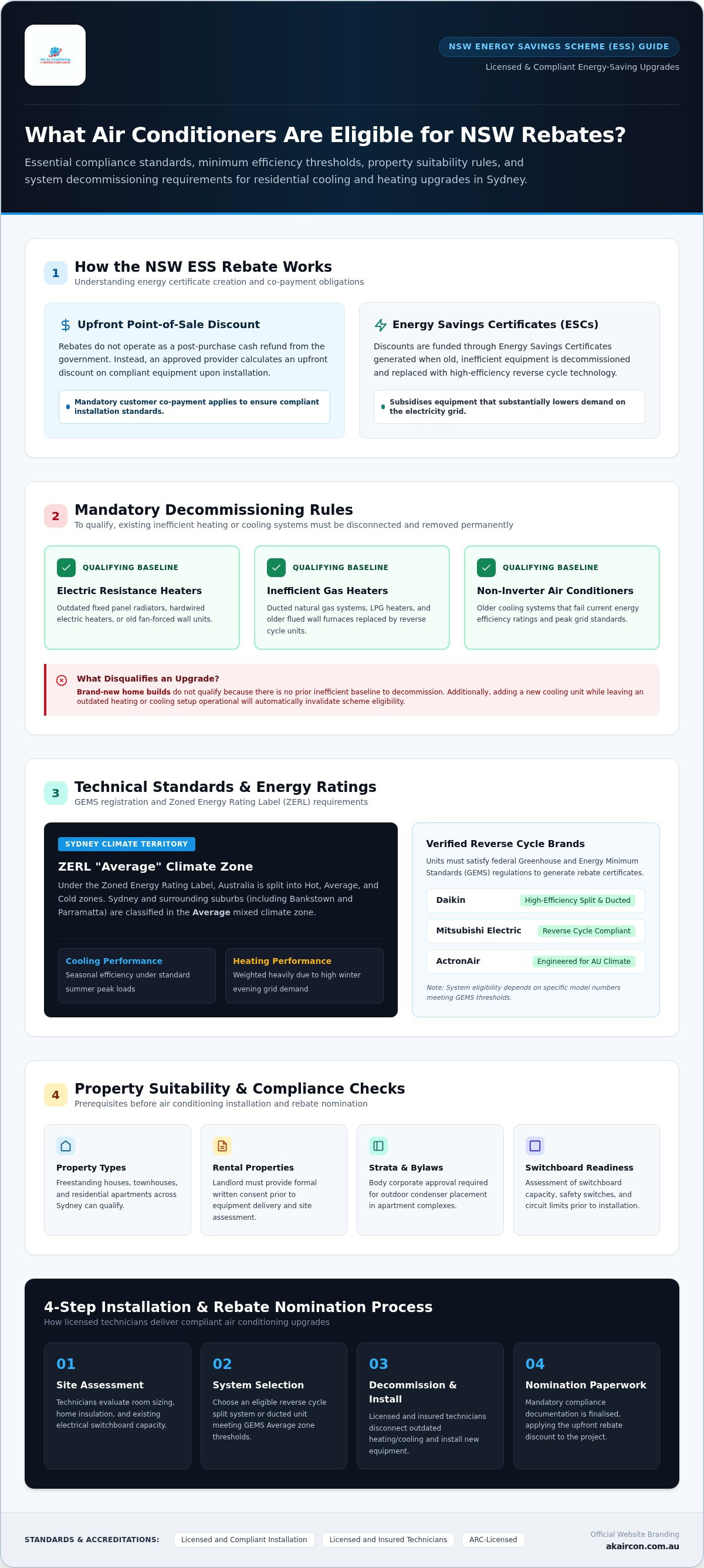
Rebates do not function as a post-purchase cash refund from the government. Instead, an approved provider calculates an upfront discount on compliant equipment, requiring a mandatory co-payment from the homeowner to ensure quality work and compliant installation standards.
To understand how state upgrade incentives and certificates operate across New South Wales, watch this helpful overview:
Core Objectives of the NSW Energy Savings Scheme
The ESS operates by generating Energy Savings Certificates when older, inefficient equipment is removed and replaced. These certificates follow foundational principles of energy conservation by subsidising equipment that draws substantially less power from the electricity grid. Brand-new home builds generally do not qualify for these specific upgrade incentives because there is no prior inefficient baseline to decommission.
Existing Heating and Cooling Systems That Qualify for Upgrades
A central rule that many online summaries overlook is decommissioning. To establish energy-saving rebate eligibility, you must decommission an existing, inefficient heating or cooling system. Qualifying baseline equipment includes:
- Outdated electric resistance space heaters, such as fixed panel radiators or old fan-forced wall units.
- Inefficient gas heaters, including ducted natural gas systems and flued wall furnaces.
- Older, non-inverter air conditioners that fail current efficiency standards.
Simply adding a new cooling unit to a bedroom while leaving an outdated system operational will disqualify your property. The older equipment must be disconnected and removed permanently.
Essential Property and Location Requirements Across Sydney
Property layout directly shapes your eligibility. Freestanding houses, townhouses, and residential apartments across Bankstown, Parramatta, and surrounding Western Sydney suburbs can qualify. For rental properties, the landlord must provide formal written consent before any equipment delivery or assessment occurs. If you live in an apartment or townhouse complex, strata bylaws and body corporate approvals regarding external condenser placement must be resolved ahead of time. Our team at AK Air Conditioning & Electrical Quality Service provides professional air conditioning supply and installation to help you determine site suitability before starting work.
Technical Standards: Minimum Star Ratings and Energy Requirements
Understanding what air conditioners are eligible for rebate nsw programs requires looking past simple showroom marketing. Equipment must meet strict seasonal performance criteria registered under federal Greenhouse and Energy Minimum Standards (GEMS) regulations to generate certificates under the scheme.
Energy efficiency standards are set rigorously because the state aims to slash household power consumption during seasonal grid peaks. As a result, not every reverse cycle unit sold in retail outlets meets the qualification baseline.
Decoding the Zoned Energy Rating Label for NSW Homes
The Zoned Energy Rating Label (ZERL) breaks Australia into three climate territories: Hot, Average, and Cold. Sydney and its surrounding suburbs, including Bankstown and Liverpool, fall strictly into the "Average" mixed climate zone. To satisfy ESS requirements, a unit's performance numbers in this specific zone are what matter.
Government calculations place significant weight on heating seasonal performance alongside cooling output. Because heating typically demands greater electrical load during cold winter evenings, a unit must achieve high efficiency in both cycles to qualify for upfront discounts.
Split System Air Conditioning Requirements
For a wall-mounted split system to meet rebate standards, it must incorporate an advanced inverter-driven compressor capable of modulating its output. Single-speed compressors do not qualify. Key technical benchmarks include:
- Meeting elevated star ratings for both heating and cooling within the Average climate zone.
- Compliance with Demand Response Enabling Device (DRED) standards, allowing the system to communicate with network load-management infrastructure.
- Accurate capacity matching, ensuring the kilowatt output fits the room size without overworking the compressor.
Ducted Air Conditioning Standards and Zoning Efficiency
Central systems face even higher operational scrutiny. A ducted air conditioning installation must deliver excellent Seasonal Energy Efficiency Ratios (SEER) while maintaining variable-speed airflow control. Inefficient fixed-speed ducted motors simply draw too much baseline power to pass scheme hurdles.
Zoning controls also play a massive role in whole-home performance. Dividing the layout into distinct zones prevents conditioned air from pouring into unoccupied rooms, keeping total power draw within compliant thresholds. If you need assistance checking whether a particular model meets these heating and cooling ratios, feel free to contact our licensed team for an assessment before you commit to a purchase.
Eligible Air Conditioner Brands and Models for Sydney Properties
Homeowners exploring what air conditioners are eligible for rebate nsw incentives often get stuck navigating model registries without knowing which trusted household names actually qualify. Rather than guessing from dry technical databases, you can focus on well-established manufacturers that engineer compliant reverse cycle systems for our climate.
Selecting an established brand ensures reliable performance, accessible replacement parts, and manufacturer warranty backing long after installation is finished.
Daikin High-Efficiency Split and Ducted Systems
Daikin remains a benchmark brand across Sydney homes. Their premium split systems feature intelligent eye sensors that adjust airflow and switch to power-saving modes when a room is empty. For larger homes, Daikin inverter ducted systems deliver quiet airflow through variable-speed indoor fan coils, maintaining optimal seasonal efficiency during hot Western Sydney summers and chilly winter mornings.
Mitsubishi Electric and Mitsubishi Heavy Industries Options
Both Mitsubishi Electric and Mitsubishi Heavy Industries build reverse cycle units that consistently meet state efficiency benchmarks. Mitsubishi Electric systems are well-regarded for whisper-quiet operation and dual-barrier filtration coatings that keep internal components cleaner for longer. Mitsubishi Heavy Industries reverse cycle wall units offer high heating performance ratios, making them excellent solutions for bedrooms and living areas across suburbs like Condell Park and Yagoona.
ActronAir and Fujitsu Energy-Efficient Solutions
Engineered locally, ActronAir systems are designed specifically for Australian temperature swings, operating smoothly even when ambient temperatures spike past 45 degrees Celsius. Their multi-zone ducted technology directs conditioned air precisely where you need it, cutting unnecessary electricity consumption. Similarly, Fujitsu delivers high-efficiency split systems featuring human sensor controls that reduce power draw automatically. To review compliant options suited to your home, explore our tailored supply and installation options across these reputable brands.
Sizing remains crucial when answering what air conditioners are eligible for rebate nsw benefits in your specific home. A five-star unit that is too small will run constantly at maximum capacity, driving up power bills and defeating the purpose of the upgrade. An on-site assessment ensures the unit's heating and cooling capacity matches your room volume perfectly.
Selecting the Right Rebate-Eligible System for Your Home
Confirming what air conditioners are eligible for rebate nsw upgrades is only half the battle. Matching an approved unit to your floor plan, ceiling heights, and daily routine determines whether you get actual comfort and efficiency gains over the long term.
Every home presents unique structural factors. A system that works efficiently in a double-brick flat in Campsie might struggle inside a weatherboard home in Bass Hill that lacks wall insulation.
Room Sizing and Heat Load Calculations
Undersizing an air conditioner causes serious operational problems. When a unit cannot handle a room's heat load, the compressor runs continuously at full tilt, driving up power bills and wearing out parts prematurely. A proper assessment considers several building factors:
- Unshaded west-facing windows that absorb intense afternoon sun.
- High or vaulted ceilings that increase total air volume.
- Level of roof cavity and wall insulation.
- Open-plan layouts connecting kitchens and living spaces.
Older single-storey homes across Chester Hill and Auburn generally demand larger heating outputs per square metre than modern, insulated apartments in Parramatta.
Split System versus Whole-Home Ducted: Making the Choice
Your choice between hardware types depends on which living areas you use most. If you spend most of your day in a single lounge or home office, installing split system air conditioning gives you fast, targeted heating and cooling with low background power consumption.
Larger families often benefit from a complete ducted air conditioning installation. Ducted systems run concealed ductwork through roof cavities, distributing air via ceiling vents into separate zones. You can condition bedrooms at night while shutting off living zones completely, keeping electrical demand controlled.
Assessing Switchboards and Electrical Infrastructure
An often overlooked hurdle when evaluating what air conditioners are eligible for rebate nsw replacements is domestic electrical capacity. Modern reverse cycle systems, especially whole-home ducted setups, require dedicated circuits with modern safety switches and circuit breakers.
Many older properties across Western Sydney still run outdated porcelain fuses. These setups cannot safely support modern inverter loads without tripping. Licensed technicians inspect your main switchboard to confirm whether a switchboard upgrade is required before new cooling equipment is connected.
Installation Standards, Accredited Providers, and Claiming Your Rebate
Finding out what air conditioners are eligible for rebate nsw programs is only step one. The installation process itself dictates whether you actually receive the incentive. Under the Energy Savings Scheme, discounts cannot be claimed retroactively after an unaccredited installation has already taken place.
Discounts are applied directly to your quote by installers partnering with an Accredited Certificate Provider (ACP). This eliminates complex paperwork for homeowners while ensuring that every replacement adheres to rigorous safety and efficiency standards.
Why Licensing and Trade Accreditations Matter
Rebate rules require a licensed and compliant installation completed by qualified, ARC-licensed technicians. In New South Wales, all electrical connections must strictly comply with AS/NZS 3000 wiring standards. Hiring unlicensed handymen or unauthorised tradespeople invalidates manufacturer warranties and immediately forfeits scheme eligibility. Working with licensed and insured technicians guarantees that your system operates safely, efficiently, and within manufacturer tolerances from day one.
Decommissioning Old Units and Completing Compliance Paperwork
Scheme integrity relies on removing outdated hardware from the grid for good. Technicians must decommission the old heating equipment and transport it to licensed recycling depots so it cannot be reused. Scheme compliance involves precise steps:
- Signing a customer nomination form prior to installation, which assigns certificate creation rights to the provider in exchange for the upfront discount.
- Taking geo-tagged photographic evidence of the old unit, serial numbers, and the new energy-saving installation.
- Paying a mandatory co-payment, which confirms a genuine commercial agreement and prevents fraudulent free-giveaway schemes.
- Receiving a detailed air-conditioning service inspection report and compliance certificate upon job completion.
Book Your Home Assessment with Local Sydney Specialists
Because eligibility, certificate values, and property suitability depend on your switchboard condition, floor plan, and existing hardware, an on-site property evaluation removes the guesswork. Once your system is up and running, protecting its long-term reliability with a preventative maintenance plan keeps heating and cooling performance at peak efficiency year after year.
Ready to upgrade? Contact our expert team to check your rebate eligibility and book a property assessment today.
Upgrade Your Home Comfort with Compliant Energy Savings
Sorting through government criteria doesn't need to be stressful. Knowing what air conditioners are eligible for rebate nsw incentives ultimately comes down to selecting high-efficiency reverse cycle hardware, sizing it accurately for your room layout, and permanently retiring outdated electric or gas heating units. Proven models from brands like Daikin, Mitsubishi Electric, and ActronAir offer reliable comfort tailored to Sydney's distinct seasonal climate.
Working with ARC-licensed tradespeople ensures the entire upgrade runs smoothly. Our team checks your switchboard capacity, conducts a licensed and compliant installation, handles all the mandatory certificate paperwork, and ensures safe decommissioning of your old gear.
Taking control of your energy efficiency is straightforward when you have trusted local specialists guiding you through every step.
Frequently Asked Questions
Can I buy any energy-efficient air conditioner and claim the NSW rebate myself?
No, you cannot simply buy a unit from a retail store and claim money back directly from the government. Financial discounts under the NSW Energy Savings Scheme are applied upfront to your installation quote by providers working with Accredited Certificate Providers. All compliance documentation, nomination forms, and system checks must be finalised before the installation begins, which prevents homeowners from claiming discounts retrospectively on DIY or unaccredited purchases.
Which air conditioning brands offer the most rebate-eligible models in NSW?
Major brands including Daikin, Mitsubishi Electric, Mitsubishi Heavy Industries, ActronAir, and Fujitsu manufacture units that meet state efficiency criteria. When determining what air conditioners are eligible for rebate nsw upgrades, models must achieve high seasonal performance ratings in Sydney's Average climate zone. Our technicians cross-reference model numbers against the national database during your assessment to confirm which systems meet current scheme criteria.
Does the NSW rebate apply to both split systems and ducted air conditioners?
Yes, incentives cover both wall-mounted split systems and whole-home ducted reverse cycle setups. Single split units work well for conditioning targeted spaces like bedrooms or main living rooms, while ducted systems provide complete climate management across separated zones. Whether a system qualifies depends on its specific seasonal efficiency ratios, correct capacity sizing, and the permanent removal of an inefficient baseline heating system.
Why do I have to decommission my old heater to qualify for the rebate?
The Energy Savings Scheme is designed to take high-emission, inefficient appliances off the electricity network permanently. If an old electric radiator or gas heater is left in place, the household's total energy demand doesn't drop. Licensed technicians must physically disconnect the older heating hardware and transport it to an approved recycling facility, generating geo-tagged photographic evidence to prove the system has been retired.
Is an air-conditioning rebate available for rental properties in Sydney?
Yes, rental properties across Bankstown, Liverpool, Parramatta, and surrounding areas can access these energy-saving upgrades. Landlords can initiate the upgrade directly, or tenants can request the work, provided the property owner gives formal written consent before installation starts. Upgrading an outdated heater or non-inverter air conditioner improves living conditions for tenants while enhancing the property's long-term energy efficiency and asset value.
What happens if my existing electrical switchboard cannot support a new air conditioner?
If your electrical panel lacks spare capacity or still uses older ceramic fuses, it must be upgraded before a new system is connected. High-efficiency reverse cycle air conditioners require dedicated electrical circuits fitted with modern residual current devices to operate safely. During an on-site property assessment, our licensed electricians inspect your switchboard and can carry out a compliant switchboard upgrade as part of the overall installation.
How much is the mandatory co-payment for an energy-saving air conditioner upgrade?
The mandatory co-payment varies based on the size of the installation, property layout, and the market value of generated certificates. When checking what air conditioners are eligible for rebate nsw incentives, government regulations strictly forbid entirely free installations to ensure quality workmanship and consumer commitment. Your installer will calculate the exact co-payment clearly on your initial quote before any work or decommissioning begins.
Important Information
This article provides general information only. Air-conditioning requirements, installation costs, energy savings and rebate eligibility vary between properties and systems. NSW program rules, certificate values and eligible models may change. Contact AK Air Conditioning & Electrical Quality Service Pty Ltd for a property-specific assessment and confirmation of current eligibility before making a purchase or installation decision.


