
Why does a "bargain" air conditioning quote often end up costing you more than a premium installation within the first two years? It's a common trap in Sydney, where many homeowners find themselves caught between confusing quotes with hidden costs and the fear of a poor-quality "back-to-back" install that eventually leaks. You want a system that runs quietly and efficiently for over a decade, not a unit that sends your electricity bills soaring because it wasn't sized correctly for your room. We understand that finding a trustworthy professional for your split system aircon installation feels like a gamble when you're worried about compliance and long-term reliability.
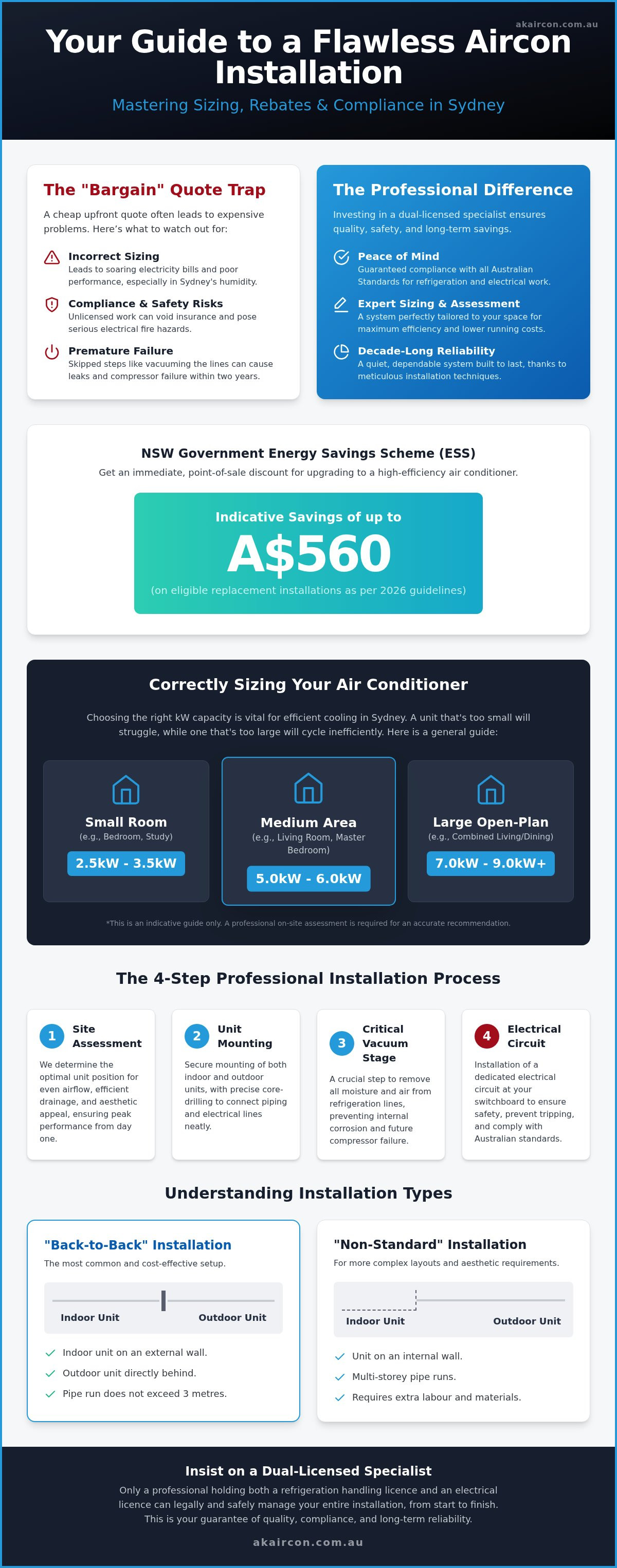
This guide simplifies the process by showing you exactly how to master everything from choosing the right kW capacity to securing significant NSW government rebates. You'll learn how the Energy Savings Scheme (ESS) provides upfront discounts on high-efficiency models, with indicative savings of up to A$560 for certain replacements according to current 2026 guidelines. We'll also explain why using a dual-licensed specialist is the only way to ensure your new system meets Australian Standards while keeping your cooling costs as low as possible. By the end of this article, you'll have the clarity needed to invest in a cooling solution that lasts.
Key Takeaways
- Understand why a professional split system aircon installation requires both refrigeration expertise and a dedicated electrical circuit to meet Australian Standards.
- Learn how to accurately size your unit's kW capacity to combat Sydney’s humidity without causing your electricity bills to skyrocket.
- Find out how the NSW Energy Savings Scheme (ESS) provides immediate point-of-sale discounts for upgrading to high-efficiency air conditioning.
- Gain peace of mind by choosing a dual-licensed specialist who manages the entire installation process from site assessment to final compliance certificates.
What is a Split System Aircon Installation and Why Choose It?
A split system aircon installation is the most popular climate control solution across Sydney for a reason. Unlike ducted systems that require extensive roof space, a split system consists of two distinct parts: an indoor unit that circulates cool or warm air and an outdoor compressor that dissipates heat. It's a versatile choice for everything from high-rise apartments in the CBD to sprawling suburban homes in Castle Hill. While the technology behind what air conditioning is has evolved, the core benefit remains the same: precise, localised comfort.
Homeowners prioritise these systems because they offer individual room control. You don't need to cool the entire house just to sleep comfortably in one bedroom. They are also whisper-quiet, as the noisy compressor sits outside, away from your living space. Most modern units are incredibly energy efficient, provided they are sized correctly for the room. Whether you're looking for a simple bedroom setup or a complex multi-storey run, the flexibility of a split system makes it an ideal investment for the Sydney lifestyle.
Reverse Cycle vs Cooling Only Systems
Sydney’s weather is notoriously unpredictable. One day it's a humid 35 degrees, and the next, a southerly buster brings a damp chill. Choosing a reverse cycle air conditioning system ensures year-round comfort. These units use heat pump technology to move heat from one place to another rather than creating it through combustion or resistance. In winter, they extract ambient heat from the outside air and move it indoors. This process is significantly more efficient than traditional gas heating, often resulting in lower quarterly energy bills for Sydney households.
Understanding the 'Back-to-Back' Standard
When you receive a quote for a split system aircon installation, you'll likely see the term "back-to-back". This refers to a specific layout where the indoor unit is mounted on an external wall, with the outdoor unit sitting directly behind it on the ground or a bracket. A standard back-to-back installation is defined as a setup where the indoor and outdoor units are separated by a single external wall with a pipe run not exceeding 3 metres in length.
Not every Sydney home fits this template. If you want a unit on an internal wall, or if you live in a multi-storey townhouse where the pipes must run through a ceiling, you'll require a non-standard installation. These complex runs require more materials and labour, but they allow for optimal airflow in rooms that don't have direct access to an outside wall. Professional installers will always assess your site first to determine the most efficient path for drainage and pipework to ensure the system operates at peak performance for years to come.
The Professional Installation Process: What to Expect
A professional split system aircon installation begins long before the first hole is drilled. We start with a thorough site assessment to determine the optimal position for airflow and drainage. Placing the indoor unit too close to a corner or near a heat source can force the system to work harder than necessary. We look for a location that ensures even distribution of air throughout the room while allowing for a clear path for the condensate drain. This careful planning ensures the system runs at peak efficiency from day one.
Step-by-Step Technical Guide
The physical installation starts with mounting the indoor unit bracket and core-drilling the external wall. This hole allows the copper piping, electrical cables, and drainage hose to pass through to the outdoor unit. We then secure the outdoor compressor, typically on a level concrete slab or heavy-duty wall brackets, ensuring it has enough clearance for heat dispersion. One of the most critical steps we perform is the 'Vacuum Stage'. We use a specialised pump to remove all moisture and air from the refrigeration lines. Skipping this step is a common mistake by cut-price installers; even a tiny amount of moisture can cause the compressor to fail prematurely.
Electrical Integration and Safety
Reliability depends on more than just the refrigeration work. Most Sydney homes require a dedicated circuit at the switchboard for a split system. Connecting a high-powered unit to an existing power circuit can lead to frequent tripping and potential fire hazards. We always assess your home's electrical capacity, especially for 5kW or larger systems. Choosing the right size air conditioner is only half the battle; ensuring your switchboard can handle the load is the other half. Once the wiring is complete, we issue a Certificate of Compliance Electrical Work (CCEW), which is essential for keeping your manufacturer's warranty valid.
Final testing is the most rewarding part of the day. We perform rigorous pressure checks and verify the refrigerant charge is precise. We don't just pack up and leave; we provide a full demonstration to ensure you know how to operate the remote and maintain the filters. Our team maintains a 'no-mess' policy, meaning we vacuum the site and remove all packaging before we depart. If you want the security of a dual-licensed specialist who handles both the refrigeration and the electrical wiring, we are ready to assist.
Sizing Your System: kW Capacity for Sydney Homes
Selecting the wrong unit size is the most expensive mistake you can make during a split system aircon installation. If the unit is too small, it will run constantly at maximum power to reach the target temperature, which causes your electricity bills to skyrocket and leads to the compressor failing years before its time. Conversely, a unit that is too large will short-cycle, turning on and off rapidly without ever properly dehumidifying the air. This is particularly relevant in Sydney, where high humidity levels mean your air conditioner must manage latent heat just as much as sensible heat to keep you comfortable.
Finding the "Goldilocks" rating requires looking beyond just the floor space. We recommend premium brands like Daikin and Mitsubishi Heavy Industries because their advanced inverter technology manages these loads with far greater precision than budget alternatives. A professional assessment ensures you don't overpay for capacity you don't need or end up with a system that struggles during a 40-degree January afternoon.
Room Size vs kW Chart for Sydney
- Small Bedrooms (up to 20sqm): A 2.5kW unit is the industry sweet spot for standard bedrooms or home offices.
- Medium Living Areas (20-40sqm): A 5.0kW system is typically the standard choice for master suites or mid-sized lounge rooms.
- Large Open-Plan Spaces (40sqm+): These areas usually require 7.0kW or 8.0kW units to ensure the cool air reaches every corner of the kitchen and dining zones.
Factors That Change Your Sizing Needs
Generic online charts often fail because they ignore the specific architecture of Sydney homes. If your lounge room has large western-facing windows, the intense Sydney afternoon sun adds a significant thermal load that a 5.0kW unit might not overcome. Similarly, older homes in the Inner West with high ceilings and no ceiling insulation lose cool air much faster than a modern, energy-rated apartment in Liverpool. A professional heat load calculation considers your window orientation, wall materials, and insulation levels to provide a tailored recommendation that a simple square-metre chart cannot match.
NSW Government Aircon Rebates: Saving on Your Upgrade
Replacing an aged, power-hungry unit doesn't have to be a financial burden. The NSW Energy Savings Scheme (ESS) is currently scheduled to run until 2050, providing Sydney residents with a significant incentive to switch to high-efficiency cooling. Unlike traditional cashback schemes that require months of waiting, this program functions as an upfront, point-of-sale discount. Depending on the size and efficiency of the unit, these savings can range from A$200 to over A$2,600. For example, replacing an old unit with a new 6kW model can attract an indicative discount of approximately A$560, directly reducing the total cost of your split system aircon installation.
We see many homeowners miss out because they don't realise that the rebate value is tied to the energy certificates created by the new system's efficiency. At AK Air Conditioning & Electrical Quality Service, we act as your guide through this regulatory landscape. We perform the necessary eligibility checks during our initial site visit, ensuring you choose a model that maximises your return on investment. By combining these upfront savings with the reduced quarterly running costs of a high-star rated unit, most Sydney households see the system pay for itself through energy savings within a few years.
Is Your Current System Eligible for a Rebate?
The most critical requirement for the ESS program is the 'In-Situ' rule. This means your old, inefficient air conditioner must be fully installed and operational at the time of the upgrade to qualify for the discount. If you remove the old unit yourself before the installers arrive, you forfeit the rebate entirely. Additionally, the new system must meet strict Minimum Energy Performance Standards (MEPS). We find that premium brands like Daikin and Mitsubishi Electric offer the widest range of rebate-compliant models that balance high performance with the star ratings required by NSW regulators.
The Application Process Simplified
Navigating government paperwork is often the biggest deterrent for homeowners. To secure the discount, you must use an installer who is an Accredited Certificate Provider (ACP) or works directly with one. The rules for these incentives were updated as recently as September 12, 2025, so quotes from older providers may no longer be accurate. We manage the entire documentation process, from capturing the required photographic evidence of the old unit to filing the compliance certificates. This seamless approach prevents common pitfalls, such as incorrect serial number recording or failing to prove the decommissioning of the old hardware. If you want to see if your home qualifies for an upgrade, you can book a rebate eligibility check with our dual-licensed team today.
Why Sydney Homeowners Choose AK Air Conditioning & Electrical
Selecting the right team for your split system aircon installation involves more than just comparing bottom-line figures. It requires finding a partner who understands the technical intersection of refrigeration and electrical safety. At AK Air Conditioning & Electrical, we provide peace of mind through our dual-licensed expertise. This means our technicians are fully qualified to handle both the refrigerant gases and the dedicated electrical wiring required for a safe, compliant setup. You won't have to coordinate between multiple trades or pay separate call-out fees for an electrician. We manage the entire process from start to finish, ensuring your system is installed to the highest Australian Standards.
Our reputation as a trusted Sydney specialist is built on transparency. We provide clear, upfront quotes that eliminate the "hidden tradie" surprises that often plague home improvement projects. As authorised installers for premium brands like Daikin, Mitsubishi Heavy Industries, and ActronAir, we offer professional advice on which unit best suits your specific property. We don't just sell boxes; we design cooling solutions that are built to last over a decade in Sydney’s harsh coastal and inland conditions. This honest, straightforward approach is why our customers trust us with their long-term home comfort.
Our Service Areas: Sydney Wide
We pride ourselves on our deep local knowledge, serving homeowners from the Inner West to the Hills District. Our teams are frequently on the ground providing air conditioning Castle Hill services, as well as helping residents in Liverpool and the Greater Sydney region. This local presence allows us to offer prompt response times for new installations and urgent repairs. We understand the specific climate challenges of different Sydney suburbs, from the humid coastal breeze to the dry heat of the western plains, and we adjust our installation techniques accordingly to ensure maximum durability.
The AK Quality Guarantee
Every split system installation we perform comes with a comprehensive workmanship warranty. We don't just walk away once the unit is cooling; we offer ongoing maintenance and servicing packages to keep your system running at peak efficiency. Regular filter cleans and refrigerant checks prevent minor issues from turning into costly breakdowns during a mid-summer heatwave. Our goal is to be your long-term partner in climate control, not just a one-time service provider. If you are ready to invest in a quiet, efficient cooling solution for your home, get your professional split system quote today and experience the difference that dual-licensed expertise makes.
Secure Your Home’s Comfort with Professional Sydney Expertise
Investing in a split system aircon installation is one of the smartest ways to enhance your home's comfort while keeping long-term running costs under control. Success depends on two critical factors: choosing the correct kW capacity for your specific room and ensuring your installer is an accredited professional who can secure upfront NSW Government discounts. By avoiding cut-price shortcuts and insisting on premium brands like Daikin or Mitsubishi, you ensure your system remains quiet and efficient for the next decade.
At AK Air Conditioning & Electrical, we provide the peace of mind that comes with using dual-licensed refrigeration and electrical experts. As authorised Daikin and Mitsubishi specialists, we manage every technical detail from precision pipework to switchboard compliance. Our rebate eligibility experts take the stress out of the Energy Savings Scheme, ensuring you receive the maximum discount available for your upgrade. Don't risk your home's safety with hidden costs or uncertified work; choose a partner dedicated to transparency and workmanship.
Book Your Sydney Split System Installation & Rebate Check
We look forward to helping you create a more efficient, comfortable environment for your family to enjoy all year round.
Frequently Asked Questions
How much does it cost to install a split system air conditioner in Sydney?
The cost of a split system aircon installation depends on several variables, including the kW capacity of the unit and the physical layout of your home. A simple back-to-back installation is generally the most cost-effective, whereas complex runs through internal walls or multi-storey properties require additional labour and materials. We provide tailored, upfront quotes that include all necessary electrical work to ensure you have a clear understanding of the total investment.
Can I install a split system aircon myself to save money?
No, you cannot legally install a split system yourself in Australia. It's a requirement under federal law for anyone handling refrigerant gases to hold an ARCtick license. The electrical components must also be handled by a licensed electrician to comply with Australian Standards. Attempting a DIY install not only risks your safety but also voids your manufacturer's warranty and can lead to significant fines from regulatory authorities.
How long does a professional split system installation take?
A professional split system aircon installation typically takes between 4 and 8 hours to complete for a single unit. This timeframe includes the site assessment, mounting the indoor and outdoor components, and performing the essential vacuum stage to remove moisture from the lines. If your home requires complex pipe runs or a significant switchboard upgrade, the process might take a full day to ensure everything is compliant.
What is the best brand of split system for Sydney's climate?
Daikin and Mitsubishi Heavy Industries are the most reliable brands for Sydney's humid climate and high summer temperatures. These manufacturers offer superior inverter technology and durable components that withstand coastal conditions. We also highly recommend ActronAir, which is an Australian brand specifically engineered for our unique environment. Investing in these premium brands ensures your unit runs efficiently for over a decade with minimal maintenance requirements.
Do I need a dedicated electrical circuit for my new aircon?
Most split systems require a dedicated electrical circuit to ensure they operate safely without overloading your home's existing power lines. Connecting a high-powered air conditioner to a standard power point circuit can cause frequent tripping and potential fire hazards. As dual-licensed experts, we install a separate circuit and safety switch at your switchboard, which is essential for both your safety and for keeping your manufacturer's warranty valid.
Is the NSW government air conditioning rebate still available in 2026?
The NSW Energy Savings Scheme (ESS) is still available in 2026 and is currently scheduled to remain active until 2050. This program provides an upfront discount at the point of sale for households replacing old, inefficient systems with high-star rated models. The rules were most recently updated in September 2025 to encourage higher efficiency. We handle the eligibility checks and paperwork to ensure the discount is applied directly to your invoice.
Where is the best place to mount the indoor unit for maximum airflow?
The indoor unit should be mounted high on an external wall with at least 15cm of clearance from the ceiling for optimal airflow. You should place it in a central position where the air can circulate freely across the room without being blocked by furniture. It's best to avoid mounting the unit directly above heat sources or electronics, as this can interfere with the thermostat's ability to read the room temperature accurately.
What is the difference between a split system and a multi-split system?
A standard split system consists of one indoor unit connected to one outdoor compressor, making it ideal for cooling a single room or open-plan area. A multi-split system allows you to connect multiple indoor units to just one outdoor compressor. This is a space-saving solution for Sydney homes with limited outdoor areas or for those who want to control the temperature in several different rooms independently without installing multiple outdoor units.
Important Information
This article provides general information only. Air-conditioning requirements, installation costs, energy savings and rebate eligibility vary between properties and systems. NSW program rules, certificate values and eligible models may change. Contact AK Air Conditioning & Electrical Quality Service Pty Ltd for a property-specific assessment and confirmation of current eligibility before making a purchase or installation decision.


